





The Hidden Cost of Limping Through August with an Aging HVAC System
Your commercial air conditioning is running nonstop, yet the dining room or sales floor still feels uncomfortably warm. If your business is fighting a losing battle against the heat, upgrading your commercial HVAC system during the late summer slowdown is one of the most effective ways to protect your revenue. At Ronald's Heating & Cooling, our team frequently gets calls during the hottest weeks of the year from business owners dealing with complete breakdowns. Waiting for a catastrophic failure during the back-to-school transition leaves your business vulnerable to unexpected closures, uncomfortable customers, and rushed decisions.
If you are considering a proactive equipment change, understanding the logistics of HVAC replacement in Virginia Beach is the first step toward securing your operational continuity.
For retail and restaurant owners, commercial Rooftop Units (RTUs) are the unsung heroes of daily operations. When these massive systems age, they lose their ability to effectively manage the heavy cooling loads required by spaces filled with customers, cooking equipment, and display lighting. Limping through August with a failing system is a hidden drain on your business. You are likely paying higher utility bills for a system that is running inefficiently, while simultaneously risking a sudden shutdown that could force you to close your doors on a busy weekend.
We always advise our commercial clients to frame the decision to replace equipment now as a proactive business strategy rather than a reactive emergency expense. By taking action before the system fails entirely, you maintain control over the timeline, the equipment selection, and the installation process. This strategic foresight prevents the panicked scramble that occurs when a unit dies completely, ensuring your business remains a comfortable, welcoming environment for your customers.
How Coastal Humidity Compounds Latent Cooling Loads
Understanding why older systems fail often requires looking at the environment they operate in. In our years of servicing Virginia Beach properties, we've seen firsthand how August late-summer coastal humidity is notoriously unforgiving. This thick, moisture-heavy air significantly increases the latent cooling load on your equipment, forcing older systems to work much harder just to dehumidify the space before they can even begin to lower the actual temperature.
The Science of Latent vs. Sensible Cooling
Commercial cooling involves two distinct processes: sensible cooling and latent cooling. Sensible cooling is the straightforward process of lowering the air temperature—what you feel when the thermometer drops. Latent cooling, however, is the energy-intensive process of removing moisture from the air. Aging units typically lose their dehumidification efficiency long before they lose their ability to blow cold air.
• Sensible Cooling — What It Does: Lowers the ambient air temperature (thermostat reading). — Impact on Aging RTUs: Requires longer run times as compressor efficiency degrades over the years.
• Latent Cooling — What It Does: Removes airborne moisture (humidity). — Impact on Aging RTUs: Forces the system to work overtime; failing coils struggle to condense heavy moisture.
When the humidity spikes, your commercial system dedicates a massive portion of its energy simply to pulling water out of the air. If your system is older, it may lack the capacity to handle both loads simultaneously, resulting in a retail space that feels cold but uncomfortably clammy.
Accelerated Wear in Coastal Environments
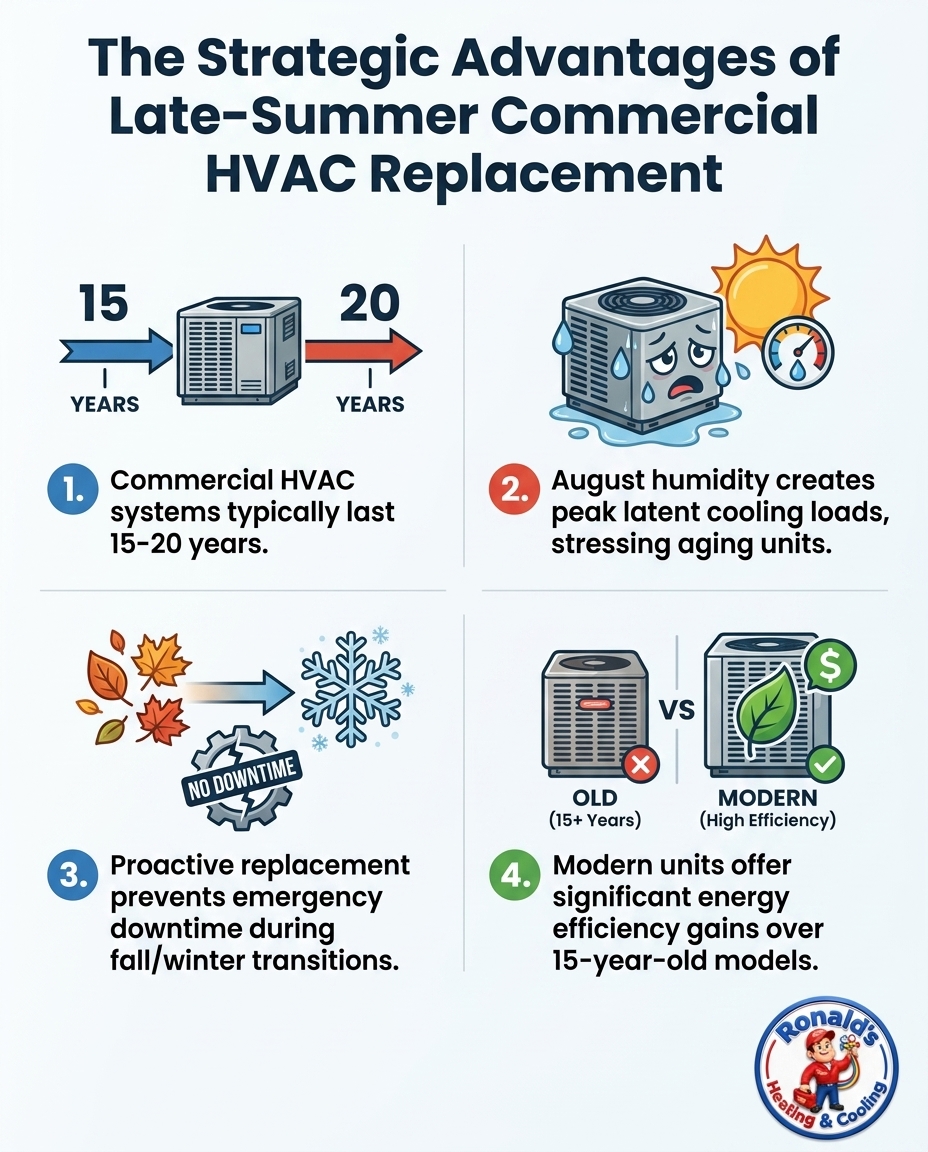
According to data from the U.S. Department of Energy and ENERGY STAR, commercial HVAC systems typically have a lifespan of 15 to 20 years. However, our technicians routinely observe that operating in the Virginia Beach coastal environment accelerates wear and tear significantly. The constant exposure to salt air exacerbates the decline of aging metal components, leading to rapid corrosion on condenser coils, cabinet panels, and internal electrical connections.
This environmental stress means that a 12-year-old unit on the coast may exhibit the same wear as a 20-year-old unit inland. The relentless August heat, combined with corrosive salt air, pushes internal components like compressors and blower motors to their absolute limits, making late-summer assessments critical for preventing sudden failures.
Strategic Timing: Leveraging the Late-Summer Slowdown
Timing a major capital improvement is always a balancing act for business owners. However, the late-summer window often provides a brief operational slowdown for many local businesses in the Virginia Beach commercial and retail districts before the fall and holiday rushes begin. Scheduling your upgrade during this specific window offers distinct logistical advantages.
If you are planning to upgrade your commercial air conditioning, utilizing this brief lull allows our team to perform the necessary site surveys, secure permits, and execute the installation with minimal impact on your foot traffic.
Beating the Fall Supply Chain Rush
One of the most critical reasons to act in late summer is supply chain management. Commercial HVAC equipment is not always stocked locally in every size and configuration. Sourcing a specific 15-ton or 20-ton unit requires lead time. By scheduling your replacement proactively, you ensure the exact right equipment is sourced without delays.
Contrast this with an emergency winter replacement, where your options may be severely limited to whatever is currently sitting in a regional warehouse. Transitioning into the upcoming heating season with a reliable, fully integrated, and properly sized system gives you peace of mind that your business is prepared for any weather fluctuations.
Evaluating Your Equipment Before the Season Changes
Before committing to a full replacement, it is vital to assess the current state of your commercial cooling equipment. You do not need to be an HVAC technician to recognize the operational red flags that indicate a system is nearing the end of its functional life. A pattern we see often involves business owners noticing performance dips in their commercial Rooftop Units (RTUs) during peak business hours.
1. Monitor temperature inconsistencies: If the dining room is freezing but the kitchen is sweltering, or if certain retail aisles hold stagnant air, your system is failing to distribute conditioned air evenly.
2. Listen for mechanical strain: Unusual grinding, screeching, or violent rattling noises during startup indicate failing internal components, such as worn blower bearings or a struggling compressor.
3. Review your utility expenses: A steady, unexplained rise in energy bills over the past two cooling seasons suggests your equipment is losing efficiency and working longer cycles to achieve the same results.
4. Assess indoor air quality: Musty odors or a noticeable increase in indoor humidity are clear signs that the system can no longer handle the latent cooling load.
Routine commercial HVAC maintenance is essential, but there comes a point where maintenance transitions into life support.
Tracking Repair Frequencies and Costs
A crucial metric for any facility manager or business owner is the frequency and cost of recent repairs. A widely accepted industry standard is the 50% rule: if the cost of a required repair approaches half the value of a new, highly efficient system, replacement is the more economical choice.
Furthermore, multiple service calls in a single summer indicate systemic failure. If you have paid for refrigerant recharges, capacitor replacements, and contactor repairs all within the span of a few months, you are throwing good money after bad. A documented history of frequent breakdowns is the strongest indicator that a full upgrade is necessary to protect your bottom line.
Executing a Major Upgrade with Minimal Business Disruption
The primary hesitation most business owners have regarding a full HVAC replacement is the fear of crippling their daily operations. Shutting down a restaurant or retail store for several days is simply not an option in the Virginia Beach commercial and retail districts. However, a major replacement can be executed smoothly when properly planned.
At Ronald's Heating & Cooling, we bring established local authority and a proven track record of performing major commercial system replacements with minimal downtime. Our experienced commercial contractors understand the unique time constraints of the retail and hospitality industries. The planning phase involves coordinating heavy equipment, such as crane lifts for rooftop units, ensuring that safety protocols are met without blocking customer access points.
Phased Installation and Off-Hours Scheduling
For larger facilities with multiple systems, phased installations are a highly effective strategy. We often stage installations so that portions of a building remain completely comfortable while work is isolated to specific zones.
For example, during a recent late-summer project our team handled for a multi-level property where both the upstairs and downstairs systems had failed, the installation was carefully phased. The replacement of both massive systems was completed efficiently within two days, leaving no trace of the heavy work behind and allowing the property to resume normal function immediately. Rapid turnaround times for multi-system properties require a contractor with the logistical bandwidth to deploy fully equipped teams, stage the new units off-site, and execute the swap during off-hours or early mornings before your first customer arrives.
Proactive Replacement as a Long-Term Continuity Strategy
Ultimately, a commercial HVAC upgrade is an investment in your building's long-term viability. Beyond simply replacing broken machinery, a proactive upgrade delivers a measurable return on investment and substantial peace of mind. Modern commercial equipment offers massive energy efficiency gains compared to 15-year-old models, utilizing variable-speed technology and advanced economizers to drastically reduce power consumption.
When you eliminate the stress of August late-summer coastal humidity, you create a consistent, comfortable indoor environment. This comfort directly protects your revenue streams. In the hospitality and retail sectors, comfortable customers stay longer, browse more, and spend more. Conversely, a hot, sticky environment drives foot traffic straight out the door.
Energy Efficiency and Operational Savings
Upgrading to modern, high-efficiency equipment also opens the door to operational savings that offset the initial capital expenditure over time. Federal tax credits or general energy rebates offered by local utility programs often apply to qualifying high-efficiency commercial upgrades, helping to accelerate your return on investment. Always consult with your tax professional or utility provider to verify which current programs your new equipment qualifies for.
Finally, a new installation allows you to start fresh with a comprehensive routine maintenance plan. Protecting your new investment from day one ensures that the equipment operates at peak efficiency for its entire expected lifespan, keeping your business cool, comfortable, and profitable for years to come.
Frequently Asked Questions
When is the best time to replace commercial HVAC?
The late summer or early spring shoulder seasons are generally the best times for replacement. During these periods, you avoid the peak emergency rushes of mid-summer and mid-winter. This allows for better equipment availability and more flexible scheduling to minimize business disruption.
How does humidity affect commercial rooftop units?
High humidity forces rooftop units to work significantly harder by increasing the latent cooling load. The system must expend massive amounts of energy removing moisture from the air before it can effectively lower the ambient temperature. Over time, this constant heavy load accelerates wear on the compressor and coils.
Why is my commercial AC struggling in late summer?
Late summer represents the peak accumulation of wear and tear after months of continuous operation. Combined with extreme coastal humidity and high temperatures, aging components that have been degrading all season finally reach their breaking point, resulting in poor airflow and inconsistent cooling.
How long do commercial rooftop HVAC units typically last?
Most commercial rooftop units have an expected lifespan of 15 to 20 years under normal conditions. However, in coastal environments where salt air accelerates metal corrosion, this lifespan can be notably shorter. Regular professional maintenance is the best way to maximize the operational life of the unit.
What are the signs a commercial HVAC unit needs replacing?
Key indicators include rising energy bills, inconsistent indoor temperatures, and frequent mechanical breakdowns. If your repair costs are approaching 50% of the cost of a new system, or if the unit is struggling to manage indoor humidity, a full replacement is usually the most cost-effective solution.
How can retail businesses minimize downtime during an HVAC replacement?
Working with an experienced commercial contractor who offers off-hours scheduling and phased installations is vital. Proper logistical planning, including coordinated crane lifts and pre-staged equipment, allows the physical swap to happen quickly, often before the business opens for the day.
Protect Your Business Continuity Today
Don't wait for a catastrophic equipment failure to dictate your business operations. Upgrading your commercial HVAC system during the late summer slowdown provides a logical, business-focused solution that minimizes operational downtime and avoids sudden emergency disruptions later in the year. If your retail space or restaurant is struggling to maintain a comfortable environment, taking proactive steps now ensures your customers stay happy and your revenue remains protected. Schedule a comprehensive evaluation of your commercial rooftop units today to secure your building's comfort for the seasons ahead.
