





The Late-Summer Heat Wall: When Your AC Finally Gives Out
Late summer in our region is undeniably unforgiving, and here at Ronald's Heating & Cooling, our dispatch board tells the whole story: this is exactly why August is the most common month for AC capacitor failures in Hampton Roads. By the time the back-to-school season rolls around, your outdoor condenser has likely been running non-stop since late May. You walk into your home after a long, sweltering afternoon, expecting a blast of cold air, only to find the house feels sticky, warm, and stagnant. When you check the thermostat, it reads well above your set temperature. In our experience, this sudden breakdown rarely happens by accident; it is the direct result of cumulative heat stress pushing your system's electrical components past their breaking point.
If your cooling system is currently struggling to keep up with the late-summer heat, exploring our air conditioning services or scheduling an immediate AC repair in Virginia Beach can help restore your home's comfort quickly and safely.
Most homeowners assume an air conditioner breakdown in August is just a stroke of bad luck. In reality, our technicians know it is a predictable mechanical fatigue. The dual run capacitor—a small, cylindrical component inside your outdoor unit—is almost always the first part we see fail under this prolonged pressure. This component acts as a massive battery, storing energy to give your compressor and fan motors the high-voltage jolt they need to start spinning. When it fails, your system loses its ability to turn on, leaving you without cooling during the hottest days of the year. Recognizing this specific issue quickly is the key to avoiding permanent, catastrophic damage to your entire HVAC system.
The Cumulative Toll of June and July on Your Cooling System
To understand why your system suddenly quits in late summer, you have to look at what it endured over the previous sixty days. Throughout early and mid-summer, AC systems run for hundreds of hours continuously. Every time your thermostat calls for cooling, the dual run capacitor sends a massive surge of electricity to the compressor and the outdoor fan motor. This process happens dozens of times a day. Over weeks and months, the constant charging and discharging generate a significant amount of internal heat.
Most standard AC capacitors are built to withstand a maximum thermal limit of about 150 degrees Fahrenheit. While that sounds incredibly hot, a sun-baked metal condenser unit sitting in a side yard easily exceeds this temperature after weeks of continuous operation. The ambient outdoor heat combined with the mechanical heat generated by the motors creates an oven-like environment inside the electrical panel.
The Thermal Limits of Electrical Components
Capacitors are not just empty metal cans; they are filled with a specialized dielectric fluid that helps regulate internal temperatures and store electrical charges. When subjected to sustained extreme heat, this fluid begins to break down.
• Continuous thermal load: During a prolonged heatwave, the outdoor temperatures remain high even at night, preventing the dielectric fluid from fully cooling down and resetting.
• Fluid degradation: As the heat persists, the fluid loses its ability to insulate the internal coils, causing the component to run even hotter.
• Physical failure: Once the fluid completely degrades and boils, the top of the capacitor swells outward (often called "mushrooming"), pops, and fails entirely.
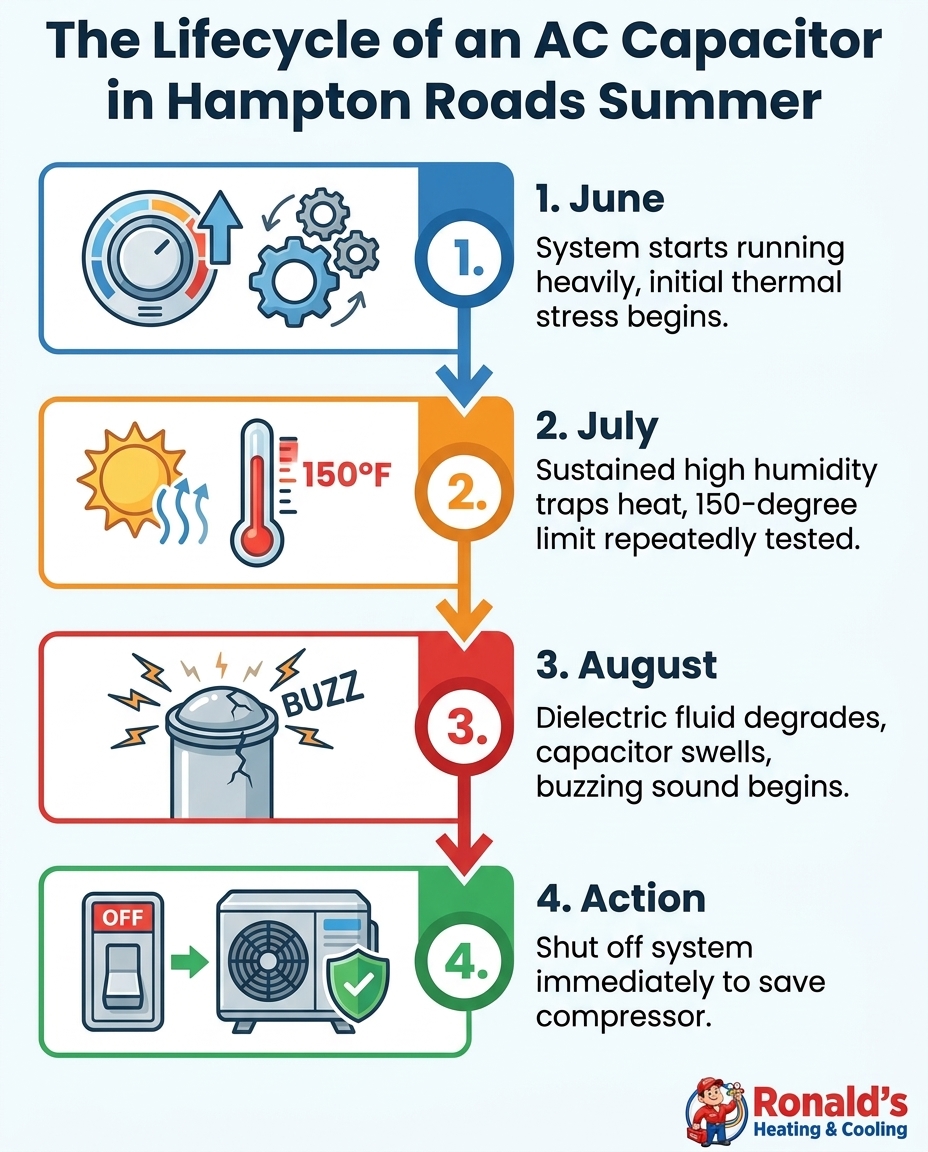
• June (Early Summer) — Operating Conditions: Moderate heat, system cycles normally with adequate rest periods overnight. — Capacitor Status: Functioning at optimal capacitance; effectively jump-starting motors.
• July (Mid Summer) — Operating Conditions: High heat, system runs continuously for hours, internal temperatures rise. — Capacitor Status: Dielectric fluid begins to degrade; component runs hotter than normal.
• August (Late Summer) — Operating Conditions: Peak cumulative heat, minimal overnight cooling, thermal limits exceeded. — Capacitor Status: Fluid boils, casing swells, component pops and completely fails.
How Coastal Humidity Traps Heat Inside the Condenser
Heat alone is not the only enemy of your cooling system. In our specific region, high relative humidity severely reduces the condenser's ability to shed heat. Our team constantly sees the toll this takes on local systems. Hampton Roads and the surrounding Virginia Beach areas are famous for prolonged periods of 90-plus degree days combined with thick, suffocating coastal moisture. This specific climate creates a unique set of challenges for HVAC electrical components.
Your outdoor AC unit does not actually "create" cold air; it removes heat from inside your home and pumps it outside. The outdoor condenser relies on the surrounding air to dissipate that extracted heat. The fan pulls cooler outdoor air through the metal fins, cooling the hot refrigerant coils. However, when the air is already saturated with thick coastal moisture, heat transfer becomes highly inefficient. The heavy, wet air simply cannot absorb the heat fast enough.
Because the heat cannot escape the unit efficiently, it backs up. This inefficiency forces the internal temperature of the entire metal cabinet to spike, effectively cooking the capacitor and the surrounding electrical wiring. The system has to work twice as hard to achieve the same amount of cooling, drawing more electricity and generating even more internal friction. This is why we always warn our customers that delaying an emergency AC repair when you notice your system struggling in July often guarantees a complete breakdown by August.
Diagnosing the Warning Signs: What a Blown Capacitor Sounds Like
When an AC capacitor fails, the system does not always just go silent. In many cases, it tries to run, giving you actionable, sensory cues that something is wrong. Identifying these signs early allows you to address the problem without attempting dangerous DIY diagnostics. In our years of serving Virginia Beach, the team at Ronald's Heating & Cooling has seen this countless times. One local homeowner recently reached out to us needing a quote for a full AC system installation after their outdoor unit began making alarming noises. We provided a fair quote and explained the work involved, ensuring they understood exactly what their home needed to stay cool safely.
If you suspect a failure, look and listen for these specific symptoms:
• The auditory cue: A distinct, rhythmic buzzing or humming sound coming from the outdoor condenser unit. It sounds like an electrical motor straining against a locked gear.
• The visual cue: The outdoor fan blades are completely stationary, even though you can hear the system trying to run and the thermostat is calling for cooling.
• The indoor cue: Warm or room-temperature air blowing steadily from your indoor vents, indicating the indoor blower is working but the outdoor compressor is offline.
• The touch test: Without touching any wires or internal components, simply placing your hand above the outdoor unit will reveal a lack of warm air exhaust, meaning the fan is stalled.
Why the System Buzzes but Won't Spin
That loud buzzing is the sound of electrical current successfully reaching the motor. The thermostat is doing its job, and the contactor is sending power. However, without the capacitor's stored energy, the motor cannot overcome its own physical inertia. The system is essentially stalled. It wants to spin, but it lacks the massive electrical "push" required to start. As a result, the motor sits there vibrating, drawing massive amounts of electricity and heating up rapidly.
The Immediate Threat to Your Compressor
If you hear that buzzing or humming sound from the outdoor condenser unit, the most important thing you can do is turn your thermostat to the "off" position immediately. Leaving the system running while it is stalled creates an immediate and severe threat to your compressor. When a motor is locked and cannot spin, it draws what is known as "locked rotor amps" (LRA). This is a massive surge of electrical current that is significantly higher than normal operating amperage.
If the system is left running, this excessive amperage causes the compressor windings to overheat violently. The internal insulation can melt, causing an electrical short to ground. What began as a minor electrical failure quickly cascades into a catastrophic mechanical failure. Replacing a capacitor is a straightforward, routine fix that takes one of our professionals less than an hour. Replacing a burned-out compressor, on the other hand, is a massive undertaking that often requires a full system replacement.
Proactive care is the best defense against these cascading failures. Keeping up with your AC maintenance ensures that our technicians can spot components drawing high amperage before they stall the system completely.
Emergency AC Response During Peak Heatwaves
Losing your air conditioning during an August heatwave in Hampton Roads is more than just frustrating; it can quickly become a safety concern as indoor temperatures climb toward 90 degrees. When a capacitor pops, you need a reliable, fast-acting solution to restore your home's comfort. Our team at Ronald's Heating & Cooling prides itself on rapid response times for emergency breakdowns, emphasizing that our technicians arrive fully stocked to resolve capacitor issues on the very first visit.
Just recently, during the end-of-season back-to-school rush, one of our service technicians responded to a family whose AC system stalled out in the middle of a brutal heatwave. We repaired the issue quickly and efficiently, ensuring the problem was resolved promptly so the family could get back to a cool, safe home. This level of readiness is crucial because high-voltage components require professional handling.
Even when the power is shut off at the breaker, a capacitor can store a lethal electrical charge (often upwards of 440 volts). A trained technician knows how to safely discharge the old component, install the correct replacement with the exact microfarad rating required by your specific system, and thoroughly test the motors to ensure the blown capacitor did not cause secondary damage to the compressor or fan.
Breaking the Cycle: How to Protect Your System Next Year
Once your cooling is restored, the goal shifts from emergency response to proactive prevention. Capacitors rarely fail without warning, provided you know where to look. They often show signs of losing their capacitance (their ability to store a full electrical charge) long before they completely fail in August.
Based on the hundreds of maintenance visits our technicians perform across Hampton Roads, we've found you can break the cycle of late-summer breakdowns by establishing a proactive care routine:
1. Schedule spring electrical load testing: A technician uses a multimeter to measure the exact microfarads your capacitor is producing. If a component is rated for 45 microfarads but is only producing 38 in May, it is guaranteed to pop in August. Replacing it early prevents the emergency.
2. Keep the outdoor condenser coils clean: The cleaner your outdoor unit is, the easier it can dissipate heat. Gently washing away dirt, pollen, and grass clippings from the metal fins reduces the internal temperature of the unit, easing the thermal stress on electrical parts.
3. Ensure proper airflow: Clear away any shrubs, weeds, or debris within two feet of the outdoor unit so the fan can pull in enough air to cool the internal components.
4. Enroll in a routine maintenance plan: Regular professional check-ups ensure that your system's electrical connections are tight, motors are lubricated, and failing parts are swapped out before the extreme weather hits.
Frequently Asked Questions About Summer AC Failures
Why do AC capacitors keep blowing in the summer?
Continuous operation under high temperatures causes the internal dielectric fluid to degrade rapidly. During the summer, your AC runs for long cycles, generating immense internal heat that cannot dissipate quickly. Once the thermal limit is exceeded repeatedly, the fluid boils, the component swells, and it ultimately fails.
What does a blown AC capacitor sound like?
It typically produces a distinct humming, buzzing, or clicking noise from the outdoor unit. This sound occurs because the motor is receiving electrical power from the contactor but lacks the massive energy burst required to start spinning. The motor sits stationary, vibrating and drawing heavy current.
Can extreme heat cause a capacitor to fail?
Yes, excessive ambient heat combined with the mechanical heat generated by the running motors pushes the capacitor past its design limits. In hot coastal climates, the high humidity also traps heat inside the condenser cabinet, accelerating the breakdown of electrical components.
Should I turn off my AC if the fan isn't spinning?
Absolutely. Leaving it on forces the compressor to draw excessive amperage, which can quickly lead to permanent compressor burnout. The moment you notice the outdoor fan is stationary while the unit is buzzing, switch your thermostat to "off" and call a professional.
How long does a dual run capacitor usually last?
In hot coastal climates with heavy usage, they typically last 5 to 7 years. However, severe heatwaves, dirty condenser coils, and prolonged periods of high humidity can significantly shorten this lifespan by forcing the component to operate under constant thermal stress.
Don't Let a Bad Capacitor Ruin Your Compressor
Addressing a buzzing AC unit immediately is critical to protecting your home's HVAC investment. The cumulative heat stress of Hampton Roads in late summer is tough on equipment, but a blown capacitor doesn't have to mean the end of your air conditioner. If you hear that warning hum, turn your system off right away to prevent catastrophic compressor damage. Reach out to local experts like our team for AC repair in Virginia Beach to get your cooling restored safely, efficiently, and correctly on the first try.
