





Navigating Your Heating Options Before the Winter Chill
Making accurate options comparisons for homeowners is often frustrating because the biggest challenge isn't just picking a reliable brand—it is knowing whether your specific house needs a modern heat pump or a traditional gas furnace before the cold weather truly sets in. At Ronald's Heating & Cooling, our team typically sees this confusion peak during the mid-fall transition in October 2026. Your current heating system might be making strange noises, running constantly without actually warming the rooms, or driving up your monthly utility bills. These are common signs that a replacement is on the horizon. However, choosing the right replacement requires much more than simply buying a unit that looks like the old one.
Evaluating long-term energy efficiency, consistent indoor comfort, and potential eligibility for generic federal tax credits requires precise mathematical calculations, not guesswork. As you prepare for a mid-fall heating startup, understanding the exact thermal requirements of your home is the only objective way to make a sound financial and comfort-based decision. If you are ready to explore your options with a team that relies on data rather than assumptions, you can learn more about our professional heating system services.
The Hidden Costs of Rule-of-Thumb HVAC Sizing
The problem: For decades, many contractors relied on "rule-of-thumb" sizing methods. This outdated practice usually involves assigning a certain amount of cooling or heating capacity based solely on the square footage of a house—for example, guessing that every 500 square feet requires one ton of HVAC capacity. While this might sound logical on the surface, our technicians have seen this outdated method severely fail homes in neighborhoods like Kempsville and Great Neck, as it completely ignores the unique thermal characteristics of your home and the specific demands of a Virginia Beach coastal climate.
The cause: When a system is installed based on a guess, it is almost always improperly sized. One local homeowner reached out to our Ronald's Heating & Cooling crew last autumn because their existing HVAC system was completely broken and failing to keep up with the weather shifts. They had been struggling with a system that was poorly matched to their home. A system that is undersized will run continuously, struggling to reach the temperature set on the thermostat. This constant operation drives up utility bills and accelerates mechanical wear and tear. Conversely, an oversized system causes a different set of severe problems, primarily short-cycling.
The solution: The only way to avoid these hidden costs is to abandon guesswork and follow the official Air Conditioning Contractors of America (ACCA) standards. By performing precise mathematical calculations, technicians ensure the new unit matches the exact load requirements of the structure. For the homeowner mentioned above, our team was dispatched to replace the entire HVAC system, but only after running the proper calculations. The system was successfully replaced with no ongoing issues, proving that data-driven sizing prevents long-term headaches.
Why Bigger Isn't Always Better
A common myth in the home service industry is that installing a larger capacity unit will heat or cool a house faster and more effectively. In reality, an oversized unit blasts the home with conditioned air, satisfies the thermostat almost immediately, and shuts off. This rapid on-and-off process is known as short-cycling.
• Mechanical wear and tear: The most stressful part of an HVAC system's operation is the startup phase. Frequent cycling puts immense strain on the compressor, blower motor, and electrical components, drastically shortening the lifespan of the equipment.
• Uneven temperatures: Because the system shuts off so quickly, the conditioned air never has a chance to circulate fully to the furthest rooms, leaving you with hot and cold spots throughout the house.
• Poor air filtration: Your indoor air is only filtered while the system is running. Short run times mean less air passes through the filter, allowing dust and allergens to accumulate.
Manual J: Calculating the Exact Heating and Cooling Load
The foundation of any proper HVAC installation is the Manual J load calculation. In simple terms, a load calculation determines exactly how much heating energy is required to keep your home warm in the winter and how much cooling energy is needed to keep it comfortable in the summer. In our years of serving Virginia Beach, we've found that shifting fall and winter temperatures alter the thermal load calculations for a home, making this mathematical baseline absolutely critical.
A true Manual J calculation goes far beyond simple square footage. A certified technician will measure and evaluate multiple factors to build a precise thermal profile of your property:
1. Square footage and volume: Measuring the exact floor space and ceiling height of every room to determine the total volume of air that needs to be conditioned.
2. Insulation levels: Evaluating the R-value of the insulation in your attic (such as noting an older R-19 rating versus a modern R-38 standard), walls, and crawlspaces. A well-insulated home requires significantly less energy to heat and cool.
3. Window quality and placement: Assessing the type of windows (single-pane vs. double-pane, low-E coatings) and which direction they face. South-facing windows, for example, bring in significant solar heat gain.
4. Home orientation and shading: Noting how the sun hits the house throughout the day and whether large trees or neighboring structures provide shade.
5. Occupants and appliances: Factoring in the body heat generated by the people living in the home, as well as the heat produced by major appliances and lighting.
By compiling this data, the Manual J calculation reveals the exact BTU (British Thermal Unit) capacity required for your home. This mathematical load determines the exact capacity needed for optimal performance. Furthermore, having a documented Manual J calculation is often a strict requirement to qualify for generic federal tax credits or local utility rebates, as these programs demand proof of proper sizing. Proper sizing is also the key to maximizing your air conditioning efficiency during the warmer months in a Virginia Beach coastal climate.
Manual S: Choosing Between a Heat Pump and a Gas Furnace
Once the exact heating and cooling load is determined by Manual J, the next step is Manual S. This standard dictates how to select the specific make and model of equipment that meets the load requirements. Manual S is where the actual choice between a heat pump and a traditional gas furnace is finalized, using objective performance data rather than personal preference.
During a mid-fall heating startup inspection, homeowners frequently ask our technicians which system is better. Manual S helps answer that question by comparing how different units perform under specific conditions, such as evaluating an older 80% AFUE gas furnace against a modern 16 SEER2 / 8.5 HSPF2 air-source heat pump. Modern heat pumps operate incredibly efficiently in moderate climates, transferring heat from the outside air into your home rather than burning fuel to create it. This makes them a highly viable alternative to combustion furnaces.
• Air-Source Heat Pump — How It Works: Transfers ambient heat from outdoors to indoors using refrigerant. — Best Climate Fit: Moderate winters; handles both heating and cooling. — Efficiency Measurement: HSPF (Heating) / SEER (Cooling)
• Gas Furnace — How It Works: Burns natural gas or propane to generate heat through a heat exchanger. — Best Climate Fit: Extreme cold; requires a separate AC unit for summer. — Efficiency Measurement: AFUE (Annual Fuel Utilization Efficiency)
By running Manual J, D, and S calculations, a professional can objectively demonstrate whether a heat pump will meet your home's heating load during the coldest nights, or if a gas furnace is necessary based on your home's specific thermal envelope.
Interpreting Efficiency Ratings
When comparing systems through the lens of Manual S, you will encounter different efficiency ratings. Gas furnaces are measured by AFUE, which indicates the percentage of fuel converted directly into usable heat. Heat pumps are measured by HSPF for heating and SEER for cooling, which calculate the ratio of heat output to electricity consumed. Manual S ensures that the selected unit will actually achieve these laboratory ratings in the real world, under the specific conditions of your home.
Manual D: Why Ductwork Design Matters for Your New System
Even if you have a perfectly sized heat pump or furnace selected through Manual J and Manual S, the entire system will fail to deliver comfort if the ductwork is inadequate. This is where Manual D comes in. Manual D is the mathematical standard for designing, sizing, and evaluating residential duct systems.
The role of static pressure: Ductwork acts as the respiratory system of your home. It must be precisely sized to handle the volume of air (measured in CFMs, or cubic feet per minute) that the new equipment produces. If the ducts are too small, the system faces high static pressure. This is similar to breathing through a tiny straw. For instance, if a new system requires pushing 1,200 CFMs of air through ducts originally designed for only 800 CFMs, the blower motor has to work incredibly hard to push air through restricted spaces, leading to loud operation, premature motor failure, and increased energy consumption.
Transitioning systems: Our installers frequently encounter this when transitioning systems from an older gas furnace to a modern high-efficiency heat pump. Heat pumps generally require a higher volume of airflow to deliver the same amount of heat as a furnace. If the existing ductwork in your Virginia Beach coastal climate home was designed for a low-airflow furnace, simply attaching a new heat pump to those old ducts will result in poor performance and significant hot and cold spots.
Improper duct sizing directly impacts air distribution and overall home comfort. Ensuring your ductwork meets Manual D standards is a critical step in providing comprehensive indoor air quality solutions, as properly sealed and sized ducts prevent unfiltered attic or crawlspace air from being pulled into your living spaces.
Why Coastal Climates Demand Mathematical Precision
The problem: As a local Virginia Beach HVAC company, we know firsthand that living in a coastal environment presents unique challenges for residential heating and cooling. Homeowners deal with high summer humidity, shifting fall temperatures, and moderate winters. When a system is installed using rule-of-thumb sizing, it usually fails to handle the specific moisture and temperature variables of a Virginia Beach coastal climate, particularly during unpredictable October temperature swings.
The cause: As mentioned earlier, an oversized system cools or heats a home too quickly and shuts off. During a humid coastal summer, an air conditioner needs to run for extended cycles to effectively pull moisture out of the indoor air. If the system is oversized, it satisfies the thermostat quickly but leaves the humidity behind, resulting in a cold, clammy, and uncomfortable indoor environment. In the winter, the moderate temperatures fall perfectly into the peak efficiency range of modern heat pumps, but only if the system is sized correctly to maintain a steady, low-speed operation.
The solution: Mathematical precision is non-negotiable. A strict Manual J calculation ensures the system is sized just right—large enough to keep the home comfortable during temperature spikes, but small enough to run long, efficient cycles that properly dehumidify the air. This balance is the secret to true indoor comfort in a coastal region.
How to Differentiate a Professional Estimate from a Sales Pitch
When you are preparing for a mid-fall heating startup and evaluating system replacements, it is vital to know who you are dealing with. The HVAC industry has its share of high-pressure salespeople who are more interested in closing a quick deal than solving your home's comfort issues. Identifying the absence of Manual J, D, and S calculations is a major red flag during an HVAC estimate.
A pattern we see often is homeowners feeling overwhelmed by aggressive sales tactics. One customer in the Sandbridge area reached out to us last spring needing a quote and evaluation for a full HVAC system installation after dealing with pushy contractors. Instead of a high-pressure pitch, we provided a clear presentation of the required load calculations, a fair quote, and a reasonable installation timeline. Our dedicated crew installed the new 15 SEER2 system professionally in just a day and a half, delivering exactly what the home needed.
Here is a checklist to help you identify a trustworthy professional:
• They measure the home: A true professional will pull out a tape measure or laser tool, check your insulation, and inspect your windows.
• They ask about comfort issues: They will ask if you have specific hot or cold spots, or if you struggle with indoor humidity.
• They perform the math: They use software to run ACCA-approved calculations rather than guessing based on square footage.
• They inspect the ductwork: They evaluate your existing ducts to ensure they can handle the airflow of a new system.
• They provide documentation: A reliable contractor will gladly show you the load calculation results before asking you to sign a contract.
At Ronald's Heating & Cooling, our commitment to thorough diagnostics ensures you get exactly the right system for your home. We believe in a consultative approach, which is why understanding the difference between a trustworthy HVAC opinion and a high-pressure sales pitch is so important for protecting your investment.
Make an Informed Decision for Your Home's Comfort
Choosing between a heat pump and a gas furnace is a mathematical decision, not a guessing game. By demanding proper Manual J, S, and D calculations, you protect your home from the hidden costs of oversized equipment, uneven temperatures, and premature system failure. Especially in a Virginia Beach coastal climate, precision sizing is the only way to guarantee long-term efficiency and consistent comfort.
As the October 2026 weather shifts, do not settle for rule-of-thumb estimates. Prioritize proper sizing, demand objective data, and ensure your next system is tailored specifically to your home's thermal envelope. The right next step is scheduling a comprehensive, diagnostic evaluation with a professional who strictly adheres to ACCA standards.
Frequently Asked Questions
What are Manual J, D, and S calculations?
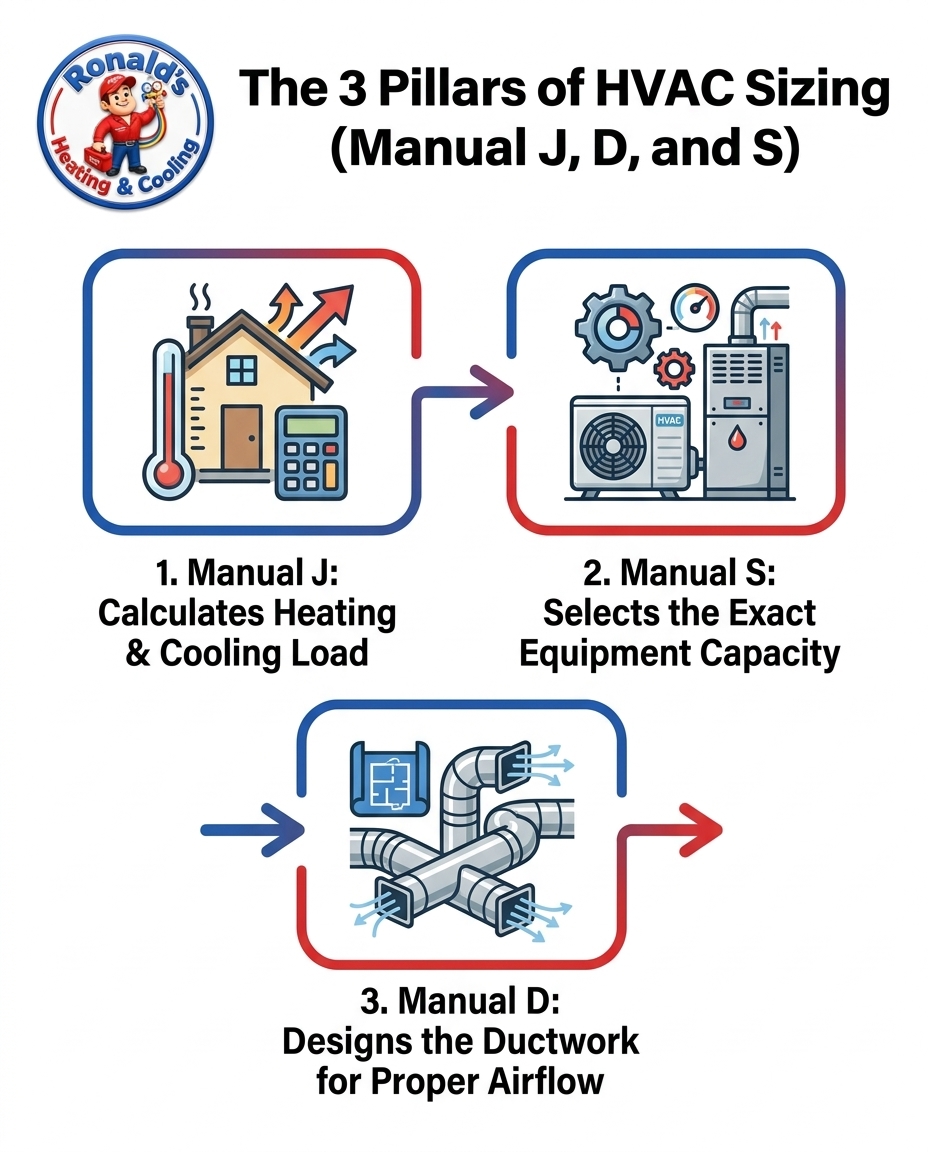
These are the official mathematical standards created by the Air Conditioning Contractors of America (ACCA) for designing HVAC systems. Manual J calculates the exact heating and cooling load of the home. Manual S selects the proper equipment size based on that load, and Manual D dictates the proper design and sizing of the ductwork.
How do I choose between a heat pump and a furnace?
The most accurate way to choose is by having a professional perform a Manual J load calculation and a Manual S equipment selection. These calculations provide objective data on how much heat your home loses in the winter. Based on those numbers, you can see whether a high-efficiency heat pump can handle the load or if the extreme cold requires the combustion power of a gas furnace.
Why is precise HVAC sizing important for coastal climates?
Coastal environments feature moderate winters and highly humid summers, which require specific system performance to maintain comfort. An accurately sized system will run in long, steady cycles, which is necessary to remove excess humidity from the indoor air. If a system is oversized, it will short-cycle and leave the home feeling cold and clammy.
Do I need a Manual J calculation for a new heat pump?
Yes, a Manual J calculation is absolutely critical when installing a new heat pump. Heat pumps are highly sensitive to proper sizing, and guessing the capacity can lead to severe performance issues and high energy bills. Furthermore, documented load calculations are often required to qualify for generic utility rebates and federal tax credits.
At what temperature does a heat pump become inefficient?
Modern cold-climate heat pumps are designed to operate efficiently even when temperatures drop below freezing. However, their efficiency gradually decreases as the outdoor air gets colder, typically requiring supplemental heat when temperatures plunge below 35°F and approach the extreme single digits. A Manual J calculation will reveal exactly when your specific home might need backup heating.
Can an oversized HVAC system cause indoor humidity problems?
Yes, an oversized air conditioning system is one of the leading causes of high indoor humidity. Because an oversized unit cools the house too quickly, it shuts off before it has time to extract moisture from the air. This results in a home that reaches the target temperature but still feels sticky and uncomfortable.
