





Facing a Sudden Breakdown During the Late-Summer Heat
Your air conditioning is running nonstop, but the house still feels uncomfortably warm, leaving you to figure out the difference between a trustworthy HVAC opinion and a high-pressure sales pitch. At Ronald's Heating & Cooling, we know this is a stressful position for any homeowner. A technician arrives, takes a quick look at the system, and immediately declares that a full replacement is your only option. When you are sweating through the peak of August late-summer humidity, the urge to simply sign on the dotted line and get the cool air flowing again is incredibly strong.
Before you make a major financial commitment, exploring professional air conditioning services or booking a diagnostic HVAC repair in Virginia Beach is the best first step.
The core decision point in this scenario is determining whether the technician's recommendation is based on a genuine, catastrophic mechanical failure or if it is a calculated sales tactic designed to capitalize on your desperation. Aggressive sales companies train their representatives to view extreme weather as an opportunity to push complete system overhauls, even when a simple repair would suffice. As a homeowner, you have every right to pause the process, ask detailed questions, and demand evidence before agreeing to a massive installation project. Understanding how to separate an honest evaluation from a manufactured emergency is the most effective way to protect your home and your budget.
Red Flags: Anatomy of a High-Pressure Sales Pitch
Aggressive HVAC salespeople rely on a specific set of psychological tactics to force a quick decision. They know that if you have time to think, research, or call another company, their chances of securing a massive commission drop significantly. Our team typically sees these behaviors when homeowners call us for a second opinion. If you notice any of these red flags during a service call, you are likely dealing with a sales pitch rather than a genuine diagnosis:
• Manufactured scare tactics: The technician exaggerates the danger of the situation, claiming your system is a fire hazard, is leaking dangerous gases, or is on the verge of an explosive failure, all without providing any tangible proof or instrument readings.
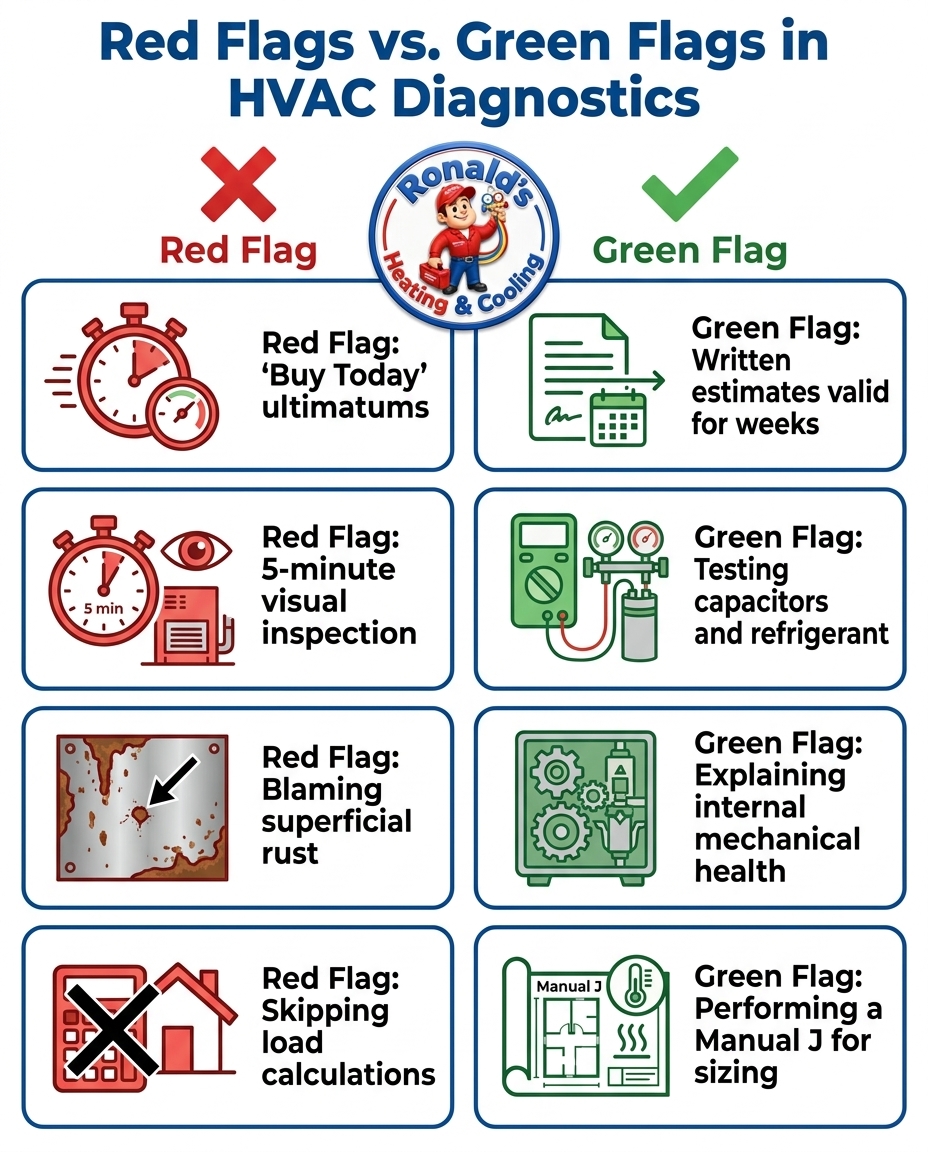
• The "Buy Today" ultimatum: You are offered a massive, limited-time discount, a "manager's special," or a cancellation slot that miraculously expires the moment the technician drives away from your house. Honest pricing does not have a thirty-minute expiration timer.
• Refusal to leave your home: The representative lingers at your kitchen table, repeatedly calling their manager to "see what they can do for you," making it socially uncomfortable for you to ask them to leave so you can think it over.
• Vague or missing written estimates: They refuse to break down the scope of work, parts, and labor, instead pushing a lump-sum contract and dodging questions about exactly what components are actually failing.
• Dismissing repair options entirely: Without fully opening the cabinet or testing the electrical components, they declare the unit "too old to touch" and refuse to even discuss whether a targeted repair is viable.
The Salt Air Scare: Coastal Wear vs. Actual System Failure
In our years serving Virginia Beach, the team at Ronald's Heating & Cooling has found that one of the most common—and deceptive—tactics involves weaponizing the local climate against the homeowner. Living in Virginia Beach means your outdoor air conditioning unit is constantly exposed to high humidity and coastal salt air. This specific environment naturally accelerates exterior corrosion. Within just a few years, the painted steel cabinet, the fan guard, and the exterior screws will likely show visible signs of rust and oxidation.
High-pressure salespeople point to this superficial, visible rust as undeniable "proof" that the entire system is failing and must be replaced immediately. They will run their finger over a rusty panel and shake their head, implying that the unit is rotting from the inside out.
Separating Cosmetics from Mechanics
The reality is that exterior cosmetic wear does not automatically mean the internal mechanical components are dead. The heart of your air conditioning system—the compressor—is hermetically sealed inside a heavy-duty steel shell. The refrigerant lines are made of copper, which may develop a patina but does not rust like steel. The aluminum fins on the condenser coil can degrade over time in salt air, but this requires a careful evaluation of the system's actual operating pressures, not just a glance at the outer casing.
A trustworthy technician understands that a rusty cabinet is a normal regional reality in Virginia Beach, not an immediate death sentence for the system. We focus on testing the internal electrical draws, the refrigerant pressures, and the mechanical performance of the compressor rather than trying to scare you with cosmetic oxidation.
Green Flags: What a Trustworthy Diagnostic Process Actually Looks Like
Empowering yourself against high-pressure tactics means knowing what a genuine, professional evaluation looks like. A real diagnosis takes time, patience, and specialized tools. When a professional arrives to evaluate your struggling system during the August late-summer humidity, they should follow a methodical process.
1. Listening and observing: A trustworthy technician starts by asking you questions about what you have noticed—strange noises, warm air, or frequent cycling—before they ever touch the equipment.
2. Utilizing diagnostic instruments: They will not just look at the unit. They will use a multimeter to test the dual run capacitors, contactors, and electrical draws. They will attach gauges to measure the refrigerant levels and ensure the system is operating within the manufacturer's specified pressures.
3. Explaining the findings clearly: Instead of vague claims that the unit is "shot," an honest professional will show you exactly what is failing. If a capacitor is bulging or a contactor is pitted, they will explain what that part does and why it caused the breakdown.
4. Discussing prevention and repair: A true professional will discuss whether keeping up with routine HVAC maintenance could have prevented the issue, and they will present a targeted repair option if the core components are still viable.
The Power of an Honest Second Opinion
You should never feel pressured to sign a major installation contract on the spot. Getting a second opinion is a standard, highly recommended practice in the home service industry. The difference between a trustworthy HVAC opinion and a high-pressure sales pitch often becomes painfully obvious the moment a second technician evaluates the exact same equipment.
While the peak of summer drives many of these situations, the need for a trustworthy second opinion applies year-round. For example, just as families are prepping for the back-to-school transition, we often see units pushed to their limits by end-of-season cooling demands. One local homeowner was recently told by another provider that their AC system was outdated and required a complete, immediate replacement. When a Ronald's Heating & Cooling technician arrived for a second opinion, we didn't just accept the first company's verdict. We dug deeper and found a simple failing part. We replaced the component, and the system returned to perfect working order—saving the homeowner from an unnecessary, massive expense.
This is why working with a trusted HVAC company is so critical. A company that prioritizes integrity and honest diagnostics will always look for the actual root cause of a problem. They know that building a long-term relationship based on trust is far more valuable than securing a one-time, high-pressure sale. A second opinion provides peace of mind, validating whether the initial diagnosis was accurate or just a tactic to boost a sales quota.
Beware the Missing Manual J: Why Sizing Matters
If a technician does determine that your system is truly beyond repair, the way they handle the replacement recommendation is another major indicator of their integrity. One of the biggest red flags during a replacement pitch is the absence of a proper load calculation.
The Problem with Rule-of-Thumb Sizing
High-pressure pitches often skip the crucial step of mathematically sizing the new unit. Instead, the salesperson might just look at the size of your broken unit and recommend putting the exact same size back in, or worse, they might push an oversized unit based on outdated "rules of thumb" (like calculating tonnage purely by square footage) to inflate the final ticket price.
The Cause of Comfort Issues
Air conditioning systems are not just designed to cool the air; they are designed to remove humidity. An improperly oversized unit will cool the house too quickly and shut off before it has a chance to dehumidify the air. This leads to short-cycling, which causes massive spikes in energy usage, premature wear on the compressor, and a home that feels cold but uncomfortably clammy during the August late-summer humidity.
The Solution: The Manual J Calculation
A trustworthy opinion always includes a proper mathematical sizing protocol before any replacement is finalized. This calculation, known as a Manual J, factors in your home's square footage, window quality, insulation levels, ceiling height, and orientation to the sun.
• Humidity Control — Oversized Unit (Sales Pitch): Poor. Cools too fast to remove moisture, leaving the home clammy. — Properly Sized Unit (Trustworthy Opinion): Excellent. Runs long enough to pull humidity out of the indoor air.
• Energy Efficiency — Oversized Unit (Sales Pitch): Low. Constant starting and stopping draws massive amounts of power. — Properly Sized Unit (Trustworthy Opinion): High. Operates in steady, efficient cycles, lowering utility bills.
• System Lifespan — Oversized Unit (Sales Pitch): Shortened. Short-cycling causes immense wear and tear on the compressor. — Properly Sized Unit (Trustworthy Opinion): Maximized. Runs as the manufacturer intended, reducing mechanical stress.
• Temperature Swings — Oversized Unit (Sales Pitch): Extreme. Blasts cold air, shuts off, and lets the house warm up quickly. — Properly Sized Unit (Trustworthy Opinion): Consistent. Maintains a steady, even temperature throughout the home.
Bridging the Gap: When an AC Replacement is Actually Necessary
While it is crucial to guard against unnecessary replacements, the reality is that HVAC systems do not last forever. The average lifespan of a modern air conditioning system in a coastal environment is generally 10 to 15 years. When an older system faces a catastrophic mechanical failure—such as a grounded compressor, a severe refrigerant leak in an obsolete R-22 system, or a cracked heat exchanger—replacement genuinely becomes the most financially responsible option.
The difference lies in how that news is delivered. At Ronald's Heating & Cooling, we believe a trustworthy technician will present a repair versus replace cost analysis without pressure. We lay out the facts: how much the repair will cost, how long the repaired system is likely to last, and what a new system would provide in terms of efficiency and warranty protection.
Furthermore, honest companies will walk you through exactly what to expect during an HVAC replacement so there are no surprises on installation day. They will also inform you about general energy rebates, utility incentives, or federal tax credits that may apply to high-efficiency heat pumps and air conditioners, allowing you time to verify these programs with your tax professional rather than using them as high-pressure "act now" leverage to force a signature.
Protecting Your Home and Your Wallet
An informed homeowner is the single best defense against high-pressure sales tactics. When you understand the difference between a trustworthy HVAC opinion and a high-pressure sales pitch, you take control of the diagnostic process. You know to look for methodical testing, clear explanations, and a complete lack of ultimatums.
If your system is struggling through the August late-summer humidity and you feel rushed by a technician demanding an immediate replacement, trust your gut. Demand transparency, ask for a written breakdown, and never hesitate to send a pushy salesperson away. Reaching out to Ronald's Heating & Cooling for a genuine, no-pressure evaluation or a second opinion will ensure you make a confident, cost-effective decision for your home's comfort.
Frequently Asked Questions
Should I get a second opinion on AC replacement?
Yes, getting a second opinion is highly recommended before committing to a major HVAC replacement. A second evaluation can confirm if the initial diagnosis was accurate or if a simple repair was overlooked by a high-pressure salesperson. It provides peace of mind and ensures you are making a financially sound decision based on facts, not fear.
How to tell if an AC compressor is really bad?
A truly failed compressor will exhibit specific mechanical or electrical faults, such as being grounded, having open windings, or mechanically locking up. A trustworthy technician will use a multimeter to test the electrical integrity of the compressor and show you the readings. Superficial rust on the outside cabinet or a blown dual run capacitor does not mean the compressor itself is dead.
How do I know if I really need a new HVAC system?
You likely need a new system if your current unit is over 10 to 15 years old, uses obsolete refrigerant, and is facing a catastrophic failure like a dead compressor or a severely leaking coil. A genuine professional will provide a transparent repair-versus-replace cost analysis, allowing you to see if investing in a repair makes mathematical sense given the age and condition of the equipment.
Can an HVAC company scam you during a routine tune-up?
Unfortunately, aggressive sales companies sometimes use low-cost tune-ups as a foot in the door to pitch unnecessary replacements. They may claim they found dangerous issues or imminent failures without showing you proof. To protect yourself, always ask to see the broken part, request a written explanation of the failure, and seek a second opinion if they push for an immediate replacement.
How long should an AC unit last in a coastal environment?
In coastal areas like Virginia Beach, the average lifespan of an air conditioning unit is typically 10 to 15 years. The salt air and high humidity can accelerate exterior cosmetic wear, but this does not always impact the internal mechanical lifespan. Regular maintenance, including washing salt residue off the condenser coils, can help maximize the life of the system.
What is a Manual J load calculation and why do I need one?
A Manual J load calculation is a mathematical formula used to determine the exact heating and cooling capacity your specific home requires. You need one because installing an oversized unit leads to short-cycling, high energy bills, and poor humidity removal. A trustworthy technician will always perform this calculation before recommending a new system size.
