





The Myth of the Doomed Furnace: Navigating the First Cold Snap
A persistent myth among homeowners is that the moment you switch on your heat in October and smell something burning, your entire system is doomed. When searching for reliable home maintenance tips and troubleshooting advice during the mid-fall heating startup, it is critical to understand the difference between normal seasonal operation and an actual mechanical failure. At Ronald's Heating & Cooling, we frequently see how that initial panic is exactly what aggressive sales technicians rely on to push unnecessary upgrades. As your equipment transitions from heavy summer cooling to its first heating cycle, it naturally reveals hidden wear and tear, but our team knows firsthand that not every unusual symptom requires a total overhaul.
Whether you are wrapping up your need for air conditioning services after a long summer or seeking a second opinion on an AC replacement in Virginia Beach before winter sets in, prioritizing honest diagnostics over quick sales is essential.
The anxiety of turning on the heat and noticing a burning dust smell or a strange clicking noise is completely understandable. Your system has been sitting dormant or operating in a completely different mode for months. When the temperature drops and you rely on your furnace or heat pump to keep your home comfortable, any irregularity feels like an emergency. However, determining if these symptoms are just normal dust burn-off or a sign that professional intervention is needed is the core decision point you face. We always remind our customers that knowing what to expect empowers you to make informed decisions rather than reacting out of fear.
During the mid-fall heating startup, the internal components of your HVAC system are subjected to sudden thermal expansion. Parts that have been cool for months are rapidly heated, which can cause minor shifting, clicking, and the burning of settled particulates. This transition period is a stress test for your equipment. By understanding the mechanics of this seasonal shift, you can protect yourself from predatory tactics and ensure your system receives the appropriate care it actually needs.
Decoding Fall Startup Smells and Sounds
Not all noises and odors are created equal when you fire up your heating system for the first time. Our team at Ronald's Heating & Cooling sees this every October: in the Virginia Beach coastal region, extreme summer heat and salt air cause unique wear patterns, often leading to premature corrosion on outdoor condenser coils. Because of this harsh environmental exposure, the fall transition becomes a critical stress test for your entire system. Understanding the difference between a harmless quirk and a dangerous malfunction is your first line of defense against an unnecessary sales pitch.
During the long summer months, dust, pet dander, and other airborne particulates settle on the heat exchanger and heating elements. When these components heat up for the first time, that accumulated debris burns off. This process creates a distinct, slightly acrid smell that often alarms homeowners. However, this is a standard part of the seasonal transition.
• Burning Smell — Normal Operation: Smells like burning dust; dissipates within 15 to 30 minutes of the first cycle. — Warning Sign (Call a Pro): Smells like melting plastic or electrical wires; persists beyond the first hour.
• Clicking Noises — Normal Operation: Faint clicking from the thermostat or minor metal expansion as ducts heat up. — Warning Sign (Call a Pro): Rapid, continuous clicking at the unit, indicating a failing ignition system.
• Banging or Booming — Normal Operation: A single minor pop as ductwork expands under initial air pressure. — Warning Sign (Call a Pro): Loud, violently shaking booms when the furnace ignites, indicating delayed gas ignition.
• Grinding Sounds — Normal Operation: None. Grinding is never part of normal operation. — Warning Sign (Call a Pro): Harsh metal-on-metal grinding, signaling failing blower motor bearings.
Living in the Virginia Beach coastal region means your outdoor heat pump unit has spent the entire summer battling high humidity and corrosive salt air. Our technicians know that this environment accelerates wear on electrical contacts and fan motors. While a mild humming from the outdoor unit is normal during a heating cycle, loud rattling or screeching often points to salt-induced wear that requires a professional diagnostic, not necessarily a full replacement.
By keeping this baseline of normal operation in mind, you can confidently monitor your system's performance. When a technician arrives for a service call, your knowledge of these differences forces them to provide specific, logical explanations for any issues they claim to find, rather than relying on vague generalizations.
Why Homeowners Fall for the HVAC System Replacement Sales Pitch
Losing heat during a sudden temperature drop creates an immediate sense of urgency and discomfort. When your home is freezing and your family is shivering, your primary goal is to restore warmth as quickly as possible. This psychological vulnerability is exactly what we see unethical technicians exploit during a mid-fall heating startup. Instead of taking the time to properly diagnose the root cause of the failure, they leverage your desperation to push a highly profitable system replacement.
The knowledge gap between HVAC professionals and homeowners is vast. Heating systems rely on complex electrical circuits, gas combustion mechanics, and pressurized refrigerants. Because most people do not understand how these components interact, they are forced to take the technician's word as absolute truth. If a professional stands in your living room and declares your system unsafe or unfixable, the natural instinct is to believe them and agree to whatever solution they propose to keep your home safe.
The rush to replace: Some companies incentivize their technicians with heavy commissions on new equipment sales rather than rewarding them for efficient repairs. This creates a conflict of interest. A technician driven by a sales quota will often skip a thorough diagnostic process entirely, glancing at an older unit and immediately drafting a replacement quote. They know that if they can keep you focused on the cold temperature in your home, you are less likely to question their findings.
This dynamic highlights exactly why seeking a second opinion is so crucial when you feel pressured. As we often advise our Virginia Beach community, understanding the trustworthy HVAC opinion vs. sales pitch dynamic can save you from making a hasty, expensive decision. A reputable professional will always respect your need to consider your options and will never use the mid-fall heating startup as an excuse to panic you into a purchase.
Red Flags of an Aggressive Sales Tactic
Protecting yourself requires knowing exactly what an aggressive sales pitch looks like in action. When a technician is more interested in hitting a quota than providing honest service, their behavior usually follows a predictable pattern. In the Virginia Beach coastal region, where systems naturally show signs of surface wear from the harsh environment, predatory techs often use normal weathering as "proof" that your system is failing.
Here are the clear warning signs our team recommends watching out for to ensure a technician is not pushing a sales agenda over a genuine diagnostic:
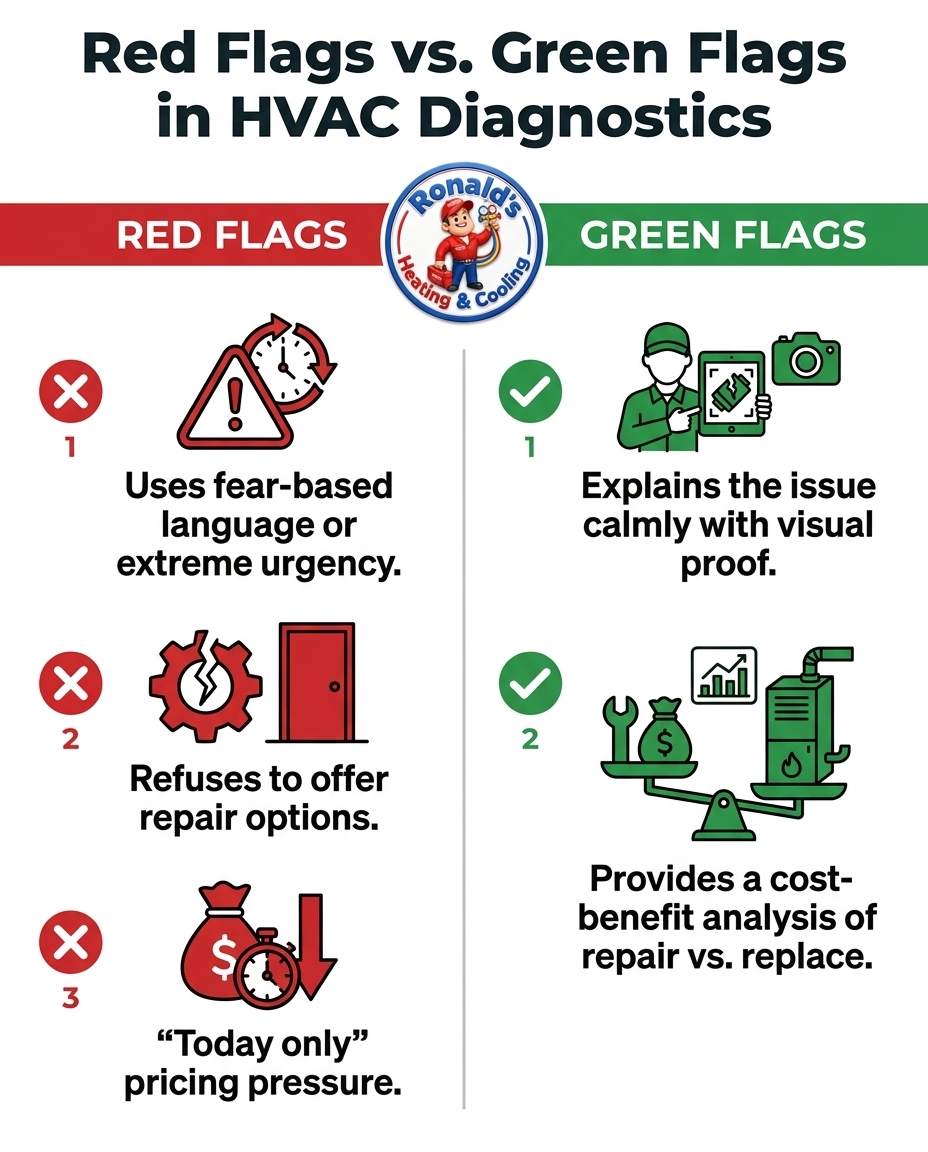
• Fear-based language: The technician uses extreme urgency, making claims about imminent carbon monoxide poisoning or catastrophic electrical fires without providing concrete, visual proof of a failure.
• Refusal to show the damage: When you ask to see the broken component, they become defensive, claim it is "too dangerous" to look at, or use overly technical jargon to confuse the issue rather than showing you the specific point of failure.
• High-pressure 'today only' discounts: They offer massive price drops or special rebates that magically expire the moment they leave your driveway. This tactic is specifically designed to prevent you from getting a second opinion.
• Dismissing simple fixes: They label a relatively straightforward repair, like replacing a capacitor or a sensor, as "not worth it" on an otherwise healthy system, insisting that a total replacement is the only logical path forward.
• Vague diagnostic explanations: Instead of naming the exact part that failed and explaining why, they use broad statements like "the whole system is shot" or "the electronics are fried."
Our team at Ronald's Heating & Cooling recently rescued a local homeowner who experienced this exact scenario during a cold snap. A previous service provider had inspected their equipment, declared the system outdated and completely unfixable, and pushed heavily for an immediate, full replacement. Refusing to bow to the pressure, the homeowner called us for a second opinion. Our technician conducted a thorough inspection and found a simple unhooked part. By ordering and installing that single missing component, the system was fully restored, demonstrating how integrity and patience save homeowners from massive unnecessary costs.
If you encounter any of these red flags during your Virginia Beach coastal region service call, the best course of action is to politely decline the immediate work, pay the diagnostic fee if required, and immediately call another company for a second opinion.
The Hallmarks of Honest Diagnostic Advice
Contrasting sharply with the high-pressure pitch is the approach of a trustworthy professional. When you schedule a mid-fall heating startup inspection, you deserve a technician who acts as an advisor, not a salesperson. As a local business, our commitment at Ronald's Heating & Cooling is to transparent diagnostics, honest advice, and building long-term customer trust over securing a quick, aggressive sale.
An honest diagnostic process follows a methodical, transparent structure. You should expect the technician to walk you through exactly what they are doing and why. Here is what our legitimate, professional inspections look like:
1. Comprehensive system evaluation: The technician performs a thorough inspection of both indoor and outdoor components. They do not just glance at the furnace; they check electrical connections, measure amperage draws on motors, test safety switches, and evaluate airflow.
2. Clear, visual evidence: If a component has failed, an honest professional will show it to you. Whether it is a burnt contactor, a leaking coil, or a cracked part, they will use photos, videos, or direct observation to explain the findings clearly without hiding behind jargon.
3. Presenting all viable options: A trustworthy technician provides repair options alongside replacement options. They will logically weigh the pros and cons of fixing the current unit versus upgrading, allowing you to see the full picture.
4. Prioritizing safety and comfort: The primary goal of the visit is to ensure your home is safe and comfortable. If a repair is safe and effective, they will recommend it. They prioritize your long-term satisfaction over a one-time equipment sale.
5. Encouraging informed decisions: Honest contractors never use "exploding offers" that expire in an hour. They give you the written estimate, answer your questions, and encourage you to take the time you need to make the right choice for your household.
When a technician follows these steps during a mid-fall heating startup, you can rest assured that their recommendations are based on the actual mechanical condition of your equipment, rather than a hidden sales agenda.
Legitimate Reasons for a Pre-Winter System Replacement
While avoiding predatory sales tactics is vital, it is equally important to acknowledge that sometimes a system replacement is genuinely the most logical and safe step forward. HVAC equipment does not last forever, especially in the Virginia Beach coastal region, where the elements constantly test the durability of outdoor components. The key is knowing how to verify that a replacement recommendation is legitimate.
An honest technician will base a replacement recommendation on verifiable data, safety concerns, and long-term economic sense. When these factors align, investing in a new system protects your home and lowers your utility burden. Regular upkeep through a preventative maintenance plan is the best way to extend your equipment's lifespan, but when the time comes, here is how you know the recommendation is real.
Safety First: Verified Heat Exchanger Failures
The heat exchanger is the metal shield that separates the breathable air in your home from the toxic combustion gases created by your furnace. If this component cracks, carbon monoxide can leak directly into your living space, creating a severe, life-threatening hazard. This is not something that can be safely patched or ignored.
However, a trustworthy technician will never just claim the heat exchanger is cracked and demand you buy a new furnace. They will prove it. They will use a specialized combustion analyzer to detect gas in the airstream, or they will use a flexible inspection camera to show you the exact physical crack or severe rust breach on the metal. Once verified, a failed heat exchanger on an older system almost always justifies a full replacement due to the high cost of the part and the labor involved.
The Cost-Benefit Analysis of Aging Systems
Industry professionals often use a repair-versus-age formula to help homeowners make logical decisions. This involves multiplying the age of your equipment in years by the estimated cost of the necessary repair. If the resulting number crosses a specific threshold—often compared to the cost of a down payment on a new, highly efficient unit—investing in the old system is considered a poor financial choice.
This is especially true in the Virginia Beach coastal region, where an older heat pump that requires a major compressor replacement will likely suffer another component failure soon after due to overall environmental wear. Furthermore, aging systems lose their efficiency. Upgrading to a modern unit significantly reduces winter utility bills, making the cost-benefit analysis lean heavily toward replacement when major breakdowns occur.
Just last season, our crew at Ronald's Heating & Cooling worked with a homeowner facing a severely malfunctioning system right as the weather turned cold. After our thorough, transparent diagnostic process, it was undeniably clear the equipment had failed beyond economical repair. We provided a clear explanation of the mechanical failures, and the entire HVAC system was replaced efficiently. The homeowner experienced no subsequent issues, proving that when the data supports it, a full replacement restores peace of mind and reliable comfort.
Navigating Your Options Without the Pressure
If you find yourself facing a legitimate need for a pre-winter system replacement, a trustworthy contractor will ensure you have the time and resources to navigate your options without feeling cornered. A major home upgrade is a significant decision, and you should feel completely supported throughout the process during the mid-fall heating startup.
One of the first things we recommend exploring is the availability of generic federal tax credits and local utility rebates designed to encourage the installation of high-efficiency heat pumps and furnaces. While specific programs and amounts vary by year and location, an honest technician will point you toward these resources. They will advise you to verify current rebate programs directly with your utility provider or a qualified tax professional to ensure you maximize your savings.
Additionally, a reputable company understands that sudden replacements are rarely planned for in the family budget. They will highlight the importance of flexible payment options to ease the immediate burden. Exploring HVAC financing options allows you to choose a highly efficient, reliable system without compromising your financial stability. The hallmark of an honest contractor is that they will give you the estimate, explain the financing and rebate options, and step back to let you make the decision on your own timeline.
Secure Your Comfort with Confidence This Season
Navigating the mid-fall heating startup does not have to be a stressful experience filled with uncertainty. By understanding the difference between normal dust burn-off smells and actual mechanical warning signs, you take control of your home's comfort. Knowing the clear, non-technical guidelines for system health empowers you to spot the red flags of aggressive sales tactics and demand transparent, honest diagnostics.
You deserve to know exactly what is happening with your equipment, backed by visual proof and logical explanations. Do not let fear dictate your home maintenance decisions this season. If your system is making unusual noises or you simply want the peace of mind that comes from a thorough, honest evaluation, schedule a pre-winter inspection with a team that values integrity and long-term trust over a quick sale.
Frequently Asked Questions
Why does my heat smell like it's burning during the first fall startup?
The burning smell is typically caused by dust and debris that has settled on the heating elements during the summer months. When the system is turned on for the first time, these particles burn off, creating a distinct odor. This is a normal part of the seasonal transition and should dissipate shortly.
How to tell if a furnace actually needs replacing or just a repair?
A furnace usually needs replacing if it is nearing the end of its expected lifespan, requires a repair that costs more than half the value of a new system, or has a verified cracked heat exchanger. A trustworthy technician will provide a clear cost-benefit analysis and show you visual proof of any catastrophic failures before recommending a replacement.
What is a normal heat pump noise during winter operation?
During winter operation, it is normal to hear a mild humming from the compressor, the sound of the fan running, and an occasional whooshing noise when the system enters its standard defrost cycle. Loud grinding, violent banging, or continuous rapid clicking are abnormal and require professional attention.
How long does the burning dust smell last when you turn on the heat?
The normal burning dust smell should completely dissipate within 15 to 30 minutes of the first heating cycle. If the smell persists for several hours, or if it changes from a dusty odor to the smell of melting plastic or electrical burning, you should turn off the system and call a professional immediately.
Can coastal salt air cause my heat pump to fail prematurely?
Yes, the corrosive nature of coastal salt air can significantly accelerate the deterioration of outdoor heat pump components, particularly the condenser coils and electrical contacts. Regular preventative maintenance, including specialized cleanings, is essential to combat this environmental wear and extend the life of the unit.
What should a technician show me to prove my heat exchanger is cracked?
A professional technician should provide concrete evidence of a cracked heat exchanger, such as a high reading on a calibrated combustion gas analyzer or a clear image from an inspection camera showing the physical breach in the metal. They should never rely solely on a visual glance from a distance to condemn the system.
