





Navigating the First Chilly Morning: Heat Pump Startup Quirks
You flip the thermostat to "heat" on the first cold morning of the year, expecting instant warmth, but instead you are greeted by a strange burning smell and air that feels surprisingly cool—a classic scenario that sends many homeowners searching for reliable home maintenance tips and troubleshooting. Here in Virginia Beach, during a mid-fall October heating startup, our dispatchers at Ronald's Heating & Cooling frequently field frantic calls about these unexpected behaviors. You might wonder if your system is breaking down right when you need it most.
Most modern air conditioning systems that double as heat pumps are incredibly resilient, but they do have specific operational quirks when shifting from cooling to heating. In our years of servicing local HVAC systems, we've found that the core challenge for any homeowner is determining whether these initial symptoms are harmless seasonal transitions or signs of deeper mechanical strain. While a temporary odor is usually nothing to worry about, persistent comfort issues often point back to foundational design flaws in the home's ductwork and equipment sizing.
Understanding how your system actually works is the first step in diagnosing the problem. A heat pump does not generate heat by burning fuel; instead, it uses a reversing valve to absorb ambient heat from the outside air and transfer it indoors. Because this process is so different from a traditional gas furnace, the air coming out of your vents will feel different, smell different, and behave differently during those first few cycles of the season.
Normal Fall Heat Pump Transitions: What to Expect
The Problem: When you turn on your heat pump for the first time in autumn, our technicians typically advise customers to expect a distinct "burning dust" odor filling the house, accompanied by airflow that barely feels warm.
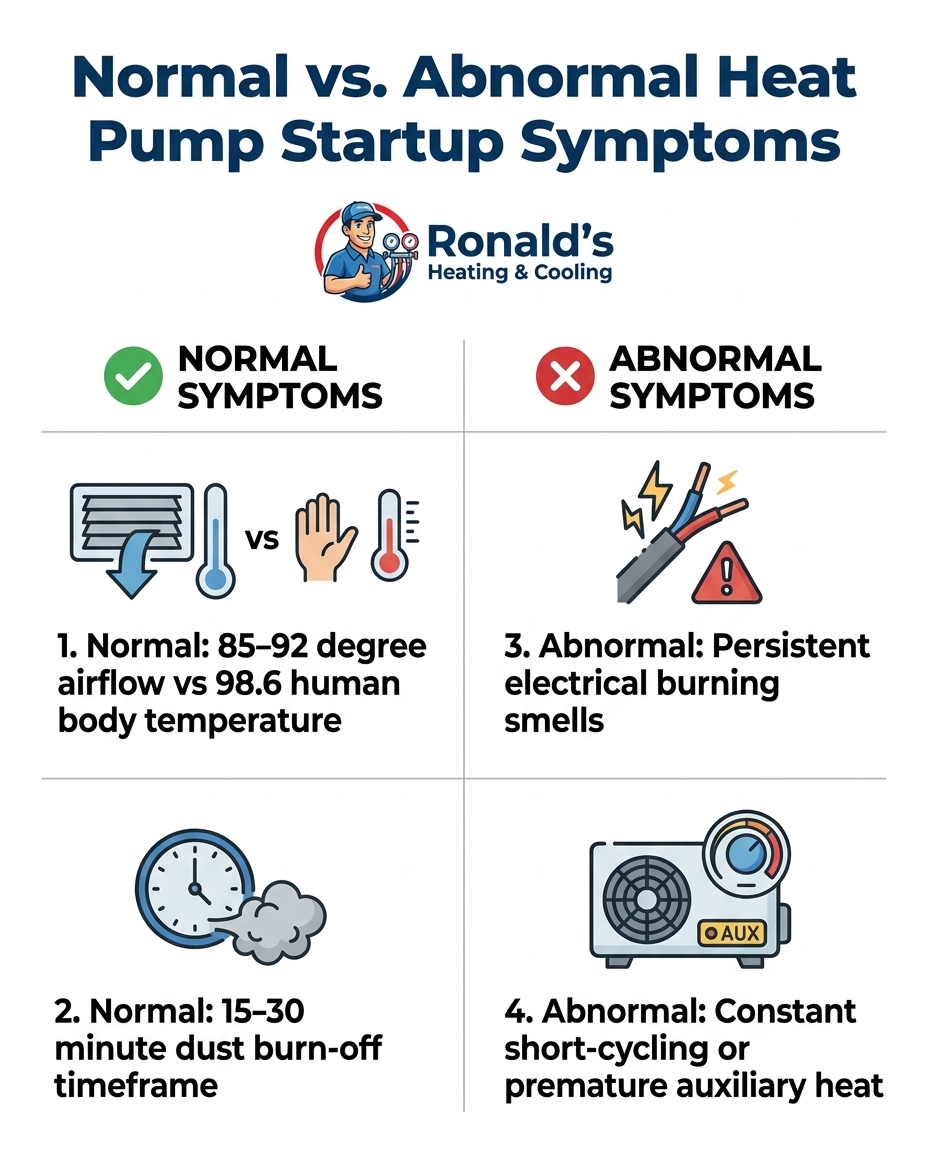
The Cause: These symptoms are a normal part of the mechanical transition. Over the long summer cooling season, dust naturally accumulates on the indoor coil and the auxiliary heating elements. When these components heat up for the first time, that settled dust safely burns off. This process typically lasts between 15 and 30 minutes. As for the lukewarm initial airflow and auxiliary heat triggers, it comes down to basic human biology and physics. Heat pumps generally supply heated air between 85 and 92 degrees Fahrenheit. Because your average human body temperature is 98.6 degrees, air that is 90 degrees will actually feel cool against your skin, even though it is actively raising the temperature of a 70-degree room.
The Solution: We always tell our customers that the best approach for these specific quirks is simply to wait. Allow the system to run for a full 30 minutes to clear the dust. You should also expect occasional defrost cycles, especially given Virginia Beach's fluctuating October temperatures. When the evening air drops suddenly, the outdoor unit may temporarily stop its fan, make a "swoosh" sound, and emit a small cloud of steam. This is the reversing valve working hard to melt away frost buildup, ensuring the system remains efficient throughout the night.
Abnormal Startup Symptoms: When to Call a Professional
While a brief dusty odor and lukewarm air are expected, our service teams know that certain behaviors are clear warning signs of mechanical distress. Knowing the difference protects your equipment from severe damage and keeps your home safe. If your system exhibits any of the following symptoms, it is time to stop waiting and call for expert help.
• Persistent electrical smells: If you detect an odor resembling melting plastic, burning wires, or ozone that lasts beyond the initial 30-minute burn-off window, turn the system off immediately. This indicates overheating components or failing electrical connections.
• Constant short-cycling: A heat pump that turns on, runs for three minutes, and abruptly shuts off is short-cycling. This is a major red flag for severe airflow restrictions, refrigerant leaks, or underlying mechanical strain that will quickly burn out the compressor.
• Premature auxiliary heat: The "auxiliary" or "emergency" heat setting should only activate when outdoor temperatures plunge near freezing. If your auxiliary heat turns on constantly during a mild 50-degree day, the primary heat pump is failing to meet the load.
• Unusual grinding or screeching: While a swoosh during a defrost cycle is normal, metal-on-metal grinding points to failing motor bearings.
As a homeowner, your first diagnostic steps should always be checking your thermostat settings and replacing a dirty air filter, as restricted airflow causes many of these symptoms. However, you should never open electrical cabinets, attempt to bypass safety switches, or perform electrical diagnostics yourself. Instead, rely on a comprehensive preventative maintenance plan to keep your system operating safely and efficiently.
The Hidden Culprit Behind Persistent Issues: Improper System Sizing
If your heat pump constantly struggles, short-cycles, or fails to maintain comfort despite having clean filters and no obvious broken parts, the root cause may not be a mechanical failure at all. Often, we discover that chronic performance issues are rooted in bad system design. A unit that is fundamentally oversized or undersized for your home's actual thermal load will never operate correctly, no matter how many replacement parts are installed.
An improperly sized system wears out exponentially faster than a correctly sized one. Oversized units blast the house with air, satisfy the thermostat in minutes, and shut down—only to turn right back on when the temperature drops. This constant starting and stopping places massive strain on the compressor and electrical components. Undersized units face the opposite problem, running non-stop in a futile attempt to reach the set temperature, driving up utility bills while failing to keep you warm.
Just last season, our crew at Ronald's Heating & Cooling responded to a local homeowner who experienced the ultimate consequence of these sizing and strain issues when their older furnace finally stopped working during an extreme winter storm. Because the system had been improperly managing the home's load for years, it suffered a complete failure on one of the coldest days of the year. Our technicians arrived right away and replaced the entire furnace immediately to restore safe heating. Professional diagnostics must evaluate the home's actual thermal load rather than just swapping out parts, framing accurate sizing as the ultimate preventative measure against premature system failure.
Demystifying Manual J, D, and S Calculations
When HVAC professionals talk about proper system design, they use terms that can sound like alphabet soup. However, these calculations are the scientific foundation of a comfortable, efficient home. Understanding what they mean helps you make informed decisions about your comfort.
• Manual J: This is the precise calculation of a home's heating and cooling load. It accounts for the square footage, the quality of your insulation, the number and orientation of your windows, and even the local climate data. It determines exactly how much heating and cooling energy the home requires.
• Manual S: Once the load is known, Manual S is the process of selecting the exact equipment size and model to meet those Manual J requirements without overshooting or falling short.
• Manual D: This is the design of the ductwork system. It ensures balanced airflow, proper static pressure, and guarantees that the right volume of conditioned air reaches every single room.
At Ronald's Heating & Cooling, our team relies on precise Manual J, D, & S calculations rather than guesswork, proving a commitment to honest diagnostics and long-term reliability.
Why Guesswork Costs Homeowners Money
"Replacing an HVAC system based on a 'rule of thumb' or the size of the old unit is a gamble where the homeowner always loses efficiency."
Historically, many installers used a "rule of thumb" based solely on square footage to choose a system size. This outdated guesswork leads directly to inefficient, uncomfortable homes. Oversized units consume significantly more electricity due to the massive power draw required every time the compressor starts. Undersized units run continuously, driving up utility bills without ever reaching the desired temperature. Proper calculations unlock the maximum efficiency and lifespan of your equipment.
How Proper Sizing Impacts Coastal Climate Comfort
The Problem: Working in a coastal environment like Virginia Beach, our installers know firsthand that an HVAC system has to do much more than just heat or cool the air; it must manage heavy humidity. When a system is sized incorrectly, it loses its ability to control moisture, leaving the indoor air feeling cold and clammy.
The Cause: Salt air and high coastal humidity require an air conditioner or heat pump to run in long, steady cycles to extract moisture from the air. An oversized unit cools a home far too quickly. It satisfies the thermostat and shuts off before it has time to pass enough indoor air over the cold evaporator coil. The temperature drops, but the humidity remains high.
The Solution: Accurate sizing ensures the system runs in long, efficient cycles that properly dehumidify the air, making the home feel crisp and comfortable. Choosing the right efficiency rating also plays a critical role in managing coastal weather extremes. If you are choosing between a 14 SEER and 18 SEER AC or heat pump, pairing the right efficiency with exact sizing is the only way to conquer coastal humidity.
• Oversized — Temperature Control: Cools/heats rapidly, wide swings — Humidity Management: Poor (leaves air feeling clammy) — System Wear & Tear: High (frequent starting and stopping)
• Undersized — Temperature Control: Struggles to reach thermostat setting — Humidity Management: Adequate, but runs constantly — System Wear & Tear: High (continuous strain on compressor)
• Properly Sized — Temperature Control: Even, consistent comfort in all rooms — Humidity Management: Excellent moisture extraction — System Wear & Tear: Low (maximizes expected lifespan)
Targeted Solutions for Hard-to-Condition Spaces
Sometimes, a home's central system is sized perfectly according to Manual J, but specific rooms still struggle to stay comfortable. Our technicians often see this in homes with unique architectural features, vaulted ceilings, sunrooms, or new additions built over garages. A central system cannot always perfectly balance these outliers without a complete redesign of the central ductwork (Manual D).
When you have a stubborn room that refuses to stay warm in the fall, targeted zoning provides personalized comfort and relieves strain on the primary heat pump. Mini-split systems are an excellent ductless option to supplement your heating and cooling. These units install directly into the room that needs help, operating independently from the main thermostat. They allow you to add precise comfort exactly where you need it, without the invasive process of tearing open walls to run new ductwork.
Next Steps for Reliable Fall Comfort: Home Maintenance Tips and Troubleshooting
As the weather shifts here in Virginia Beach, our team highly recommends a proactive approach to your HVAC system as the best way to ensure a warm, comfortable season. While a brief dusty smell and lukewarm air are perfectly normal during the first October heating cycles, persistent odors, short-cycling, or early auxiliary heat activation require an expert eye. Do not settle for a system that constantly struggles or leaves your home feeling humid and clammy.
Having your system evaluated using proper load calculations ensures that your equipment is actually designed to handle your home's unique footprint. By following these home maintenance tips and troubleshooting strategies, you can stop guessing about your comfort. Seek professional guidance today to ensure your heat pump is thoroughly prepared for whatever winter brings.
Frequently Asked Questions
Why does my heat pump smell like burning dust?
A burning dust smell is entirely normal during the first heating cycle of the season. Over the summer, dust naturally settles on the indoor coil and auxiliary heating elements. When you switch to heat mode, this dust safely burns off. The odor should dissipate completely within 15 to 30 minutes of operation.
Is lukewarm air normal when turning on the heat?
Yes, it is normal for heat pump air to feel lukewarm to the touch. Heat pumps typically supply air between 85 and 92 degrees Fahrenheit. Because your average body temperature is 98.6 degrees, this air feels cool against your skin, even though it is effectively warming a 70-degree room.
When should I worry about a burning smell from my heater?
You should be concerned if the burning smell resembles melting plastic, electrical ozone, or burning rubber, and lasts longer than an hour. Unlike harmless burning dust, these odors indicate overheating electrical components or failing wires. Turn the system off at the thermostat immediately and contact a licensed professional.
What are Manual J, D, and S calculations?
These are industry-standard scientific formulas used to design an HVAC system. Manual J calculates the exact heating and cooling load of the home. Manual S selects the precise equipment to meet that load, and Manual D designs the ductwork to deliver the air efficiently to every room.
Why is my heat pump auxiliary heat turning on early?
Auxiliary heat should only activate when outdoor temperatures drop near freezing and the primary heat pump needs help. If it turns on during mild fall weather, it usually means the heat pump is struggling due to low refrigerant, a failing compressor, or severe airflow restrictions. This requires a professional diagnostic check.
How does HVAC sizing affect indoor humidity?
Proper sizing is critical for moisture control, especially in coastal climates. An oversized system cools the house too quickly and shuts off before it can extract humidity from the air, leaving the home feeling cold and clammy. A correctly sized system runs in longer, steady cycles that effectively remove indoor moisture.
