





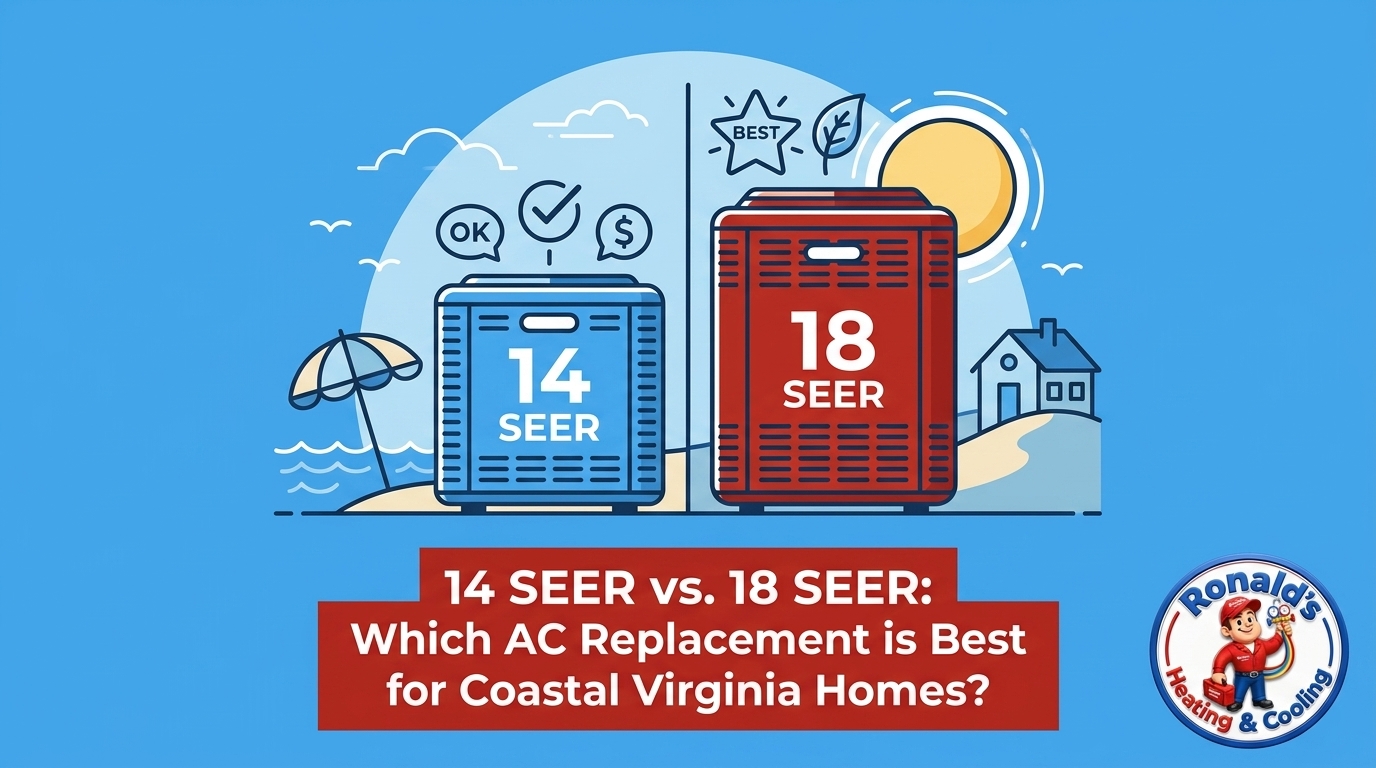
Myth vs. Reality: Surviving a Sudden Summer AC Breakdown
A common myth among homeowners is that a higher efficiency rating only changes the number on your monthly utility bill. However, when you are choosing between a 14 SEER and 18 SEER AC replacement for Coastal Virginia homes, that rating dictates the type of compressor technology you get—and ultimately, how well your house handles intense indoor moisture.
When your air conditioner unexpectedly fails in the middle of a July high-humidity summer, the indoor temperature climbs rapidly. The air quickly feels heavy, sticky, and thoroughly uncomfortable. At Ronald's Heating & Cooling, our team sees this panic firsthand every summer. Facing a sudden breakdown forces you to make a major financial decision under immense pressure. Most homeowners assume they should just replace their broken unit with a standard model to get the cold air flowing again as fast as possible. But in our years of repairing and replacing systems in extreme coastal climates, we have learned that treating your air conditioner like a basic fan is a costly mistake.
If you are currently relying on aging equipment to fight the heat, exploring your options for modern air conditioning systems can bring back your peace of mind.
The reality is that a system's SEER (Seasonal Energy Efficiency Ratio) rating is heavily tied to its ability to control indoor humidity. Higher SEER units use advanced mechanical components that actively pull moisture out of your living space. To make a confident, long-term investment under the stress of a mid-summer breakdown, you need to understand exactly how these two efficiency tiers operate side-by-side.
The Core Differences: Single-Stage vs. Variable-Speed Technology
To understand why these two options perform so differently in Virginia Beach / Coastal Virginia, you have to look inside the outdoor cabinet. The core mechanical difference between a standard 14 SEER unit and a high-efficiency 18 SEER unit comes down to the compressor. The compressor is the engine of your cooling system, and how it operates determines your daily comfort.
The Limitations of 14 SEER Single-Stage Systems
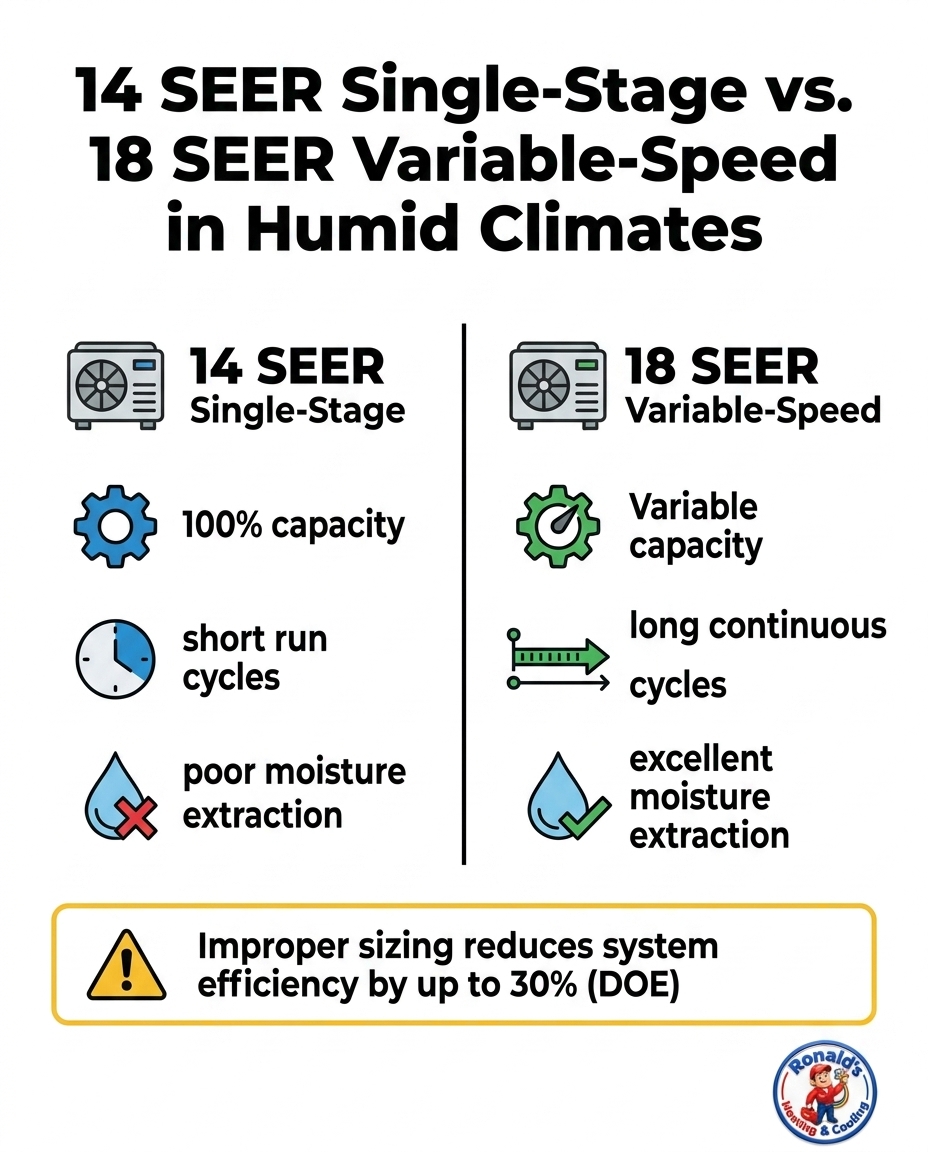
A standard 14 SEER air conditioner typically utilizes a single-stage compressor. This means the system only has one speed: 100 percent capacity. When your thermostat detects that the house is too warm, the system kicks on at full blast. It pumps a massive amount of cold air into the rooms until the target temperature is reached, and then it shuts off completely.
The drawback: This frequent on-and-off cycling draws significantly more starting amperage, which drives up your electricity usage. While a single-stage system is perfectly adequate for dropping the temperature quickly, it lacks the finesse required for continuous air mixing and steady comfort.
The Adaptive Nature of 18 SEER Systems
An 18 SEER unit usually features a variable-speed compressor. Instead of only running at 100 percent, this advanced technology can adjust its cooling output precisely to your home's real-time demands. It operates much like a car's accelerator pedal. If the house only needs a little bit of cooling to maintain the temperature, the system might run at 30 or 40 percent capacity.
The advantage: This allows for continuous, low-and-slow operation. By running longer cycles at lower capacities, an 18 SEER system provides constant air filtration and eliminates the abrupt hot and cold spots associated with single-stage units. If you are looking into an AC replacement in Virginia Beach, our technicians find that this adaptive technology is the primary reason homeowners choose to upgrade.
• Operational Cycle — 14 SEER (Single-Stage): Short, frequent on/off cycles — 18 SEER (Variable-Speed): Long, continuous, adaptive cycles
• Energy Draw — 14 SEER (Single-Stage): High spikes during startup — 18 SEER (Variable-Speed): Low, steady energy consumption
• Temperature Control — 14 SEER (Single-Stage): Fluctuates 2-3 degrees from target — 18 SEER (Variable-Speed): Holds precise target temperature
• Air Filtration — 14 SEER (Single-Stage): Basic (only filters when running) — 18 SEER (Variable-Speed): Exceptional (constant air circulation)
Tackling Oppressive Coastal Humidity: Latent vs. Sensible Heat
With summer temperatures soaring and relative humidity levels frequently exceeding 70 percent in the region, moisture removal is just as important as temperature reduction. In the HVAC industry, we measure cooling in two ways: sensible heat and latent heat.
Sensible heat is the actual temperature you read on your thermostat—the physical heat you can measure with a thermometer. Latent heat refers to the invisible moisture suspended in the air—the heavy, sticky feeling that makes 75 degrees feel like 85 degrees. In our extensive experience serving Coastal Virginia, tackling latent heat is your biggest challenge during a July high-humidity summer.
Here is how the two different SEER ratings handle that heavy coastal moisture:
1. The condensation process: Your air conditioner removes humidity by passing warm indoor air over a freezing cold evaporator coil. The moisture in the air condenses into water droplets on the coil and drains away outside.
2. The time factor: The evaporator coil needs time to get cold, and the air needs time to pass over it. Dehumidification does not happen instantly.
3. The 14 SEER failure point: Because a single-stage 14 SEER unit blasts cold air at 100 percent capacity, it cools the room down very quickly. The thermostat shuts the system off before the evaporator coil has enough time to wring the moisture out of the air. The room is cold, but it feels clammy and damp.
4. The 18 SEER solution: A variable-speed 18 SEER unit runs at a lower capacity for a much longer period. This continuous, low-and-slow operation constantly pulls air over the cold coil, stripping the latent heat (moisture) out of your home while keeping the sensible heat (temperature) perfectly steady.
The Danger of Oversizing: Why a High SEER Rating Isn't Enough
When upgrading to a high-efficiency system, many homeowners fall into the trap of thinking that "bigger is better." They assume that buying a larger capacity 18 SEER unit will cool their house faster and provide even better comfort. Our team sees this massive misconception often, and it can completely ruin your indoor air quality.
The Problem: If you install an oversized 18 SEER unit, it produces too much cooling capacity for your specific square footage. Even with variable-speed technology, the system will drop the indoor temperature too rapidly.
The Cause: This rapid temperature drop causes the system to short-cycle—turning on and off frequently just like a standard 14 SEER unit. When an 18 SEER system short-cycles, it completely negates its variable-speed dehumidification benefits. The system never runs long enough to extract the heavy moisture typical of Virginia Beach / Coastal Virginia summers. The Department of Energy (DOE) notes that improper sizing and installation can reduce a system's overall efficiency by up to 30 percent.
The Solution: An 18 SEER investment is completely wasted without expert sizing. At Ronald's Heating & Cooling, we perform precise load calculations to ensure your new equipment matches your home's exact requirements, guaranteeing optimal humidity control.
What is a Manual J Load Calculation?
A Manual J calculation is the industry-standard scientific method for determining a home's exact cooling requirements. It goes far beyond simple square footage. To prevent the costly mistake of guessing system size, our professionals measure your home's insulation levels, window quality, ceiling height, and direct sun exposure. Relying on Manual J load calculations ensures your new variable-speed system runs exactly as the manufacturer intended.
Weighing the Investment: Comfort, Efficiency, and Long-Term Value
Choosing between these two systems ultimately comes down to balancing your immediate budget with your long-term comfort goals. Both options will keep you safe during a July high-humidity summer, but they offer very different daily experiences.
A 14 SEER unit requires a lower initial investment. It provides reliable, standard cooling that meets all current federal minimums. If you are planning to move out of the house in the next few years, or if the unit is for a rarely used guest property, the standard single-stage option makes financial sense.
An 18 SEER unit offers substantial long-term value through significantly reduced energy consumption, superior indoor air quality, and unparalleled humidity control. The variable-speed motor operates so quietly you often will not even know it is running. Old, failing units often show signs of extreme electrical stress before dying entirely—such as when an AC circuit breaker keeps tripping—making the choice of a highly reliable, efficient replacement crucial for your peace of mind.
For example, one coastal homeowner reached out to our team at Ronald's Heating & Cooling last summer needing a quote for a full AC installation after their aging system began to fail. We presented them with a fair, transparent explanation of the work required and the true long-term value of higher-efficiency equipment. By understanding the exact differences in moisture control and energy draw, the customer received a reasonable quote and felt completely informed about their investment rather than pressured into a quick sale.
Navigating an Emergency Replacement: Quality Installation Matters
When your system completely breaks down mid-summer and emergency repairs are no longer viable, the urgency to get a new unit installed is intense. However, acting quickly does not mean you have to sacrifice quality. In our experience, the expertise of the installation team is just as important as the SEER rating printed on the side of the box.
Another local homeowner recently needed a complete new HVAC system installed during the busy peak-summer rush. Our professional installation team at Ronald's Heating & Cooling arrived promptly, meticulously integrated the new variable-speed equipment, and completed the complex job in just a day and a half. We left the site spotless, ensuring the new system was functioning perfectly to the customer's total satisfaction.
If you find yourself in need of emergency AC repair that suddenly turns into a full replacement, here is what you should expect from a high-quality installation in Virginia Beach / Coastal Virginia:
• Property protection: Professional installers use drop cloths and wear shoe covers to protect your flooring from the outdoor elements.
• Custom sheet metal work: The new indoor coil must be perfectly sealed to your existing ductwork to prevent precious cold air from leaking into your hot attic or crawlspace.
• Precise refrigerant charging: The team will weigh in the exact amount of refrigerant required for your specific line set length, ensuring the compressor runs at peak efficiency.
• Thorough performance testing: Before leaving, technicians will run the system through all of its paces, checking the static pressure and temperature drop to guarantee optimal performance.
Frequently Asked Questions About Coastal AC Upgrades
Is an 18 SEER AC worth the extra money in a humid climate?
Yes, an 18 SEER unit is highly recommended for humid climates because of its variable-speed technology. Standard units blast cold air and shut off quickly, leaving heavy moisture behind. The advanced compressor in an 18 SEER system runs longer cycles at lower speeds, actively wringing the sticky humidity out of your indoor air during a July high-humidity summer. The resulting comfort and lower monthly energy bills often justify the higher upfront investment.
How does an 18 SEER air conditioner reduce humidity better than a 14 SEER?
An 18 SEER air conditioner reduces humidity by operating continuously at a lower capacity, giving the indoor evaporator coil more time to extract moisture. A 14 SEER unit only runs at 100 percent capacity, cooling the house down so fast that it shuts off before dehumidification can occur. The longer the air circulates over a cold coil, the more dry and comfortable your home will feel.
What is the actual difference between 14 SEER and 18 SEER?
The primary difference lies in the compressor technology and energy efficiency. A 14 SEER unit typically uses a single-stage compressor that is either completely on or completely off. An 18 SEER unit utilizes a variable-speed compressor that ramps up and down to match your exact cooling needs. This results in quieter operation, steadier temperatures, and lower electrical consumption.
Does a higher SEER rating cool a house faster?
No, a higher SEER rating does not mean the system cools your house faster. In fact, high-efficiency systems are specifically designed to cool your home slower and more evenly. This low-and-slow approach is intentional, as it prevents cold and hot spots while maximizing the system's ability to filter the air and remove excess indoor moisture.
What is the best SEER rating for hot and humid coastal climates?
For hot and humid coastal climates, a rating of 16 to 18 SEER is generally considered the sweet spot for balancing upfront cost with essential dehumidification. Systems in this range almost always feature two-stage or variable-speed compressors. These advanced components are critical for tackling heavy coastal moisture that standard single-stage units simply cannot handle efficiently.
Can an oversized high-SEER unit cause indoor humidity problems?
Yes, an oversized high-SEER unit will absolutely cause severe indoor humidity problems. If the system is too large for your home's square footage, it will cool the space too rapidly and shut down before it can remove moisture from the air. This short-cycling behavior completely ruins the dehumidification benefits of your investment, leaving your home feeling cold and clammy.
Secure Your Comfort with the Right AC Replacement Today
Choosing between a 14 SEER and 18 SEER replacement ultimately comes down to balancing your immediate budget with the absolute necessity of coastal humidity control. While a standard unit will reliably lower the temperature, investing in variable-speed technology ensures your home remains dry, comfortable, and highly energy-efficient during the worst of the summer heat.
Remember that the equipment is only half the battle. Proper sizing through scientific load calculations and meticulous professional installation are the true keys to unlocking any system's efficiency in Virginia Beach / Coastal Virginia. Do not let a sudden breakdown force you into a rushed decision. Schedule an expert consultation with Ronald's Heating & Cooling today to evaluate your specific home cooling needs and secure your long-term comfort.
