





The Late-Summer Air Quality Dilemma: Convenience vs. Clean Air
A common myth among homeowners is that a permanent, washable air filter is universally the best choice for every home and climate, but when evaluating reusable vs. pleated disposable filters: a late-summer air quality test quickly proves otherwise. Many people assume that buying a single filter and simply washing it out for five years is the ultimate life hack for their HVAC system. It sounds incredibly convenient on paper. However, as the August back-to-school transition begins, this assumption starts to fall apart under the weight of changing household dynamics and shifting weather patterns.
Late summer brings a unique set of challenges to your home's indoor environment. The sudden surge of foot traffic from kids returning to school introduces new dirt, germs, and allergens into the house. At the same time, local late-summer weather patterns complicate routine HVAC maintenance, making the simple act of washing and drying a filter surprisingly difficult. This creates a critical decision point for homeowners: do you continue investing time in washing and meticulously drying a reusable filter, or is it time to switch to a high-MERV pleated disposable option that handles the seasonal shift more effectively?
For a comprehensive look at how to protect your home's environment during this seasonal shift, exploring professional indoor air quality solutions is the best place to start.
The Allergen Challenge: Why Back-to-School Season Demands Better Filtration
The shift from lazy summer afternoons to a bustling back-to-school schedule drastically changes the air inside your home. The increased household foot traffic kicks up settled dust, pollen, and pet dander that would otherwise remain dormant on your floors and furniture. Suddenly, your HVAC system is forced to process a much higher volume of microscopic airborne particles.
Microscopic Invaders in Late Summer
As August rolls into September, specific allergens reach their peak. Your air conditioner acts as the lungs of your home, pulling in and circulating everything that floats through your living space. During this busy seasonal transition, your system has to contend with a specific set of microscopic invaders:
• Ragweed pollen: This highly aggressive allergen begins to peak in late August and easily travels indoors on shoes, backpacks, and clothing.
• Playground dust and dirt: Kids returning from recess or sports practice bring fine particulate matter directly into the house.
• Pet dander: As families spend more time indoors during the evening, pets shed dander that gets trapped in the enclosed environment.
• Mold spores: Late-summer moisture encourages outdoor mold growth, which inevitably finds its way into your return vents.
When these particles enter your ductwork, the type of filter you have installed dictates whether they are captured or simply blown right back into your bedrooms. Understanding how dirty air filters impact your AC system is crucial for maintaining a healthy environment during this high-traffic period.
MERV Ratings Explained for Homeowners
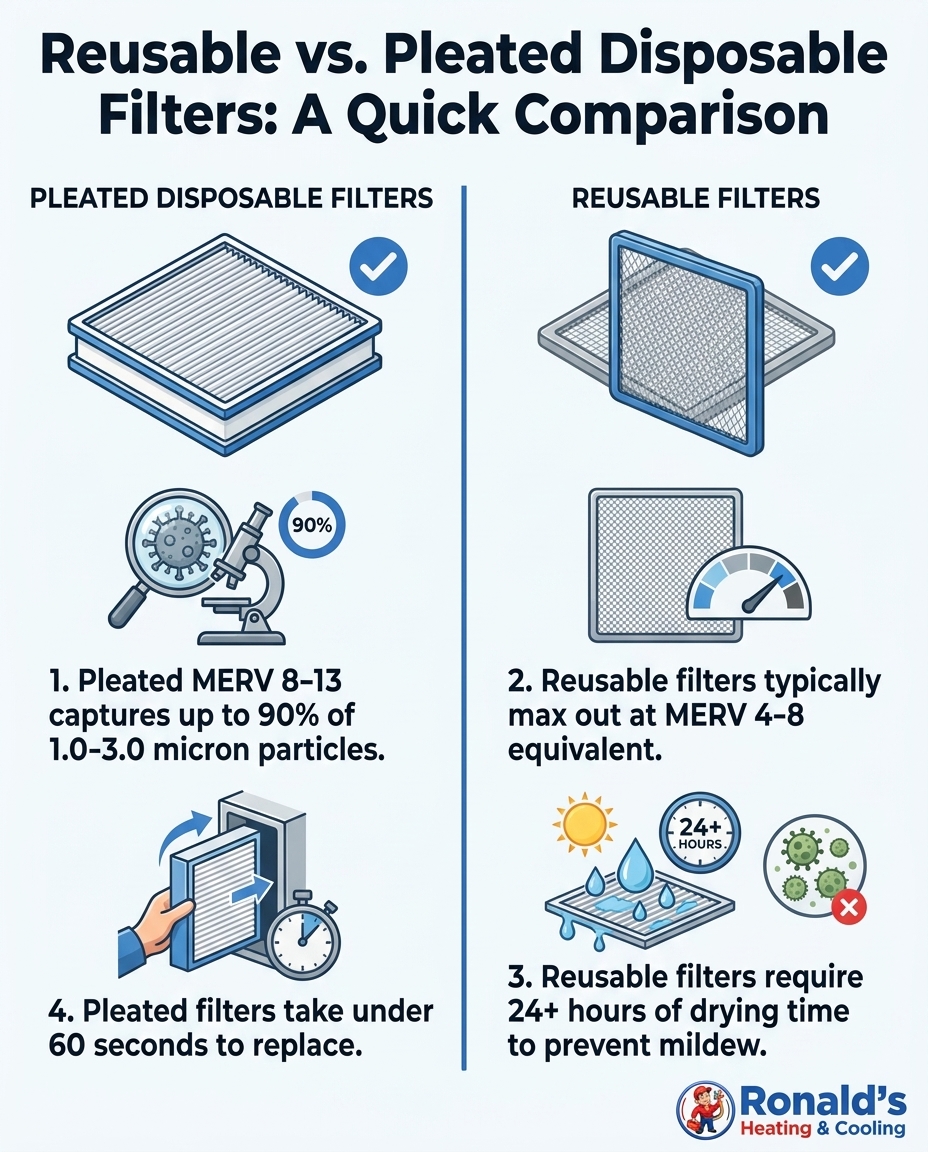
To understand why different filters perform differently, you have to look at their MERV (Minimum Efficiency Reporting Value) rating. This rating measures a filter's ability to capture particles of varying sizes. High-quality pleated disposable filters typically carry a MERV rating between 8 and 13. At this level, the dense synthetic fibers can capture up to 90% of particles between 1.0 and 3.0 microns in size—easily trapping fine dust, pollen, and pet dander.
In contrast, most reusable electrostatic filters rely on friction to create a static charge that attracts particles. While this sounds advanced, these washable filters typically max out at a MERV 4 to 8 equivalent. They are excellent at catching large debris like dog hair or heavy lint, but they often let microscopic allergens slip right through. When the August back-to-school transition introduces a massive spike in fine particulate matter, a lower MERV rating simply cannot keep up with the demand.
The Humidity Factor: Why Washable Filters Struggle in Coastal Climates
The biggest hidden drawback of a reusable filter isn't just its lower MERV rating; it is the physical maintenance required to keep it functioning safely. The instructions for washable filters are strict: they must be washed thoroughly and, most importantly, they must be 100% dry before being reinstalled in your HVAC system. In a vacuum, this sounds like a simple afternoon chore. In reality, local climate conditions make this a frustrating and potentially hazardous task.
Virginia Beach coastal humidity completely changes the equation for maintaining a washable filter. During late summer, morning humidity levels regularly exceed 80%. When the air is already saturated with moisture, the evaporation process slows to a crawl. If you wash your filter with a hose in the driveway and leave it in the sun to dry, that heavy coastal moisture prevents the dense electrostatic layers from drying efficiently. A process that should take a few hours can easily stretch into a full day or more.
Bringing a wet filter indoors to dry is entirely counterproductive. Not only does it still take hours to dry inside, but it leaves your HVAC system completely unprotected while you wait. You are forced into a difficult position: either turn the air conditioner off during the lingering late-summer heat, or run the system without a filter and risk pulling unfiltered dust directly into the sensitive evaporator coil. Furthermore, the EPA Indoor Air Quality Guidelines strongly warn against introducing any source of moisture into HVAC ductwork, making the long drying times of reusable filters a significant liability in humid coastal regions.
The Hidden Risks of Reinstalling a Damp Filter
Patience often wears thin when the house is getting warm and a washed filter is still damp to the touch. A typical pattern we see is homeowners deciding that a "mostly dry" filter is good enough, reinstalling it into the air handler to get the cooling system running again. This is one of the most detrimental mistakes you can make for your home's indoor air quality.
Your HVAC system's ductwork is dark, enclosed, and warm—the exact environmental conditions required for microbial growth. When you introduce a slightly damp filter into this environment, you create a perfect breeding ground for mold and mildew. The dense layers of the reusable filter trap the moisture, and within a matter of days, mold spores can begin to colonize the filter media itself.
Once microbial growth takes hold on the filter, the HVAC blower motor acts as a distribution system, actively pushing musty odors and airborne spores through the supply vents and into every room of your house. This actively sabotages your indoor air quality right when your family needs clean air the most. Additionally, Virginia Beach coastal humidity already forces your air conditioning system to work overtime to pull ambient moisture from the air. Forcing the system to pull air through a wet, restrictive sponge completely undermines its dehumidification capabilities.
If a damp filter has already caused musty odors to spread through your home, simply swapping the filter won't be enough to solve the problem. At that stage, professional air duct cleaning in Virginia Beach becomes a necessary step to remove the microbial growth that has spread beyond the filter housing and settled into the ductwork.
Side-by-Side Comparison: Reusable vs. Pleated Disposables
Making an informed decision about your HVAC maintenance requires looking at the facts without the influence of marketing hype. Many companies push expensive, permanent washable filters as a premium upgrade. However, a transparent look at the data shows that the potentially cheaper option—standard pleated disposable filters—often serves the customer's health much better in a humid coastal climate. We prioritize your family's respiratory health over upselling a "premium" permanent filter that could easily become a liability.
To make the decision process straightforward, here is a clear framework comparing the two options across the most important performance metrics for late-summer comfort:
• Allergen Capture — Reusable Washable Filters: Only suitable for larger debris; struggles with the microscopic dust common during the August back-to-school transition. — Pleated Disposable Filters: Highly effective. Captures up to 90% of microscopic allergens, pollen, and fine dust.
• Moisture Risk — Reusable Washable Filters: High risk. Requires 24+ hours of drying time; severe risk of mildew if installed damp. — Pleated Disposable Filters: Zero risk. The filter is immediately dry and ready to install straight out of the package.
• Maintenance Time — Reusable Washable Filters: High effort. Requires washing, rinsing, and monitoring outdoor drying conditions. — Pleated Disposable Filters: Low effort. Takes exactly 60 seconds to slide the old one out and slide the new one in.
• Long-Term Health Impact — Reusable Washable Filters: May degrade indoor air quality over time if improperly maintained or if mildew develops. — Pleated Disposable Filters: Actively improves indoor air quality by consistently removing fine particulates from the air supply.
Airflow and Static Pressure: Protecting Your HVAC Equipment
Beyond allergen capture and moisture risks, you must also consider the mechanical impact your filter choice has on your HVAC equipment. Every air conditioning system is designed to operate within a specific range of static pressure—the resistance to airflow within the duct system. If a filter is too restrictive, it suffocates the air handler, forcing the blower motor to draw more electricity and run hotter just to push the same amount of air.
A common concern homeowners raise is that high-MERV pleated filters restrict airflow too much. The truth is, while a MERV 13 filter does create more initial resistance than a cheap fiberglass filter, it is perfectly safe for your system as long as it is changed regularly. The real danger to your equipment actually comes from aging reusable filters.
While a washable filter might seem perfectly clean after a thorough hosing down, microscopic particles slowly embed themselves deep within the electrostatic plastic layers over time. These embedded particles cannot be washed out. Month after month, they build up, secretly acting like a solid wall that restricts airflow even immediately after washing. Because Virginia Beach coastal humidity makes proper airflow absolutely critical for effective dehumidification and end-of-season cooling efficiency, a permanently clogged reusable filter can cause your evaporator coil to freeze over or your blower motor to fail prematurely.
Beyond the Filter: Elevating Your Home's Air Quality Defenses
While choosing the right filter is foundational to HVAC maintenance, it is important to acknowledge that even the best high-MERV pleated disposable filter is only the first line of defense. A filter is a passive device; it can only capture the allergens and dust that happen to get pulled into the return vent. For households dealing with severe allergies during the August back-to-school transition, passive filtration often isn't enough to maintain true comfort.
This is where active air purification steps in. Unlike a standard filter that simply traps particles, whole-home air purification systems actively neutralize airborne contaminants before they ever reach your living space. These advanced systems integrate directly into your existing ductwork, working silently in the background whenever your blower motor runs.
By utilizing specialized technology like UV light and catalytic processes, these systems break down bacteria, neutralize mold spores, and reduce volatile organic compounds (VOCs) in the air supply. If your family is constantly battling sniffles, sneezing, and poor air quality despite regularly changing your pleated filters, upgrading to whole-home air scrubbers offers the ultimate solution for comprehensive, active protection.
Late-Summer Filter FAQs: Expert Answers
Why does my reusable filter smell musty?
A musty smell from a reusable filter usually means it was reinstalled into the HVAC system before it was completely dry. The dark, warm environment of the ductwork combined with trapped moisture creates an ideal breeding ground for mildew and mold. To fix this, the filter must be thoroughly cleaned, sanitized, and allowed to dry completely in the sun, though replacing it with a disposable filter is often the safer route.
What is the best HVAC filter for back-to-school allergies?
The best choice for back-to-school allergies is a high-quality pleated disposable filter with a MERV rating between 8 and 13. These filters are specifically designed to capture microscopic particles like pollen, pet dander, and fine playground dust that reusable filters often miss. Changing these pleated filters monthly during peak allergy season ensures maximum protection.
How long does a washable filter take to dry?
Drying time depends entirely on your local climate, but in humid coastal areas, a washable filter can easily take 24 hours or more to dry completely outdoors. If the morning humidity is extremely high, the dense layers of the filter will hold onto moisture stubbornly. It is critical never to reinstall the filter while it is still damp.
Are washable air filters worth it?
While washable filters save you from buying replacements every few months, they are often not worth the hidden costs in humid climates. The extensive drying time, the risk of microbial growth, and their lower efficiency at capturing microscopic allergens make them less effective than standard pleated filters. For most homeowners, the convenience and superior air quality of disposable filters easily outweigh the minor recurring cost.
Do pleated filters restrict airflow?
Pleated filters do create slightly more initial resistance than thin fiberglass or basic washable filters, but they do not dangerously restrict airflow as long as they are replaced regularly. The dense pleats actually provide a larger surface area for air to pass through. Problems with restricted airflow only occur when a pleated filter is left in the system long after it has become clogged with dirt.
Can a damp air filter damage my AC unit?
Yes, a damp air filter can cause significant problems for your AC unit. The moisture can foster mold growth that spreads into the ductwork and onto the sensitive evaporator coil, leading to costly cleaning requirements. Additionally, a wet filter restricts airflow severely, which can cause the evaporator coil to freeze solid and potentially damage the compressor.
Make the Right Filter Choice for Your Late-Summer Comfort
When you weigh the facts, standard pleated disposable filters emerge as the safer, more effective choice for handling the heavy humidity and the August back-to-school transition. They offer superior capture rates for microscopic allergens, take only seconds to replace, and completely eliminate the risk of introducing mildew-causing moisture into your ductwork. Optimizing your home's air quality doesn't have to be complicated or involve risky maintenance routines.
If you want to ensure your system is clean, properly filtered, and fully prepared for the changing seasons, professional oversight makes all the difference. Enrolling in a routine HVAC maintenance plan ensures that your equipment operates efficiently, your static pressure remains balanced, and your family breathes cleaner air all year long.
