





Staring Down a Heatwave With a Broken AC: What Now?
Are you suddenly researching Window Units vs. Central AC Band-Aids: Surviving a Summer Breakdown While Awaiting Parts because your main system just failed? Is your central AC actually dead, or is it simply waiting on a critical replacement component while your house slowly turns into a sauna? There are few things more stressful than watching your indoor thermostat climb past 80 degrees, knowing the exact factory part you need is delayed. If you need immediate professional assistance, schedule AC repair in Virginia Beach with our team at Ronald's Heating & Cooling today to get a proper diagnosis. We have guided countless local homeowners through this exact frustrating scenario.
Losing your central cooling during a severe July heatwave is more than just an inconvenience; it is a sudden disruption to your family's daily life. When our technicians deliver the news that a major component, like a compressor or an ECM blower motor, is backordered, the panic often sets in immediately. The frustration of being stuck in limbo is completely valid. You are caught between a broken system and a future repair date, with the immediate reality of a sweltering home.
This puts you at a critical decision point: figuring out the safest, most effective temporary cooling "band-aid" to keep your living space habitable. You have to decide how to bridge the gap between today's heat and tomorrow's repair. However, not all temporary cooling solutions are created equal. Some methods handle heavy moisture beautifully, while others simply blow warm, wet air around the room. Making the right choice is vital for both your physical comfort and the safety of your home's interior.
The Reality of HVAC Supply Chain Delays
Understanding why specific parts take time to arrive can help alleviate some of the frustration of waiting. Modern central air conditioning systems are highly engineered, calibrated machines. They require highly specific, manufacturer-matched parts to function safely and efficiently. You cannot simply pull a generic compressor off a local hardware store shelf and wire it into a high-efficiency communicating heat pump.
Global supply chain logistics occasionally cause multi-day waiting periods for these specialized components. Factories may have localized shortages, regional distribution centers might be waiting on freight shipments, and specific tonnages or proprietary control boards can take time to source. When a major component fails, the wait time is often entirely dictated by these complex logistics, completely outside the control of your local technician.
Transparent communication matters: As your local HVAC partner, Ronald's Heating & Cooling will never leave you in the dark. We believe in providing honest timelines rather than making empty promises about a part arriving "tomorrow" just to keep you happy in the short term. If a compressor is on a three-day delay from the manufacturer, we tell you exactly that, ensuring your family knows exactly what to expect.
Our team sees these complex situations often. Just last summer, a local homeowner contacted us with a severe system issue right in the middle of a hot stretch. Our technician Mark arrived promptly, performed an outstanding job diagnosing the root cause, and resolved the issue efficiently. But in cases where a major internal component has completely seized and the exact replacement is physically located three states away, even the most knowledgeable technician must wait for the freight truck. The focus must then shift from the delay itself to actionable, safe strategies for managing your indoor environment during the interim period.
Why Humidity Control is Your Biggest Challenge
Cooling the air is only half the battle when surviving a breakdown. Without proper dehumidification, indoor air quickly becomes stagnant, oppressive, and potentially unsafe. In our years of servicing the Virginia Beach coastal region, we've found that battling intensely hot and highly humid summers is the true test of any cooling system. The heavy coastal air holds a massive amount of moisture, meaning a standard box fan is completely insufficient to make a room comfortable.
The science of summer comfort: Air conditioning systems perform two distinct jobs. They lower the sensible heat (the temperature you read on a thermometer) and they remove the latent heat (the invisible moisture suspended in the air). Department of Energy (DOE) guidelines emphasize that heavy moisture loads severely impact indoor air quality and human comfort. When an AC breaks down, the sensible heat rises, but the latent heat makes the environment feel suffocating.
The human body relies on evaporating sweat to cool itself down. When indoor humidity levels exceed 70%, that sweat has nowhere to go. The air is already saturated, so moisture stays on your skin, causing your core body temperature to remain elevated. This is why 80 degrees in a dry climate feels perfectly fine, but 80 degrees inside a damp, unconditioned coastal home feels miserable.
When evaluating temporary AC options, we always advise our customers to judge them based on their ability to remove moisture, not just lower the temperature. A "band-aid" solution that drops the room to 72 degrees but leaves the humidity at 75% will leave you shivering but sweating—a cold, clammy environment that can also encourage mildew growth on your walls and furniture.
Window Units: The Heavy-Duty Temporary Fix
When our technicians diagnose a backordered part, we frequently recommend window air conditioners as the most effective temporary method for actual temperature and humidity reduction. Because they sit partially outside, they efficiently reject heat and drip condensed moisture directly into your yard, mimicking the function of your central system on a much smaller scale.
However, relying on window units requires careful planning and realistic expectations. Here is a breakdown of what you need to know:
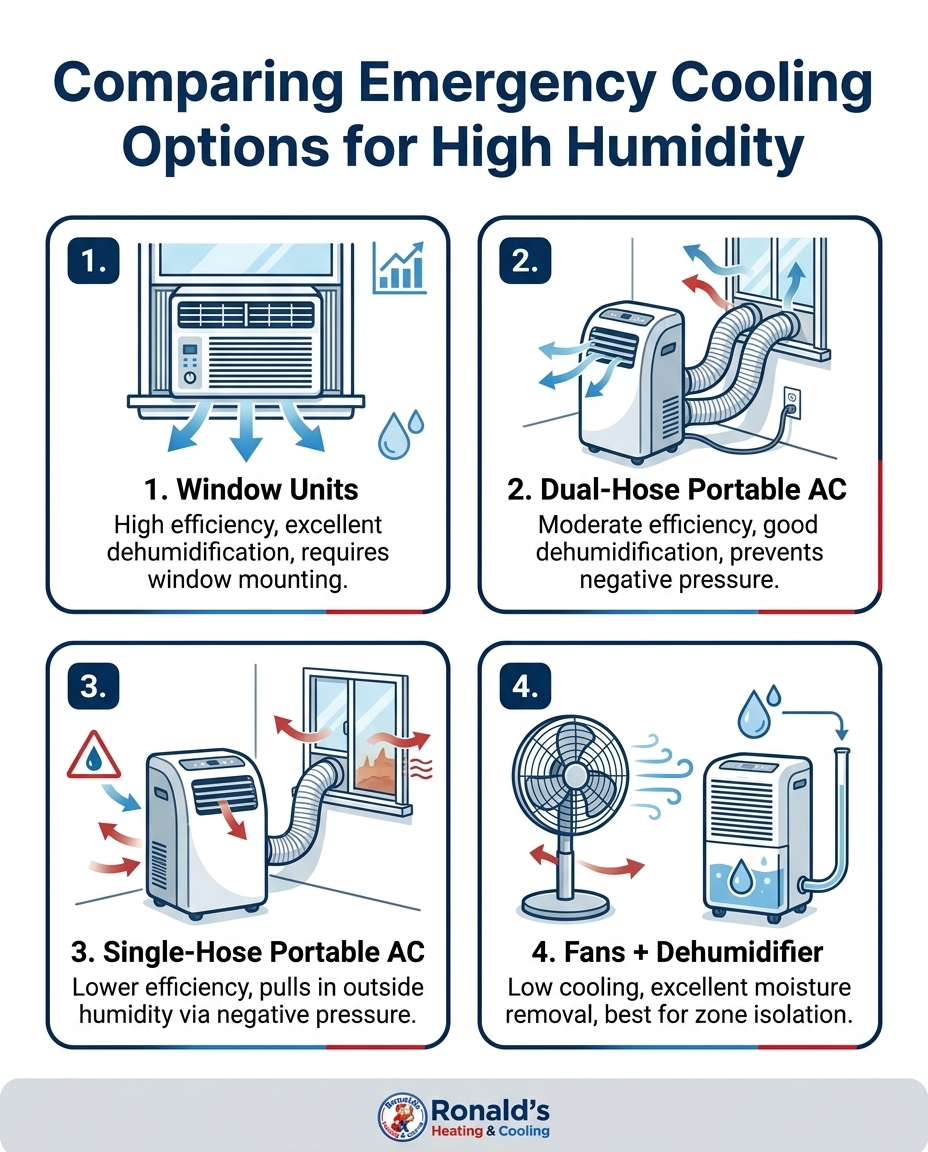
• Excellent Dehumidification: Because the cold evaporator coil is indoors and the hot condenser coil is outdoors, window units actively pull moisture out of the room and drain it away.
• Targeted Relief: They are highly effective at isolating and cooling a single primary living space, such as a master bedroom or a central living room.
• Physical Installation Challenges: Lifting a heavy, awkward appliance into a window frame requires physical strength. You also must ensure the unit is securely mounted so it doesn't fall outward.
• Security Concerns: Placing a window unit on a first-floor window prevents you from locking that window. You must use sturdy brackets or cut a piece of wood to block the window track to maintain home security.
The critical importance of proper sizing: You might assume that buying the biggest window unit available will cool your room the fastest. This is a common mistake we see in the field. An oversized unit will "short cycle." It cools the air so rapidly that the thermostat shuts the compressor off before it has time to extract the humidity. You are left with a room that is cold but incredibly damp. Always match the unit's BTU rating to the square footage of the room you are isolating.
You also have to consider the electrical load. Plugging heavy-duty appliances into standard bedroom outlets can easily overload a circuit. If you are running a window unit, a television, and several lamps on the same breaker, you might suddenly lose power. Understanding what makes your AC circuit breaker trip is essential when adding high-draw temporary appliances to your home's electrical panel.
Portable Air Conditioners: Flexibility with Caveats
If your home has casement windows, or if you physically cannot lift a heavy window unit, portable air conditioners offer an appealing alternative. These units sit entirely inside the room on caster wheels and vent their hot exhaust air out a window through a flexible plastic hose. The setup is much easier, they offer great mobility, and there is no heavy lifting into window frames.
However, portable units come with a significant engineering caveat that you must understand before relying on them during a heatwave. The type of portable unit you choose drastically impacts your indoor comfort.
• How It Works — Single-Hose Portable AC: Pulls indoor air to cool the compressor, then exhausts that heated air outside through one hose. — Dual-Hose Portable AC: Uses one hose to pull outside air for cooling the compressor, and a second hose to exhaust the heat.
• Pressure Effect — Single-Hose Portable AC: Creates negative pressure in the room. — Dual-Hose Portable AC: Maintains neutral pressure in the room.
• Efficiency — Single-Hose Portable AC: Lower efficiency. Constantly fighting the warm air it pulls into the house. — Dual-Hose Portable AC: Higher efficiency. Cools the room faster and uses less energy.
• Humidity Control — Single-Hose Portable AC: Poor. Pulls outside coastal humidity into the home through cracks and gaps. — Dual-Hose Portable AC: Good. Does not draw unconditioned outside air into the living space.
The negative pressure problem: Single-hose units create a vacuum effect. Because they are constantly blowing indoor air outside through the exhaust hose, replacement air must enter the house to balance the pressure. This means your home is actively sucking in hot, humid outside air through the attic, under doors, and around window frames. The portable unit is forced to work harder to cool the very air it just dragged inside.
To maximize a portable unit's moisture-removal capabilities, always opt for a dual-hose model if possible. Furthermore, ensure the window venting kit is sealed tightly with weather stripping or painter's tape. Any gaps around the window bracket will allow the exhausted heat to immediately bleed back into your living space.
Strategic Zone Cooling: Maximizing Fans and Dehumidifiers
If purchasing a temporary AC unit is not feasible, or if you are waiting for a unit to be delivered, you must employ alternative survival strategies. Trying to cool an entire house with a few fans is a losing battle. Instead, our team often advises families to practice strategic zone cooling.
Zone cooling involves abandoning the rest of the house and focusing all your efforts on a single, shaded living space. Here is how to lock down a "safe room" during a breakdown:
1. Isolate the space: Choose a room on the lowest level of your home, ideally on the north or east side to avoid peak afternoon sun. Close all doors leading to hallways or other rooms. Block the gap under the door with a rolled-up towel to trap whatever cool air you can generate.
2. Block solar heat gain: Sunlight streaming through glass acts like a magnifying glass. Keep all blinds, shutters, and heavy curtains completely closed during daylight hours. Blackout curtains are highly effective at stopping radiant heat from baking the room.
3. Optimize fan placement: Do not just point a fan directly at your face. Use fans to create cross-breezes. In the early morning or late evening, place a box fan in a window blowing inward to capture cooler outside air, and another fan on the opposite side of the room blowing outward to expel trapped heat. Once the outside temperature rises above the indoor temperature, shut the windows immediately and transition to circulating indoor air.
4. Deploy a standalone dehumidifier: If you own a portable dehumidifier, run it continuously in your isolated room. By stripping the heavy moisture out of the air, a room that is 82 degrees will feel significantly more tolerable.
5. Minimize internal heat loads: Avoid generating any unnecessary heat. Do not use the oven, the clothes dryer, or the dishwasher during the day. Turn off incandescent lighting, desktop computers, and large televisions, as all of these appliances radiate sensible heat into your carefully isolated space.
Preparing for the Permanent Fix
Surviving a breakdown with temporary band-aids is exhausting, but it is strictly a short-term measure for safety and comfort. While you manage the indoor environment, your HVAC provider is working behind the scenes to secure the necessary components. Bridging the gap to the eventual professional repair requires understanding what happens next.
When the backordered part finally arrives, our Ronald's Heating & Cooling technicians will return to complete the installation. For major components like a compressor, this is not a quick plug-and-play job. The technician must safely recover the existing refrigerant, braze the new compressor into place, pressure test the system with nitrogen to ensure there are no leaks, pull a deep vacuum to remove any moisture from the copper lines, and finally recharge the system with fresh refrigerant. This meticulous process ensures the new part operates flawlessly.
However, surviving a severe breakdown often prompts homeowners to evaluate the overall age and reliability of their system. If your air conditioner is over twelve years old and has just suffered a catastrophic compressor failure, spending significant funds on a repair might not be the wisest investment. The stress of waiting for parts, combined with the likelihood of future breakdowns, often makes AC replacement the next logical step.
Weighing repair costs against a full upgrade is a crucial conversation our team has with homeowners every summer. A new system provides peace of mind, improved energy efficiency (which may even qualify for federal tax credits or local utility incentives—always verify current programs with a tax professional), and a fresh warranty, ensuring you won't be scrambling for window units during the next summer heatwave.
Frequently Asked Questions About Emergency Cooling
Which is better for emergencies: a window AC or a portable AC?
Window units generally cool more efficiently and handle humidity better because their heat-generating components sit outside the home. They are the superior choice for actual climate control. Portable units, however, offer faster, easier setup and don't require heavy lifting, though single-hose models may struggle with negative pressure.
How do I keep my house cool while waiting for AC repair?
Isolate a single room on the lowest floor, block out all sunlight with heavy curtains, and use a combination of fans and standalone dehumidifiers to manage the environment. You should also avoid generating internal heat by keeping ovens, dryers, and large electronics turned off during the hottest parts of the day.
Is it worth buying a window AC for a broken central air system?
Yes, if the wait time for parts spans several days during peak heat, purchasing a window unit serves as a crucial safety measure against dangerous indoor temperatures. Once your central system is fixed, the window unit can be safely stored in the garage or attic as a reliable backup for any future emergencies.
How do you survive a heatwave without central air?
Focus heavily on personal hydration, utilize localized cooling techniques like damp cloths or ice packs, and monitor indoor heat index levels closely. If indoor temperatures reach unsafe thresholds according to EPA guidelines and you cannot lower the humidity, you should seek alternative shelter with friends, family, or a public cooling center.
Can running temporary units damage my home's electrical system?
Plugging multiple high-draw appliances into a single standard circuit can easily trip breakers and cause temporary power loss to that room. To maintain safety, always distribute heavy electrical loads across different circuits, and avoid running high-wattage items like hair dryers or vacuums on the same breaker as a window AC.
Stay Safe While We Restore Your Comfort
Waiting for critical replacement parts is undeniably frustrating, but managing your indoor environment safely must remain the top priority. Temporary band-aids like window units and strategic zone cooling are essential tools for getting through a severe heatwave, but they are no substitute for a fully functioning central system. A professional, lasting fix is always the ultimate goal. If you are struggling with a failing system, reach out to our local experts at Ronald's Heating & Cooling to track part shipments, evaluate your current setup, or discuss permanent Air Conditioning repair options so you can finally relax in total comfort.
