





The Hidden Threat of Late-Summer AC Condensation
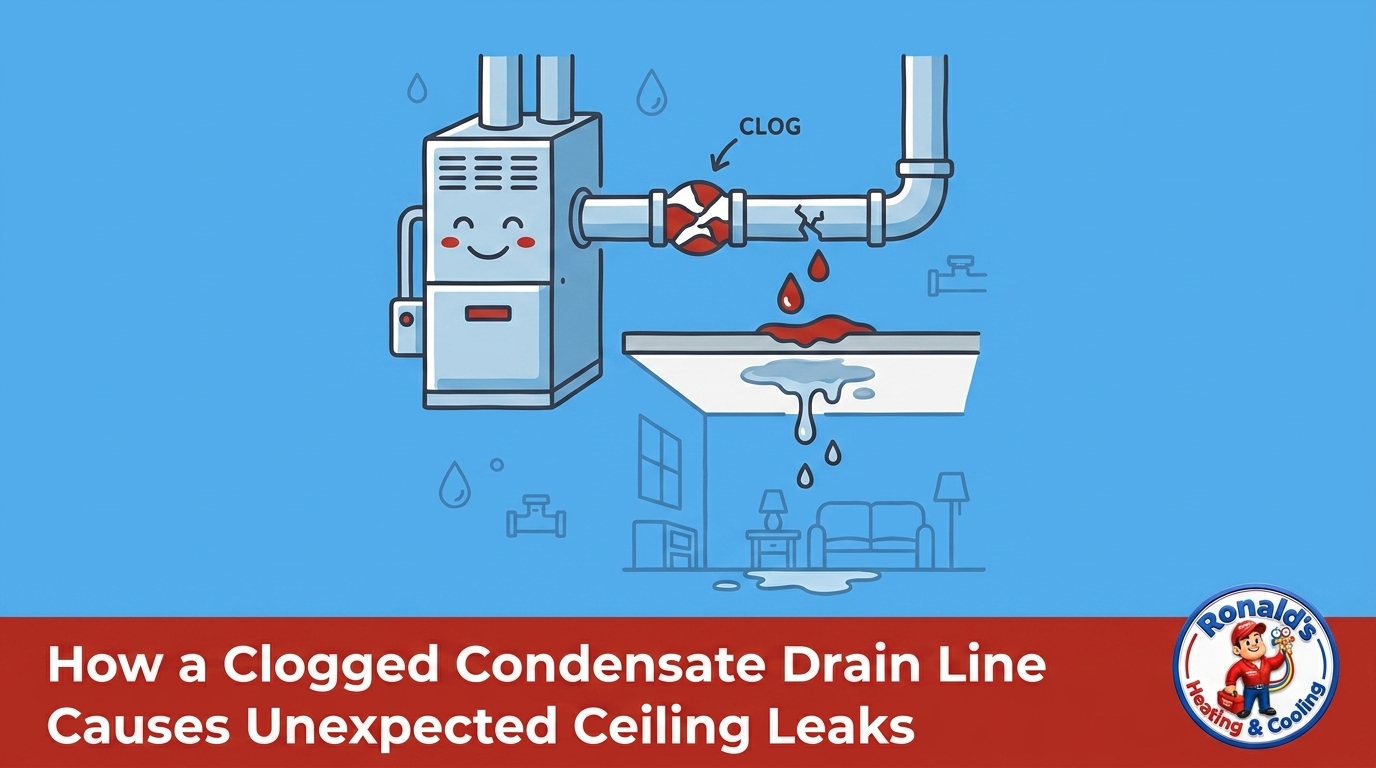
August heat brings peak temperatures to Virginia Beach, but as our team at Ronald's Heating & Cooling often sees during the back-to-school transition, it also brings a hidden threat right above your head. Understanding how a clogged condensate drain line causes unexpected ceiling leaks is one of the most important things you can learn when late-summer humidity pushes your cooling system to its absolute limit. You walk into your hallway or living room and notice a spreading brown water spot on the ceiling. Because the sky outside is perfectly clear, a roof leak doesn't make sense. The true culprit is almost always sitting quietly in your attic: your air conditioning system.
For comprehensive system care, explore our air conditioning services.
Addressing this early is the single most important decision you can make to avoid catastrophic drywall damage. While most homeowners think of their air conditioner as a machine that simply pumps cold air into the house, it is actually a massive dehumidifier. Basic cooling systems generate massive amounts of water that must safely exit your home. By late summer (August), your system has been running for months, generating gallons of water every single day. When that water has nowhere to go, gravity takes over, and your ceiling becomes the unfortunate path of least resistance.
The Physics of Attic Heat and Water
To understand why this happens, you have to look at the environment where your system operates. Attics are incredibly harsh spaces. During the peak of the day, an attic can easily reach temperatures exceeding 130°F. Inside the air handler unit housed in that sweltering space, the evaporator coil is ice cold. When extremely hot, humid air meets an ice-cold surface, condensation forms rapidly. This stark temperature difference is what creates the constant flow of water that your drainage system must manage. If any part of that drainage pathway becomes compromised, the water will inevitably find its way into your home's insulation and drywall.
The Anatomy of Your Air Conditioner's Drainage System
Before you can spot a problem, it helps to understand how condensation is normally managed within your HVAC system. The physics of cooling dictate that as the air conditioner cools warm indoor air, it extracts airborne moisture, turning that vapor into liquid condensation. This isn't a trickle; it is a heavy, constant flow. According to data from the Department of Energy, a standard central air conditioner can produce 5 to 20 gallons of condensation per day during peak cooling season. To put that into perspective, that is the equivalent of emptying four large buckets of water directly into your attic every 24 hours.
The normal path for this water is highly engineered. As moisture drips off the cold evaporator coil, it falls into the primary drain pan located directly underneath the coil inside the air handler. From there, gravity pulls the water into a white PVC condensate drain line, which routes the water safely outside your home. Because this primary system handles so much volume, manufacturers include emergency backups. A secondary drain pan sits entirely underneath the air handler unit to catch any overflow, and small electronic float switches are wired into the system to shut the whole machine down if water begins to pool dangerously high.
In our years of servicing HVAC units across the Virginia Beach area, we've learned that our coastal climate's exceptionally high relative humidity means systems are constantly pulling maximum moisture from the indoor air. Your system works overtime to wring that moisture out like a sponge, which our team knows makes the drainage system one of the hardest-working components in your home.
• Primary Drain Pan — Primary Function: Catches condensation directly from the evaporator coil inside the unit. — What Happens When It Fails: Water overflows the internal pan and spills into the secondary emergency pan below.
• PVC Condensate Line — Primary Function: Routes water from the primary pan to the exterior of the house. — What Happens When It Fails: Water backs up into the primary pan, triggering the first stage of an overflow event.
• Secondary Drain Pan — Primary Function: Acts as a safety net beneath the entire air handler unit. — What Happens When It Fails: Water breaches the lip of the pan, soaking the attic floor and ceiling drywall below.
• Float Switch — Primary Function: Detects rising water levels and cuts power to the AC unit to stop condensation. — What Happens When It Fails: The AC continues running and producing water, guaranteeing a severe overflow and leak.
How Attic Installations Increase the Risk
Gravity is both a friend and a foe for attic-mounted air conditioning units. On one hand, gravity is what allows the water to flow down the PVC pipe and safely out of your house without requiring a mechanical pump. On the other hand, the location directly above your living spaces means any failure in the drainage system immediately threatens the ceiling below. If an AC unit is located in a basement or garage, a clogged drain line might result in a puddle on a concrete floor. In an attic, that same puddle is absorbed by fiberglass insulation and heavy drywall, turning a minor plumbing backup into a major structural repair.
Why Algae and Sludge Thrive in August
The water dripping off your evaporator coil isn't pure, distilled water. As your system pulls air from inside your home, microscopic airborne particles—dust, pet dander, and biological matter—slip past the air filter and stick to the wet coil. This debris washes down into the drain pan and enters the PVC line. When you combine this organic food source with water and heat, you get a powerful biological reaction.
During the peak of summer, a "greenhouse effect" occurs in dark, warm attics. The constant flow of water combined with high ambient temperatures creates the perfect breeding ground for algae, mold, and biological slime. This biological growth doesn't happen overnight. It accumulates slowly over the entire cooling season. By the time late summer arrives, what started as a thin biofilm has mutated into a thick, gelatinous sludge that easily clings to the interior walls of your narrow PVC plumbing.
Virginia Beach's prolonged late-summer coastal humidity acts as a massive accelerant for this algae growth compared to drier, arid regions. The air is thick with moisture for months on end, meaning the drain line never has a chance to dry out. The constant dampness ensures the algae colony continues to expand. It is important to understand that this buildup isn't a sign of a broken air conditioner. It is a completely natural consequence of the environment that simply requires proper management to prevent common AC drainage problems.
The Biological Reality of Coastal Cooling
Many homeowners are surprised to learn that their air conditioner is essentially acting as an incubator for biological growth. The sludge that forms inside a condensate line is highly resilient. It binds itself to the plastic walls of the pipe, catching more dirt and debris as water flows over it. As the sludge mass grows, the diameter of the pipe narrows. The water flow slows from a steady stream to a slow trickle. Our technicians frequently find that eventually, a single clump of algae will shift, acting like a cork in a bottle, completely sealing off the exit path.
The Chain Reaction: From Clogged Pipe to Ceiling Breach
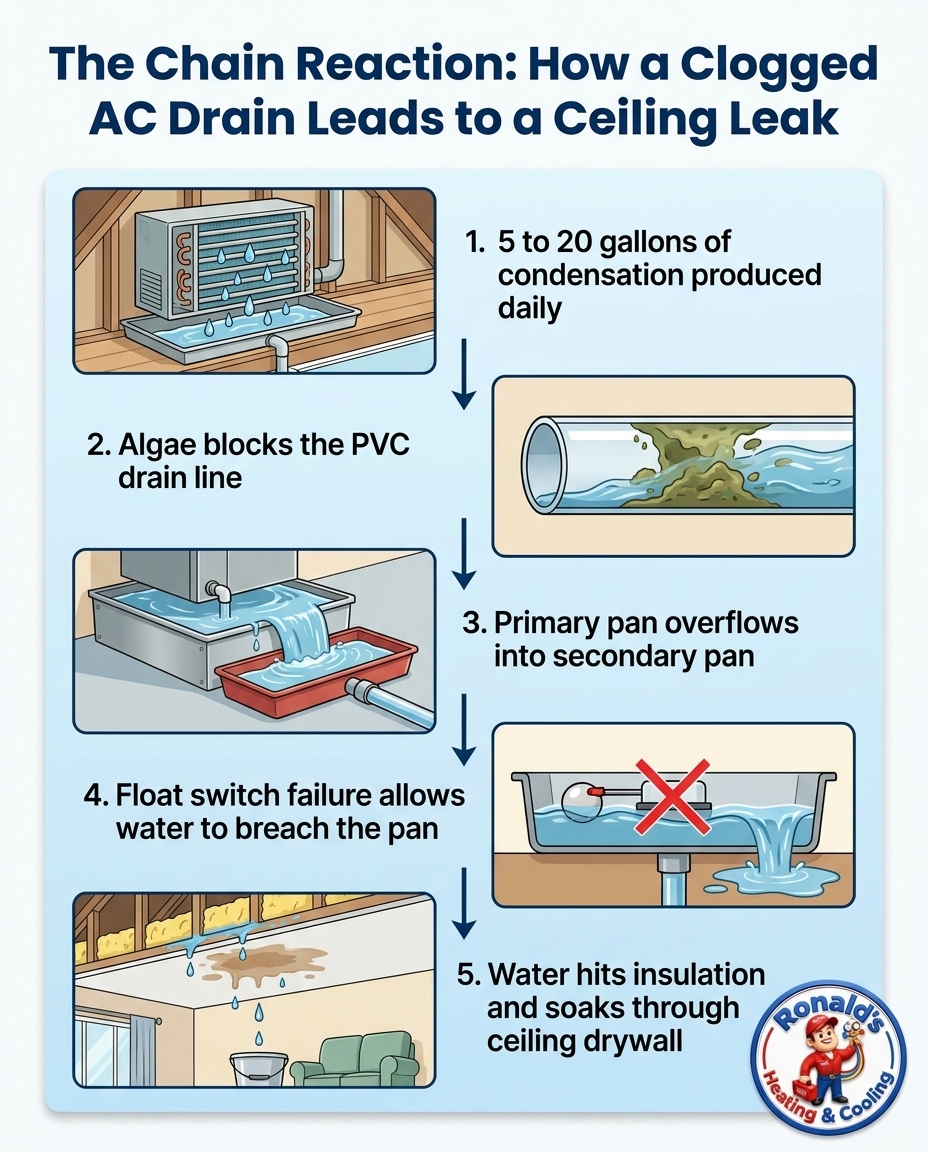
When a clogged condensate drain line causes unexpected ceiling leaks, the mechanical progression is predictable and swift. If the blockage isn't caught early, the system follows a specific chain reaction that ends in drywall damage. Here is exactly how an attic pan overflow occurs:
1. The blockage forms: Biological sludge thickens enough to completely block the narrow white PVC drain line, trapping the water inside.
2. The primary backup: Because the water cannot exit the pipe, it backs up into the primary drain pan located inside the air handler.
3. The overflow: The primary pan reaches its maximum capacity and overflows, spilling water into the secondary emergency pan situated beneath the unit.
4. The safety failure: If the emergency pan is rusted, clogged with debris, or lacks a functioning electronic float switch, the system continues to produce condensation until the water breaches the outer edge.
5. The ceiling breach: The overflow drips directly onto the attic floor, soaking completely through the thermal insulation and eventually breaching the drywall ceiling below, resulting in structural damage and water stains.
Our repair crews at Ronald's Heating & Cooling have witnessed this entire progression happen in a matter of hours on a particularly hot, humid late-summer day when the system is producing maximum condensation.
Why the Emergency Safeguards Sometimes Fail
You might wonder why the float switch—the device designed specifically to stop this chain reaction—doesn't always save the day. Float switches are simple mechanical devices. A small buoyant piece of plastic sits inside a cylinder. When water rises, the plastic floats upward, triggering a switch that cuts the low-voltage power to the thermostat. However, if the pan is filled with sludge, that buoyant piece of plastic can easily become stuck. If it cannot float upward, the switch never triggers, and the air conditioner keeps running, completely unaware that it is flooding your attic.
Early Warning Signs Before the Drywall Damage Occurs
Empowering yourself to recognize the symptoms of a backing-up drain line before it becomes a catastrophic leak is the best defense against drywall damage. Your HVAC system will usually give you subtle hints that the drainage pathway is struggling before the actual ceiling breach occurs.
• Musty or moldy odors: If you notice a damp, dirty-sock smell circulating through the air vents when the system runs, it often means standing water and algae are pooling in the primary pan.
• The system abruptly shutting off: An air conditioner that suddenly turns off and refuses to turn back on is usually a sign that the float switch has successfully tripped to prevent an overflow.
• Visible standing water: If you safely inspect the attic unit and see water pooling in the secondary drain pan beneath the machine, your primary line is already clogged.
• Gurgling or bubbling sounds: Strange noises coming from the indoor unit or the exterior drain pipe indicate that air is struggling to pass through a narrowing, sludge-filled pipe.
If you notice any of these signs, especially during late summer (August), it is critical to seek AC repair in Virginia Beach immediately. Catching the issue at the "musty smell" or "gurgling" stage means the water hasn't yet breached the secondary pan, saving you from a highly disruptive ceiling repair.
Why Basic Filter Checks Cannot Prevent Drain Line Clogs
A common misconception among homeowners is that changing the air filter regularly will prevent drain line clogs. While changing your air filter is absolutely necessary for improving airflow and protecting the blower motor, it does nothing to clear the biological sludge actively growing inside the plumbing. Filters catch dry particles; they cannot stop the microscopic biological matter that feeds algae growth in a wet environment.
When a clog does occur, many people attempt DIY methods they find online, such as pouring bleach down the access pipe or attaching a wet/dry shop vacuum to the exterior line. These methods are highly risky and strongly discouraged. Pouring bleach down a PVC line can degrade the chemical glue holding the pipe joints together, creating new leaks inside the attic walls. Using a vacuum improperly can sometimes push the clog deeper into the plumbing, compacting the sludge into an immovable block.
The professional process is entirely different and vastly more effective. Technicians use specialized tools to safely apply high-pressure suction, completely flush the line of all debris, and apply professional-grade algaecide treatments that prevent regrowth without damaging the PVC joints. Professional clearing is the only guaranteed way to protect your home's structural integrity from water damage.
Ronald's Heating & Cooling goes beyond basic filter checks; our maintenance protocol specifically includes flushing and clearing condensate lines to prevent these exact unexpected water disasters. We've seen firsthand that a clean filter doesn't matter if the drain line is backing up into your living room.
The Value of a Comprehensive System Assessment
A professional technician doesn't just clear the clog and walk away. They perform a comprehensive assessment of the entire drainage ecosystem. They inspect the metal pans for structural rust that could cause future leaks, and they physically test the emergency float switches to ensure they will trigger correctly in an emergency.
Recently, our team at Ronald's Heating & Cooling helped a local homeowner whose AC system required emergency repairs after a late-summer backup. Because our technician took the time to thoroughly explain the necessary work—including exactly how the drainage system functions and why the line had clogged—and answered all their questions, the customer felt completely confident in the process and the ongoing reliability of their system. Thorough explanations of necessary work give homeowners peace of mind, transforming a stressful situation into a manageable, educational experience.
FAQ
Why is my AC leaking water through the ceiling?
Your AC leaks through the ceiling when the condensate drain line becomes clogged with algae or debris. The condensation backs up into the drain pan, overflows the safety margins, and drips directly onto the attic floor, eventually soaking through the drywall below.
Can a clogged AC drain cause a ceiling leak?
Yes, a clogged AC drain is one of the most common causes of ceiling leaks during the summer. Because an air conditioner can produce up to 20 gallons of water a day, a blocked pipe forces that massive volume of water to find an alternative exit, which is usually over the edge of the attic drain pan.
What are the early signs of a clogged AC condensate line?
Early signs include a musty or moldy odor coming from your air vents, gurgling sounds near the indoor unit, or the air conditioner abruptly shutting off. You may also notice standing water in the secondary drain pan if you look in the attic.
How do you know if your AC drain is clogged?
You will usually know your drain is clogged if the system's emergency float switch cuts power to the thermostat, preventing the AC from turning on. Additionally, checking the exterior PVC exit pipe and seeing no water dripping while the AC is running is a strong indicator of a blockage.
Why does my AC unit shut off randomly during the summer?
Random shut-offs during peak summer heat are frequently caused by the condensate float switch detecting a water backup. When the switch senses rising water in the drain pan, it intentionally cuts power to the unit to stop condensation and prevent a catastrophic home flood.
How often should an AC condensate drain line be professionally flushed?
Your AC condensate drain line should be professionally flushed at least once a year, ideally during your pre-season cooling maintenance. In extremely humid coastal climates, having the line treated with algaecide during the late summer can further prevent unexpected sludge blockages.
Protect Your Home Before the Damage Is Done
A clogged drain line is a silent threat that can turn a hot August afternoon into a stressful structural emergency. Recognizing the early warning signs and trusting a professional to flush the system is the safest way to prevent costly drywall damage. For ultimate peace of mind, enroll in a comprehensive preventative maintenance plan to ensure your drainage system remains clear, clean, and fully functional all season long.
