





The Shock of the Late-Summer Electric Bill
Late-summer August in Virginia Beach brings some of the most intense, relentless heat of the year. Right as families are navigating the busy back-to-school transition, a shockingly high utility statement often lands in the mailbox. Opening that envelope can be a frustrating experience, especially when you feel like you have been doing everything right by keeping doors closed and blinds drawn. The immediate question most homeowners ask is whether their air conditioning unit is actually failing, or if it is simply working overtime to combat the extreme coastal temperatures.
When you receive a surprisingly high statement, it forces a critical decision point. You have to determine if this heavy energy consumption justifies exploring a new, higher-efficiency system, or if your current setup just needs a little professional attention. Before you panic, it is crucial to understand exactly what is driving that power draw. If your system is struggling, exploring professional air conditioning services is the first step toward considering an AC replacement in Virginia Beach.
Evaluating system performance goes far beyond just looking at the final balance due. It requires looking at the actual data and understanding how your equipment responds to the environment. An aging system might still blow cold air, but the sheer amount of electricity it consumes to produce that air can become a massive financial drain. By breaking down the specific factors that influence your home's cooling load, you can take the guesswork out of your late-summer utility statement.
How to Read Your Dominion Energy kWh Usage History
The biggest mistake homeowners make when analyzing their utility statement is focusing entirely on the total amount due. To truly understand what your air conditioner is doing, you need to look closely at your Dominion Energy kWh usage history. Kilowatt-hours (kWh) are the actual units of electricity your home consumes, and tracking this metric is the only way to separate your cooling costs from other household energy demands.
By shifting your focus from the final balance to the raw data, you can pinpoint exactly when and why your system is drawing so much power. Here is how you can effectively analyze your smart meter data:
1. Access the online dashboard: Log into your Dominion Energy online account and navigate to the energy usage section. This portal provides detailed graphs that break down your consumption far beyond a simple monthly total.
2. Switch to the daily and hourly view: Look past the monthly summary and drill down into the daily or even hourly data. This level of detail is where the true story of your air conditioner's performance is revealed.
3. Establish your baseline: Look at your energy consumption during the middle of the night or early morning when the AC is running minimally. This shows you what your home's baseline power draw looks like without a heavy cooling load.
4. Identify the cooling spikes: Look for massive jumps in your kWh consumption that correlate directly with the hottest parts of the afternoon. These spikes are the direct result of your cooling system kicking into high gear.
Identifying Afternoon Usage Spikes
Once you are logged into the utility portal and viewing the hourly data, start matching your peak usage times with the hottest parts of the day. If you see your kWh usage skyrocket between 2:00 PM and 6:00 PM, your air conditioner is the primary culprit. The most important thing to look for is whether these usage spikes ever drop back down during the afternoon. If the graph stays elevated and flat at a high level for several hours, it indicates that your AC is running continuously without cycling off. Continuous operation is a massive drain on power, and identifying this pattern in your Dominion Energy kWh usage history is the first clue that your system is struggling to keep up with the demand.
Virginia Beach Climate and Continuous AC Cycling
Understanding your utility data requires understanding the environment your system is fighting against. Late-summer August in Virginia Beach presents a unique and punishing climate for residential cooling systems. Unlike regions with dry heat, the coastal environment introduces a massive amount of humidity into the air. This creates a dual burden on your air conditioner: it must lower the physical temperature of the home while simultaneously removing heavy, thick moisture from the indoor air.
The latent heat load—the energy required to dehumidify the air—forces your equipment to work significantly harder. When the humidity is exceptionally high, an older unit will struggle to extract enough moisture to make the home feel comfortable, even if the thermostat reads a cool temperature. This leads to continuous AC cycling. Instead of turning on, cooling the house, and resting, the system runs non-stop for hours on end. This continuous operation prevents the compressor from taking a break, leading to rapid and sustained energy consumption.
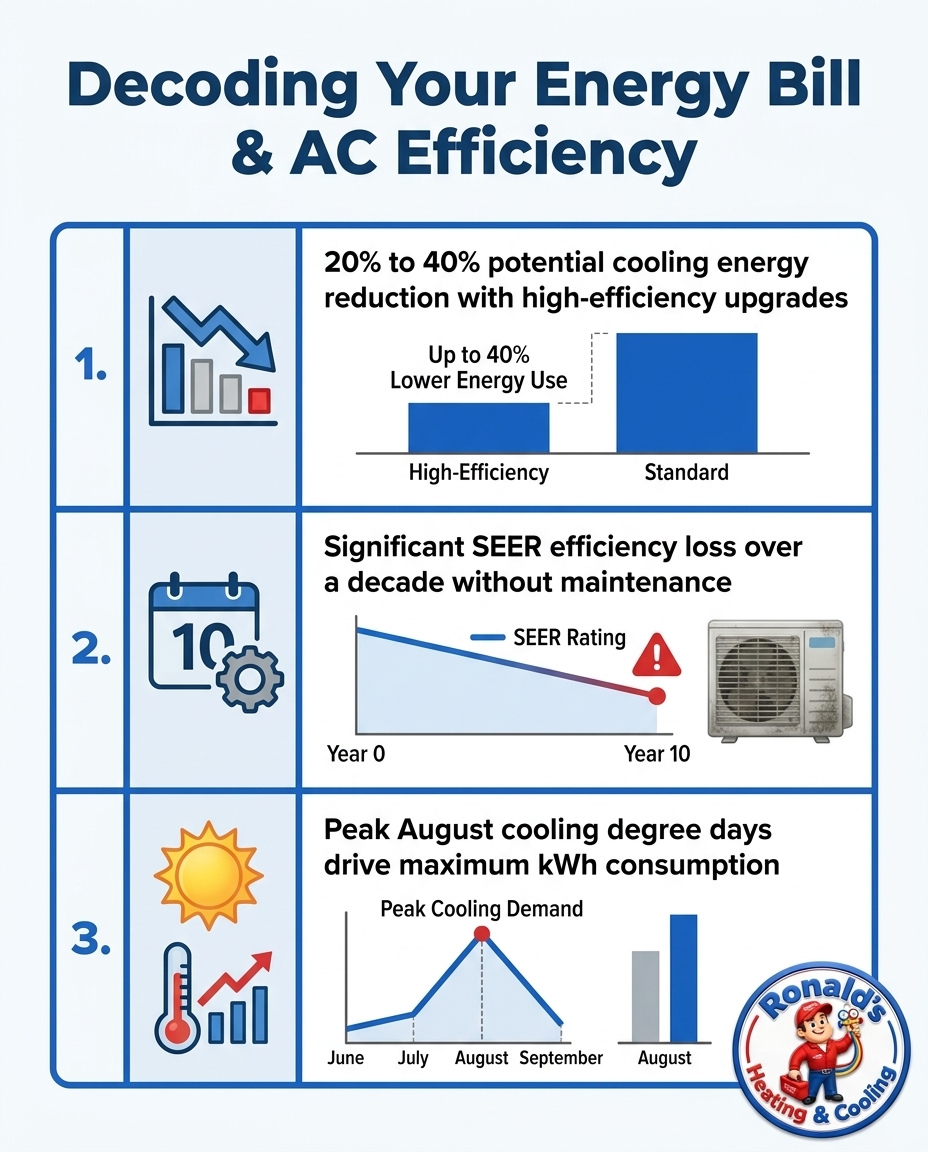
Contrast this heavy workload with milder spring or early summer conditions. In May or June, your system might only run for ten or fifteen minutes at a time before shutting off. But as peak cooling degree days hit in August, that same system is forced into a marathon. This localized climate factor is exactly why late-summer Virginia Beach heat and high humidity force older units to run continuously, drastically reducing their overall efficiency compared to systems operating in dry, arid environments. The longer the system runs without a break, the more power it pulls from the grid.
SEER Degradation: The Hidden Cost of an Aging AC
If your system is running constantly, you might assume it is just the weather. However, if your unit is older, there is a hidden mechanical factor driving up your power consumption: SEER degradation. SEER stands for Seasonal Energy Efficiency Ratio, and it is the standard measurement of how efficiently an air conditioner converts electricity into cooling power over a typical season. When you buy a brand-new unit, it operates at its factory-rated SEER level. But over time, that efficiency rating does not stay static.
Efficiency loss over a decade is a very real phenomenon. As coils accumulate micro-debris, as compressor valves wear down, and as refrigerant lines experience minor fluctuations, the system slowly loses its ability to transfer heat effectively. An older system can lose a significant percentage of its original efficiency over ten to twelve years. This means an aging unit must work much harder—and use significantly more kWh—to produce the exact same amount of cooling it did when it was first installed. It is like driving a car with a clogged fuel filter; you have to press the gas pedal much harder just to maintain the same speed.
This degradation is why upgrading your equipment can have such a profound impact on your energy consumption. Upgrading from a degraded, low-SEER unit to a modern, high-efficiency system can reduce your cooling energy consumption by 20% to 40%. If you are comparing 14 SEER and 18 SEER AC replacements, understanding this efficiency drop is vital. A higher SEER rating means the system uses less electricity to achieve the same comfort level, directly combating the heavy loads experienced during late-summer August in Virginia Beach.
Honest Assessments: When to Repair vs. Replace
Faced with spiking utility data, homeowners eventually have to make a choice: do you keep pouring money into an aging system, or do you invest in a new one? Making this financial decision requires looking closely at your Dominion Energy kWh usage history and getting an honest, professional evaluation. Sometimes a system just needs a specific part replaced—like a failing capacitor or a clogged condensate line—rather than a full overhaul.
One local homeowner reached out to us during the summer heat when they realized they needed a quality installation of a new HVAC system. Our technicians arrived on time, provided a thorough and transparent evaluation of their failing unit, and went above and beyond to ensure the new installation was completed perfectly without any aggressive sales pressure. Providing honest, transparent assessments to determine if a simple repair or a full replacement makes the most sense is the best way to help homeowners navigate these stressful decisions.
When weighing your options, you have to look at the cost of ongoing high energy bills against the investment of a new system. It is also worth noting that qualifying high-efficiency installations may be eligible for generic federal tax credits or local utility rebates, which can help offset the initial investment. Here is a breakdown of what to consider:
• System Age — Lean Toward Repair: Under 10 years old — Lean Toward Replacement: Over 10 to 12 years old
• kWh Usage Trends — Lean Toward Repair: Stable year-over-year — Lean Toward Replacement: Spiking drastically each summer
• Repair Frequency — Lean Toward Repair: Rare, minor fixes — Lean Toward Replacement: Frequent, expensive breakdowns
• Cooling Performance — Lean Toward Repair: Consistent, even temperatures — Lean Toward Replacement: Struggling to remove humidity
Can Maintenance Save a Failing System?
If you are not quite ready for a full replacement, you might wonder if routine upkeep can reverse that efficiency loss and lower your utility statement. The short answer is that maintenance is absolutely critical, but it has its limitations. When an air conditioner is neglected, dirty air filters and severely neglected coils restrict airflow. This forces the blower motor to work harder and the compressor to run longer, drastically increasing the energy draw.
The limits of maintenance: While a thorough cleaning can restore lost airflow and improve heat transfer, it cannot magically reverse severe mechanical SEER degradation. If the compressor valves are worn out or the internal components are heavily degraded after fifteen years of battling late-summer August in Virginia Beach, cleaning the coils will only provide a marginal improvement. Maintenance optimizes what you currently have; it does not turn an old system into a new one.
However, if your system is still relatively healthy, scheduling a professional AC tune-up can significantly optimize its current performance. A technician can clear the condensate lines, check the electrical connections, and ensure the refrigerant charge is exactly where it needs to be. Staying on top of routine AC maintenance is the single best way to prevent future efficiency drops and keep your system running as efficiently as possible for as long as possible.
Frequently Asked Questions About Late-Summer Energy Bills
Why is my electric bill so high in summer?
Continuous AC operation during peak heatwaves is the primary driver of high summer kWh usage. When temperatures soar, your cooling system has to run longer cycles to maintain your desired indoor temperature. Additionally, high coastal humidity forces the system to work harder to remove moisture from the air. This combination of long runtimes and heavy workloads results in a significant spike in electricity consumption.
How do I check my kWh usage on my Dominion Energy account?
You can track your specific energy consumption by logging into your online utility portal or accessing your smart meter dashboard. Once logged in, navigate away from the billing summary and look for the detailed usage graphs. These tools allow you to view your consumption on a daily and hourly basis, helping you pinpoint exactly when your air conditioner is drawing the most power during the day.
Is my old AC causing my high electric bill?
Yes, older units lose efficiency over time, requiring more electricity to provide the exact same cooling output. As components wear down and coils degrade, the system has to run longer cycles to cool your home. If you check your Dominion Energy kWh usage history and notice that your consumption has steadily increased over the years despite your habits remaining the same, an aging, inefficient air conditioner is likely the main culprit.
How much efficiency does an AC lose over time?
Without proper, consistent maintenance, systems can lose a significant percentage of their original SEER rating over a decade. Micro-debris on the coils, wear and tear on the compressor, and minor refrigerant fluctuations all contribute to this slow decline. While regular tune-ups can slow this process down, a unit that is fifteen years old will inherently use much more power than it did when it was brand new.
Does a new AC lower your electric bill?
Upgrading to a modern, high-efficiency system can reduce cooling energy consumption by 20% to 40% compared to an older, degraded unit. New systems utilize advanced technology, such as variable-speed compressors and enhanced coil designs, to provide better cooling and dehumidification while drawing far less power. This increased efficiency directly translates to lower kWh usage during the hottest months of the year.
Are there tax credits available for upgrading my AC?
Generic federal tax credits and local utility rebates may apply to qualifying high-efficiency heat pump and air conditioning installations. These incentive programs are designed to encourage homeowners to transition to more energy-efficient equipment, helping to offset the initial installation investment. Because these programs change frequently, it is always best to consult a tax professional or check with your local utility provider for the most current details and eligibility requirements.
Take Control of Your Home's Cooling Efficiency
Ultimately, understanding your kWh usage is the essential key to decoding a surprisingly high utility statement. When you know exactly how much power your system is drawing during a late-summer August in Virginia Beach, you can make informed decisions about your home comfort. Instead of just accepting high energy consumption as a fact of life, you can take proactive steps to evaluate your equipment.
A transparent, professional assessment can clarify whether a targeted repair, a comprehensive tune-up, or a full system replacement is the best path forward for your specific situation. If your older unit is struggling to keep up with the coastal humidity and driving your power usage through the roof, it is time to talk to a local expert. Reaching out for a thorough evaluation will give you a clear explanation of how to check your energy trends, understand the signs of efficiency loss, and find the right solution to keep your home comfortable and efficient for years to come.
