





Preparing Your Home Before the Winter Heating Rush
September in the Virginia Beach coastal region brings a welcome break from summer heat, but as our team at Ronald's Heating & Cooling knows firsthand, it also signals a rapidly closing window for home preparation. Understanding the reality of HVAC supply chain delays and why fall is the best time to order can be the difference between a comfortable winter and a stressful emergency. If your air conditioner barely survived August, you might be tempted to turn it off and ignore your heating and cooling system until the first frost hits. However, waiting for an aging system to fail during peak winter demand exposes you to a significant risk: spending weeks without heat because specific replacement units or critical parts are severely backordered.
Taking proactive steps during the September pre-heating season allows you to secure the exact equipment your home needs without the panic of an emergency. Rather than rolling the dice on warehouse availability in January, you can make an informed, stress-free decision right now. If you are ready to explore your heating services options, scheduling a heating replacement in Virginia Beach during the early fall ensures your home stays warm, safe, and efficient all winter long.
Understanding the Modern HVAC Supply Chain Reality
The heating and cooling industry is undergoing massive shifts that directly affect how quickly you can get a new furnace or heat pump. These are not temporary hiccups; they are structural changes in manufacturing and distribution. When you know how these industry transitions work, you can better navigate the delays and protect your home comfort.
The Impact of New Refrigerant and Efficiency Standards
The U.S. Department of Energy regularly updates efficiency regulations, and the industry is currently managing a major transition toward new, environmentally friendly refrigerant standards. To meet these strict new compliance rules, manufacturers have to retool their entire assembly lines. This massive shift means that production facilities are heavily focused on building the newest compliant models, which naturally slows down the manufacturing output of older replacement parts and legacy systems. When assembly lines pause to reconfigure for new federal standards, the ripple effect is felt at every local supply house across the country. Inventory levels fluctuate wildly, and the older your current system is, the harder it becomes to track down compatible replacement components.
Manufacturing Bottlenecks for Specialized Components
There is a vast difference between picking up a standard air filter and ordering a high-efficiency, variable-speed compressor. Basic, universal parts are usually kept in stock, but custom or high-efficiency HVAC components are often built to order or held in very limited quantities. When demand spikes, these specialized orders face the longest backorder times. Manufacturers prioritize standard units to keep up with mass demand, pushing custom efficiency components to the back of the line. If your home requires a specific tonnage, a unique footprint, or you want a top-tier energy-saving model, you cannot rely on next-day availability. Acknowledging this honest industry update empowers you to order your preferred equipment while the supply chain is relatively stable in the fall.
The True Cost of Waiting for a Winter Breakdown
Pushing an old, struggling heating system through one more season often feels like a way to save money, but the reality of a mid-winter failure is both expensive and chaotic. When a furnace gives out in January, the stakes are incredibly high, and the logistics work entirely against you.
Emergency Replacements During Severe Weather
Losing heat when the temperature drops below freezing is not just a comfort issue; it is a threat to your property. Freezing pipes, plummeting indoor temperatures, and the immediate scramble to find space heaters create a highly stressful environment. Our technicians at Ronald's Heating & Cooling see this pattern every winter. Last year, we helped a local family who experienced this firsthand when their furnace stopped working completely during a severe winter storm. Because they were dealing with the coldest weather of the year, the situation required an immediate, emergency replacement by a dedicated crew just to restore safe conditions. During extreme weather events, contractor mobility is severely limited by icy roads, and you find yourself competing with hundreds of other residents making the exact same no-heat panic call.
The Risk of Weeks Without Heat
The supply chain reality: If your emergency breakdown requires a specific unit that is currently backordered, you could be facing weeks without central heat. When local warehouses are tapped out, technicians cannot simply magically produce the furnace you need. This forces homeowners to rely on temporary heating solutions, like electric space heaters, which are dangerously inefficient, expensive to run continuously, and incapable of warming an entire house evenly. Contrasting the chaos of an emergency failure with the calm, scheduled process of a planned installation highlights exactly why waiting is a gamble you do not want to take.
How Coastal Weather Shifts Drain Local Inventory
The climate in our specific region plays a massive role in how quickly HVAC parts disappear from distributor shelves. National supply chain issues are one thing, but local weather patterns dictate exactly when the supply houses run dry.
The Sudden Shift to Winter Nor'easters
Living in the Virginia Beach coastal region means enjoying long, mild autumns that can abruptly end with a violent weather shift. The transition from comfortable fall days to sudden, severe winter nor'easters is notoriously unpredictable. In our years of servicing Virginia Beach homes, we often see temperatures plummet overnight, accompanied by freezing rain and high winds. These sudden temperature drops historically drive rapid, massive spikes in local emergency service requests. An aging system that seemed perfectly fine in 60-degree weather will suddenly crack under the intense strain of a 25-degree night, triggering widespread heating failures across the entire coastal community simultaneously.
Why Regional Warehouses Empty Quickly
HVAC supply houses operate on localized logistics. They stock a carefully calculated number of standard-sized furnaces and heat pumps based on average historical demand. However, when a sudden coastal freeze event hits, that average demand flies out the window. A sudden influx of emergency calls drains regional parts inventories in a matter of days—sometimes hours. The coastal climate leaves zero buffer time. If you need a heating part and the local warehouse was emptied by the morning rush, you are immediately at the mercy of national backorders and shipping delays.
The "Leftover Inventory" Dilemma vs. Custom Home Comfort
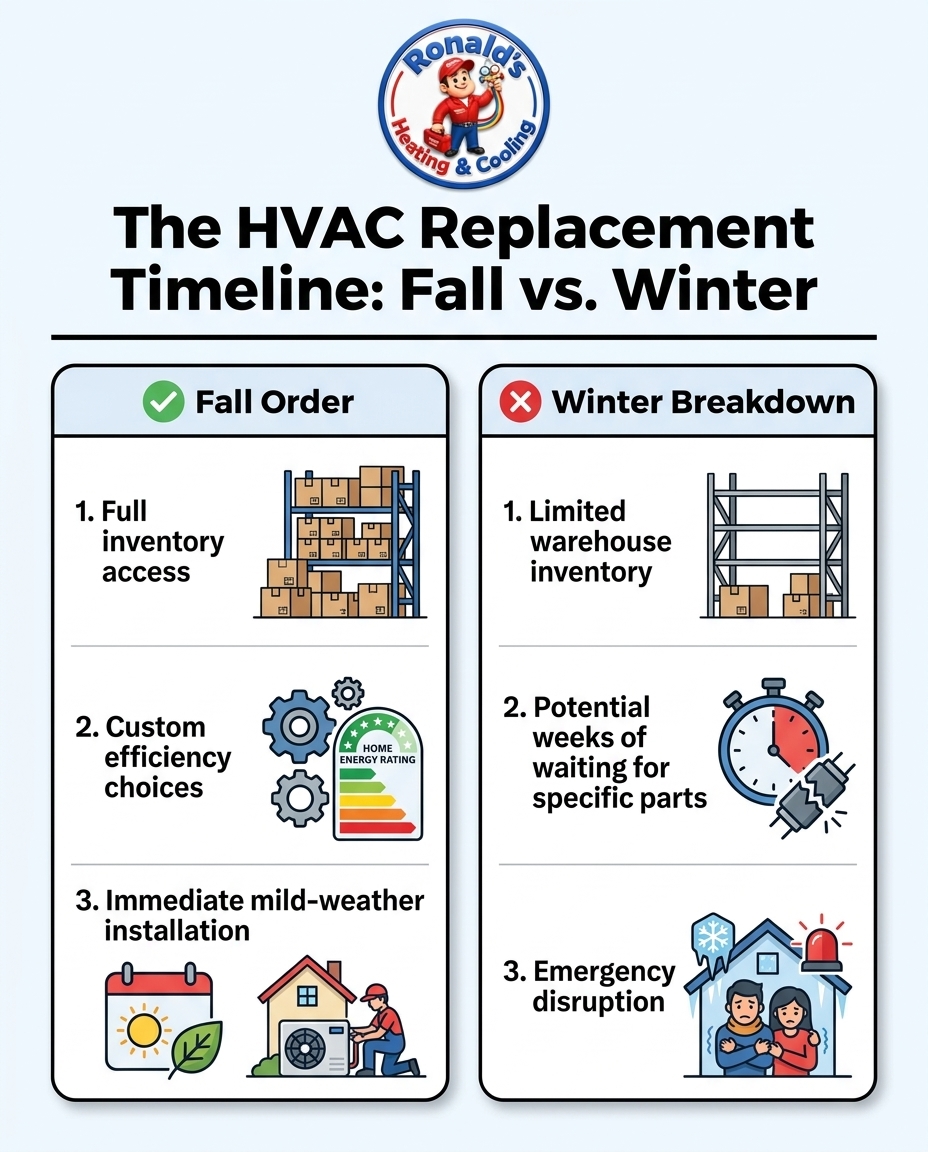
When you wait for a total breakdown in the middle of winter, you forfeit your ability to choose. Emergency replacements are dictated by what is sitting on the shelf that very morning, which often leads to the "leftover inventory" dilemma.
• Equipment Choice — Emergency Winter Replacement: Limited to whatever is left in the local warehouse. — Proactive Fall Installation: Full access to specific makes, models, and features.
• System Sizing — Emergency Winter Replacement: Risk of installing an oversized or undersized "close enough" unit. — Proactive Fall Installation: Precise load calculations for the exact right fit.
• Efficiency Ratings — Emergency Winter Replacement: Often forced to settle for lower-tier baseline efficiency. — Proactive Fall Installation: Ability to select high-efficiency models that lower bills.
• Installation Pace — Emergency Winter Replacement: Rushed, chaotic, and competing with other emergency calls. — Proactive Fall Installation: Calm, scheduled, and minimally disruptive to your home.
Settling for What's Available
If your ideal furnace is on a three-week backorder during a freeze, you will likely have to settle for a leftover unit just to get the heat back on. This often means installing mismatched equipment or a system with lower efficiency ratings than you originally wanted. Installing an improperly sized unit—just because it was the only one in stock—carries a heavy long-term energy cost. An oversized system will short-cycle, wearing out parts prematurely, while an undersized system will run constantly, driving your utility bills through the roof.
Securing the Right High-Efficiency System
Ordering early allows professionals to perform proper load calculations, taking into account your home's square footage, insulation, and window placement. This ensures you secure the exact right high-efficiency system. We believe in providing a transparent, consultative explanation of inventory realities, empowering you to choose without high-pressure scare tactics. Taking your time in the fall also allows you to explore units that may qualify for general energy rebates or federal tax credits, maximizing your investment. Furthermore, you have the breathing room to review flexible HVAC financing options that make proactive, high-quality choices much easier on your household budget.
The Strategic Advantage of a Proactive Fall Installation
Choosing to replace your system in the early fall provides a brief, golden window of mild weather that is absolutely perfect for scheduling a major home upgrade. The strategic advantage of acting now cannot be overstated.
Immediate Availability of Premium Equipment
Supply chains often stabilize briefly in the early fall. The summer cooling rush has ended, and the winter heating panic has not yet begun. This lull gives distributors time to restock their shelves. By ordering in September, you highlight your ability to secure exact makes, models, and premium features without delay. Just last season, our crew at Ronald's Heating & Cooling helped a local customer take advantage of this exact window when their HVAC system was severely malfunctioning during the fall season. By reaching out before the weather turned cold, they were able to have their entire system replaced seamlessly, ensuring everything worked perfectly with zero issues before winter arrived.
Seamless Scheduling Before the Freeze
Contractor availability is significantly higher before the traditional surge of no-heat calls begins. Mild autumn temperatures make the installation process far less disruptive to your household—you won't be freezing in your living room while the technicians have the doors open to move equipment. Securing your spot on the schedule now gives you total peace of mind knowing the system is tested, calibrated, and ready before the first freeze. To understand exactly how smooth this process can be, you can review what to expect during a complete one-day HVAC replacement.
Assessing Your Aging Heating System Today
If you are unsure whether your older HVAC system barely survived the summer or if it has a few good years left, a thorough assessment is your best next step. Identifying a struggling system early gives you the runway to make smart decisions.
Signs Your System Won't Survive Winter
You don't have to be an HVAC technician to spot the warning signs of impending failure. Keep an eye out for these common indicators:
• Unusual, loud noises: Grinding, squealing, or banging sounds often point to failing internal motors or cracked components.
• Frequent cycling: If the heater turns on and off constantly without actually warming the house, the system is overworking and failing to distribute air properly.
• Poor airflow: Weak air coming from the vents usually means a failing blower motor or severe duct issues.
• Rising energy bills: A sudden spike in your utility costs, despite using the system normally, indicates a massive drop in efficiency.
If you notice any of these symptoms, it is time to call our team at Ronald's Heating & Cooling for an honest, pressure-free assessment of your equipment.
Bridging the Gap with Preventative Care
If your system shows signs of wear but does not require a full replacement just yet, professional upkeep is absolutely critical to prevent a winter failure. A comprehensive tune-up can significantly extend the lifespan of an aging unit by cleaning dirty sensors, lubricating moving parts, and catching small electrical issues before they fry the control board. Securing a preventative maintenance plan keeps your aging equipment running optimally while you monitor ongoing supply chain shifts and prepare for a future upgrade.
Frequently Asked Questions About HVAC Equipment Sourcing
Why are HVAC parts on backorder?
HVAC parts are on backorder primarily due to ongoing shifts in manufacturing as the industry adapts to new federal efficiency and refrigerant standards. When assembly lines retool to produce new, compliant models, the production of older legacy parts naturally slows down. Additionally, global logistical bottlenecks continue to affect the raw materials needed for specialized, high-efficiency components.
Is fall a good time to replace an HVAC system?
Yes, fall is widely considered the most strategic time to replace an HVAC system. The mild weather means your home won't become uncomfortably hot or freezing cold while the system is offline for the day. Furthermore, contractor schedules are generally more flexible, and local supply houses tend to have better inventory levels before the winter emergency rush begins.
How long does it take to get a replacement furnace?
The timeline for getting a replacement furnace depends heavily on the season and the specific model you need. During the mild fall months, standard and even high-efficiency models can often be sourced and installed within a few days. However, if you wait until a winter freeze when demand spikes, specific backordered models can take several weeks to arrive.
Are there still HVAC supply chain issues?
Yes, the HVAC industry continues to experience fluctuating supply chain issues, though they are more localized and specific to certain models than in previous years. The transition to new SEER2 efficiency ratings and updated refrigerants keeps manufacturing output highly focused on new compliance, occasionally leaving gaps in the availability of custom sizes and legacy replacement parts.
What is the best month to buy a new HVAC system?
September and October are generally the best months to buy a new heating system. Purchasing during the early fall pre-heating season ensures you have access to a wide selection of equipment without the pressure of an immediate breakdown. It also allows you to take advantage of off-peak scheduling before the first major cold snap fills up contractor calendars.
Can I upgrade to a high-efficiency system if I wait until winter?
You can certainly attempt to upgrade to a high-efficiency system in the winter, but your options may be severely limited by what is currently sitting in the local warehouse. High-efficiency units are often the first to sell out during a severe cold weather event, and ordering a custom unit mid-winter could leave you waiting weeks without central heat while it ships.
Make an Informed Decision Before the Winter Rush
Navigating modern supply chain delays is ultimately about timing and making proactive choices. Waiting for your aging heater to fail on the coldest night of the year strips away your ability to choose the best system for your home and forces you to settle for whatever is left in stock. By acting during the September pre-heating season, you guarantee access to the exact, high-efficiency equipment your home deserves.
Ordering in early fall is the safest, most reliable way to ensure a smooth installation without long, uncomfortable delays. Don't let a sudden winter nor'easter dictate your home comfort. Schedule an inspection or a consultation today to review your options, explore a heating replacement in Virginia Beach, and secure your peace of mind long before the winter rush begins.
