





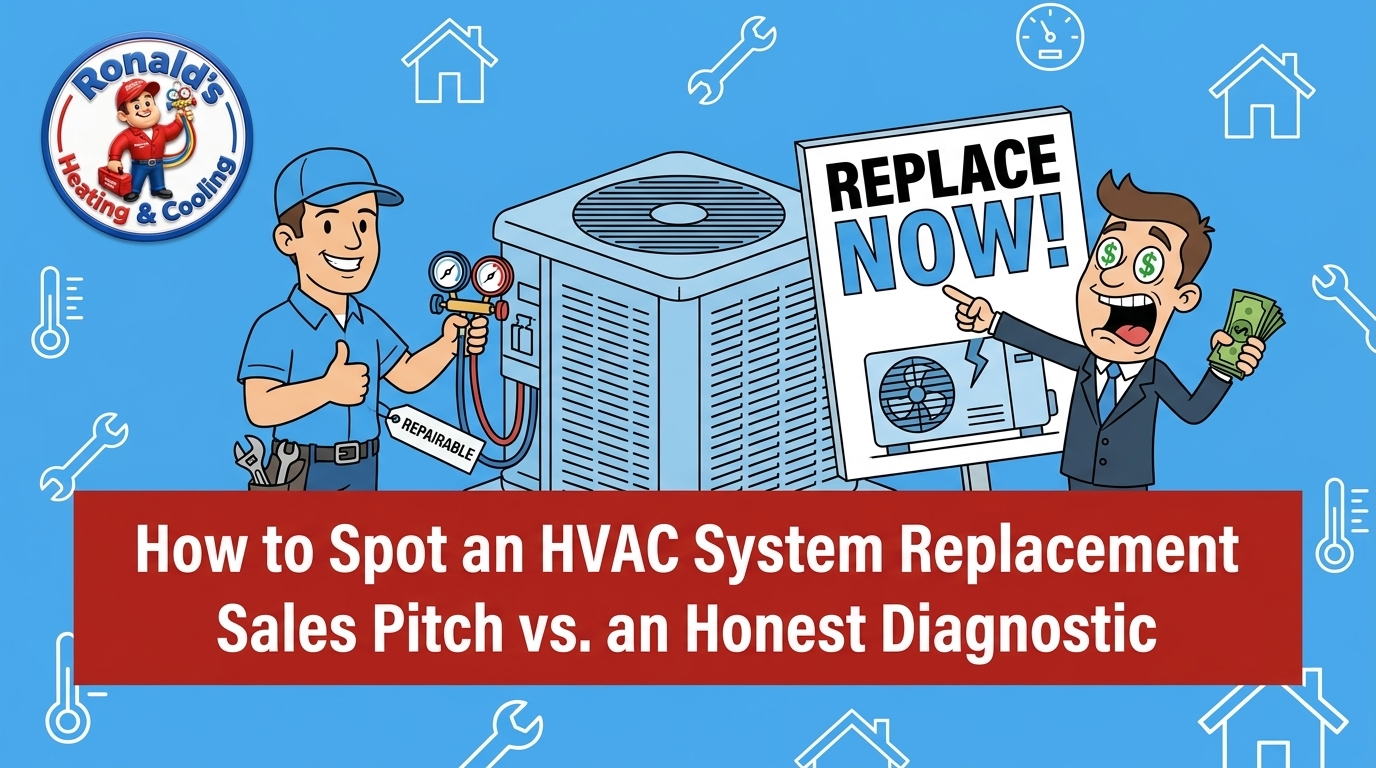
The Mid-October Heating Startup: Don't Panic Over a Burning Smell
A burning smell coming from your vents doesn't automatically mean your house is in danger—or that your entire system is failing. If you are searching for home maintenance tips and troubleshooting advice right now, you are likely staring at your thermostat with a sense of dread. At Ronald's Heating & Cooling, our team typically fields dozens of panicked calls every mid-October when the heating startup triggers a distinct, alarming odor that fills the hallways, leading many homeowners to assume the absolute worst about their equipment.
After months of relying on your system for cooling, transitioning to heat can produce unexpected results. While you might be familiar with standard air conditioning services, a heating startup requires a different troubleshooting approach. That initial burning smell is one of the most common reasons homeowners panic and call for emergency repairs. Unfortunately, this very normal seasonal occurrence is also the exact moment when unscrupulous contractors push unnecessary, high-pressure sales pitches.
Understanding what happens inside your heating system during the fall transition is your best defense. When your furnace or heat pump sits idle throughout the long summer, dust, pet dander, and airborne particles settle directly onto the heating elements and heat exchangers. The moment you switch the thermostat to "heat" for the first time, those settled particles instantly incinerate. The resulting odor is simply the system clearing its throat, so to speak.
The critical decision point: You need to know whether to shut off the system immediately to prevent a hazard, or simply open a few windows and let the normal seasonal dust burn off. Knowing the difference between harmless dust and a failing motor protects you from panic, keeps your family safe, and shields you from predatory technicians who use fear to sell equipment you don't actually need.
Normal Coastal Dust Burn-Off vs. True Mechanical Hazards
Distinguishing between a harmless seasonal symptom and a legitimate mechanical failure requires knowing exactly what to look for—and what to smell. In our years serving the Virginia Beach area, we've found that our unique coastal climate can slightly exaggerate these symptoms, which makes understanding the baseline even more important for your peace of mind.
Why Coastal Humidity Changes the Startup Smell
If you live in the Virginia Beach coastal environment, your HVAC system works under specific atmospheric conditions that change how it behaves in the fall. High summer humidity combined with coastal salt air creates a slightly "sticky" residue on internal components. Instead of dry dust settling lightly on the heating strips or heat exchanger, the moisture and salt cause a thicker, more stubborn layer of particles to accumulate.
Because this coastal residue is denser than the dry dust found in inland climates, the resulting burn-off is often more pungent. It can smell stronger, produce a slightly hazy look near the vents, and linger a bit longer than you might expect. However, despite the intensity, this is still a completely normal part of the seasonal transition.
Red Flags That Indicate Real Danger
While dust burn-off is harmless, there are specific odors and sounds that indicate a genuine electrical or mechanical hazard. If you notice an acrid, plastic-like smell, or the distinct scent of electrical ozone (similar to a burning wire), this is not dust. Furthermore, if the smell is accompanied by unusual grinding, squealing, or screeching noises from the blower motor, you are likely dealing with a failing component.
If you experience these red flags, shut the system down immediately at the thermostat and call a professional. Do not attempt DIY diagnostics on electrical components or gas-fired heat exchangers. If you ultimately need an AC replacement in Virginia Beach or a new heating system, it should be based on verifiable mechanical failure, not a temporary seasonal odor.
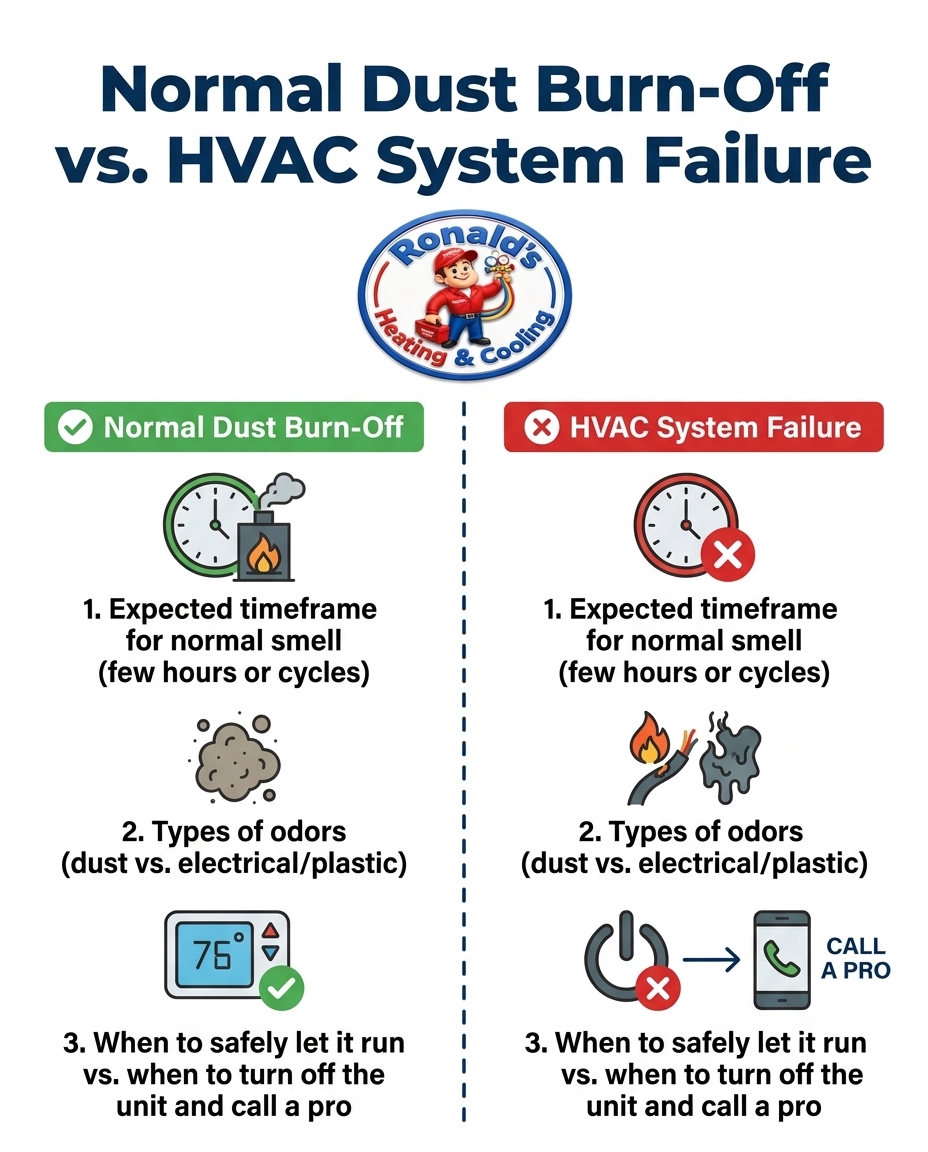
• Type of Odor — Normal Dust Burn-Off: Smells like toasted dust or a slightly musty burning scent. — Mechanical Hazard (Call a Pro): Smells like melting plastic, burning rubber, or electrical ozone.
• Duration — Normal Dust Burn-Off: Fades entirely within 30 minutes to a few hours of operation. — Mechanical Hazard (Call a Pro): Persists continuously or grows stronger the longer the unit runs.
• Accompanying Sounds — Normal Dust Burn-Off: Normal airflow and standard operational clicks. — Mechanical Hazard (Call a Pro): Loud grinding, screeching, banging, or rapid clicking.
• Visual Signs — Normal Dust Burn-Off: None, or very brief, faint haze from the nearest vent. — Mechanical Hazard (Call a Pro): Visible smoke, soot around the unit, or tripped electrical breakers.
Identifying the Predatory HVAC System Replacement Sales Pitch
The anxiety of a mid-October heating startup makes homeowners incredibly vulnerable. Unscrupulous contractors know exactly how to weaponize the normal burning dust smell to push a lucrative system replacement. By the time they arrive, you are already worried about a fire hazard, making you prime for a high-pressure pitch.
The "Scare Tactic" Urgency Play
A predatory technician will almost always use artificial urgency to force a quick decision. They might claim your system is an immediate fire hazard or that a cracked heat exchanger is actively leaking carbon monoxide into your home, demanding that you sign a replacement contract on the spot. Understanding the trustworthy HVAC opinion vs. sales pitch dynamic is your best defense against these tactics.
Skipping the Diagnostic Process
A bad actor is not there to fix your heater; they are there to sell a new one. Because of this, they will often skip the actual diagnostic work. Here is exactly what the predatory process looks like:
• The visual-only inspection: The technician shines a flashlight inside the cabinet, points to some normal surface rust, and declares the unit "unsafe to operate" without hooking up a single testing tool.
• Refusing to show the evidence: If they claim a part is cracked or broken, they refuse to take a photo of the damage or show you the component in question.
• The "obsolete part" excuse: They claim a minor broken part is no longer manufactured, insisting that the entire system must be swapped out today.
• Jumping straight to the clipboard: Rather than explaining what failed and offering a repair estimate, they immediately start drawing up quotes for a complete system overhaul.
The Hallmarks of an Honest, Transparent HVAC Diagnostic
In stark contrast to the scare tactics of a bad actor, a professional evaluation is methodical, transparent, and educational. An honest technician operates as an investigator, not a salesperson. At Ronald's Heating & Cooling, we believe in providing transparent, honest diagnostics without high-pressure sales tactics or hidden fees. You should always expect a clear explanation of the facts.
Thorough Testing Over Guesswork
A legitimate diagnostic evaluation relies on hard data. The technician will systematically test the components of your heating system to isolate the exact cause of the problem.
1. Electrical verification: The technician will use a multimeter to check the voltage and amperage draw on the blower motor, capacitor, and heating elements to ensure they are operating within the manufacturer's specifications.
2. Airflow and pressure testing: Using a manometer, they will check the static pressure of your ductwork to ensure the system is breathing properly and not overheating due to a clogged filter or restricted vents.
3. Safety switch inspection: They will manually test the high-limit switches and flame sensors to verify that the system's built-in safety mechanisms are functioning correctly.
4. Visual confirmation with technology: If a cracked heat exchanger is suspected, an honest technician will use a combustion analyzer and a specialized inspection camera to show you the exact location of the failure on a screen.
Providing Options Rather Than Ultimatums
Once the testing is complete, a professional will explain the findings in plain, jargon-free language. They will present a clear breakdown of repair costs versus the long-term viability of the current system. If the data shows that heating replacement services are truly necessary, the technician will explain exactly why, often referencing proper sizing evaluations like Manual J calculations, rather than just demanding a signature.
Why Second Opinions Matter: Avoiding Premature Replacements
When a technician condemns your entire HVAC system and hits you with a massive replacement quote, the best thing you can do is take a breath and seek a second opinion. A condemned system is not always truly unfixable. Frequently, minor issues are misrepresented as fatal flaws by contractors looking for an easy sale.
Consider a situation our team encountered during a recent cold winter storm. One local Virginia Beach homeowner was told by their previous provider that their HVAC equipment was entirely outdated and required a full replacement immediately. The situation felt incredibly urgent, and the sales pressure was high. However, after pausing to get a second opinion, our technicians discovered the real issue: a missing, relatively small part was preventing the furnace from firing up. Once that single component was installed, the system worked perfectly, completely avoiding an expensive, unnecessary full replacement.
This happens more often than most homeowners realize. A disconnected wire, a dirty flame sensor, or a failed capacitor can cause a system to shut down completely. To the untrained eye, the heater is "dead." To a predatory salesperson, it is an opportunity. To an honest technician, it is a simple repair. Never let the anxiety of a mid-October heating startup rush you into a major financial commitment without verifying the diagnosis first.
The Repair vs. Replace Decision Framework
If your system is experiencing legitimate mechanical issues beyond normal seasonal dust burn-off, you need an objective way to decide whether to repair or replace it. Removing emotion from the equation helps you make the best financial decision for your home.
Evaluating System Age and Coastal Wear
Age is a primary factor, but it must be weighed against your specific environment. In the Virginia Beach coastal environment, systems often face accelerated wear. Constant exposure to salt air can cause galvanic corrosion on outdoor condenser coils and electrical contacts. When evaluating your system, you must distinguish between superficial surface rust on the cabinet and severe, deep corrosion on critical internal components.
• The 50% Rule: A reliable industry benchmark is to compare the cost of the proposed repair against the cost of a brand-new system. If the repair estimate exceeds 50% of the cost of a replacement, investing in new, highly efficient equipment is generally the wiser financial move.
• Decreasing Efficiency: If your energy bills have been steadily climbing over the past three winters despite regular maintenance, the system is losing its efficiency. A repair might fix the immediate breakdown, but it will not restore the unit's original energy performance.
Weighing the Frequency of Repairs
Assess whether your system is experiencing cascading failures. If you have had to call a technician out two or three times in the last couple of years for different failing parts, the system is likely reaching the end of its lifespan. The cumulative stress of constant breakdowns, combined with the unreliability of an aging unit, often outweighs the perceived savings of patching it up one more time.
When the data clearly points to a replacement, it does not have to be a financial disaster. Access to flexible HVAC financing options can make the transition manageable, allowing you to upgrade to a safer, more efficient system without immediate financial strain.
Frequently Asked Questions About Heating Startup Symptoms
How long should a heater smell like burning dust?
A normal dust burn-off smell should typically fade within 30 minutes to a few hours of the system running. The exact duration depends on how much dust settled on the heating elements during the summer months. If you open a few windows to let the air circulate, the odor should dissipate quickly. If the smell persists for days, it is time to call a professional for an inspection.
How do I know if my heater is burning dust or breaking down?
You can usually tell by the specific scent and the accompanying sounds. Dust burn-off smells like warm, toasted lint and operates quietly. A breaking down system will often produce an acrid, plastic, or electrical burning smell. Additionally, if you hear loud grinding, squealing, or continuous clicking, the system is experiencing a mechanical failure rather than a normal seasonal startup.
Is a burning smell from the heater dangerous?
If the smell is simply dust burning off the heat exchanger, it is not dangerous and is a normal part of the fall transition. However, if the smell is caused by melting electrical wires, an overheating blower motor, or a cracked heat exchanger, it can present a serious fire or carbon monoxide hazard. When in doubt, turn the system off and have a certified technician perform a diagnostic check.
Can a dirty furnace or heat pump cause a fire?
While rare, extreme neglect can increase the risk of fire hazards. If a furnace is completely clogged with debris, pet hair, and dirt, it can restrict airflow, causing the system to overheat and trip its safety limits continuously. Regular proactive maintenance cleans these components, ensuring they operate safely and efficiently without overheating.
What should I do if an HVAC technician pressures me to replace my system immediately?
You should firmly decline to sign anything on the spot and immediately seek a second opinion. High-pressure tactics, artificial urgency, and a refusal to clearly explain the diagnostic data are major red flags. A trustworthy technician will always provide you with written options, explain the exact nature of the failure, and give you time to make an informed decision.
Secure a Trustworthy Evaluation for Your HVAC System
Understanding the normal symptoms of a fall startup empowers you as a homeowner. When you know that a brief burning smell is just standard dust burn-off in the Virginia Beach coastal environment, you can confidently let your system run without panic. More importantly, this knowledge protects you from contractors who rely on your anxiety to push unnecessary sales.
The best way to eliminate startup anxiety entirely is through proactive fall maintenance. A professional tune-up cleans the heating elements before the system is turned on, preventing the burning smell from happening in the first place. If you are ever in doubt about your system's safety, or if you need a second opinion on a previous contractor's quote, seek out an honest, transparent diagnostic evaluation. With the right home maintenance tips and troubleshooting guidance, you can keep your home comfortable and safe all winter long.
