





Inheriting an Unknown HVAC System During the Fall Transition
You just unpacked the last box in your new home, but a lingering worry remains: you have no idea if the existing heating and cooling equipment will actually survive the winter. At Ronald's Heating & Cooling, we know that when you are searching for The First-Time Homebuyer's Guide to Assessing an Inherited HVAC System, the biggest hurdle is usually the fear of the unknown. Moving into a new property brings plenty of excitement, but inheriting an unfamiliar mechanical system often creates underlying anxiety. The shift from summer cooling to fall heating requires confidence that the equipment is ready for the temperature drop.
To establish a clear baseline for your new property, setting up an HVAC maintenance plan is one of the smartest steps you can take. Identifying potential issues early prevents unexpected emergency breakdowns when the first cold front hits.
The Challenge of the September Shift
The September pre-heating transition is a critical window for any homeowner. The days might still hold onto summer warmth, but the nights rapidly cool down, forcing your equipment to switch operational modes. If the previous owner neglected the system all summer, the sudden demand for heat can push worn-out components past their breaking point.
Establishing a baseline understanding of the equipment helps you make informed decisions about future upkeep. You do not need to be a mechanical expert to take ownership of your home's comfort. By performing a few safe, visual checks, you can gather enough information to know exactly what you inherited and whether you need to call in a professional before the freezing weather arrives.
Why a Standard Home Inspection Isn't a Complete HVAC Evaluation
The problem: Many first-time buyers assume that because their home passed a general inspection, the mechanical systems are in perfect condition. Unfortunately, our team frequently reminds homeowners that a standard home inspector's sign-off is not a guarantee of deep mechanical health.
The cause: General home inspections confirm basic operational status. The inspector will turn the thermostat to "cool," verify that cold air comes out, switch it to "heat," and verify that warm air blows. They look for obvious safety hazards, but they rarely assess the deep mechanical health of the heating system. In fact, most general inspection reports explicitly disclaim liability for the remaining lifespan, internal wear and tear, or hidden degradation of complex mechanical equipment.
The solution: A visual-only assessment by you, the homeowner, is the first step toward understanding what the inspector might have glossed over. Determining the system's true condition dictates whether an immediate professional evaluation is necessary.
Home Inspector vs. HVAC Professional
Understanding the difference between these two evaluations helps you see the gaps in a standard home purchase report:
• Operational Testing — General Home Inspector: Turns system on and off at the thermostat. — HVAC Professional Baseline: Tests electrical loads, amp draws, and motor function.
• Internal Inspection — General Home Inspector: Visual check of the exterior casing only. — HVAC Professional Baseline: Inspects heat exchangers, blower wheels, and evaporator coils.
• Safety & Efficiency — General Home Inspector: Notes obvious, visible hazards (e.g., exposed wires). — HVAC Professional Baseline: Checks refrigerant levels, gas pressures, and carbon monoxide risks.
• Lifespan Prediction — General Home Inspector: Usually disclaims remaining lifespan entirely. — HVAC Professional Baseline: Provides a transparent assessment of wear and expected longevity.
How to Find the Manufacture Date on Your New Home's Equipment
The age of the equipment is the most critical factor in anticipating future reliability and efficiency. Average lifespans dictate that systems over 10 to 15 years old require much closer monitoring during seasonal transitions. Finding out exactly how old your system is requires a quick trip outside.
Steps to Locate and Read the Data Plate
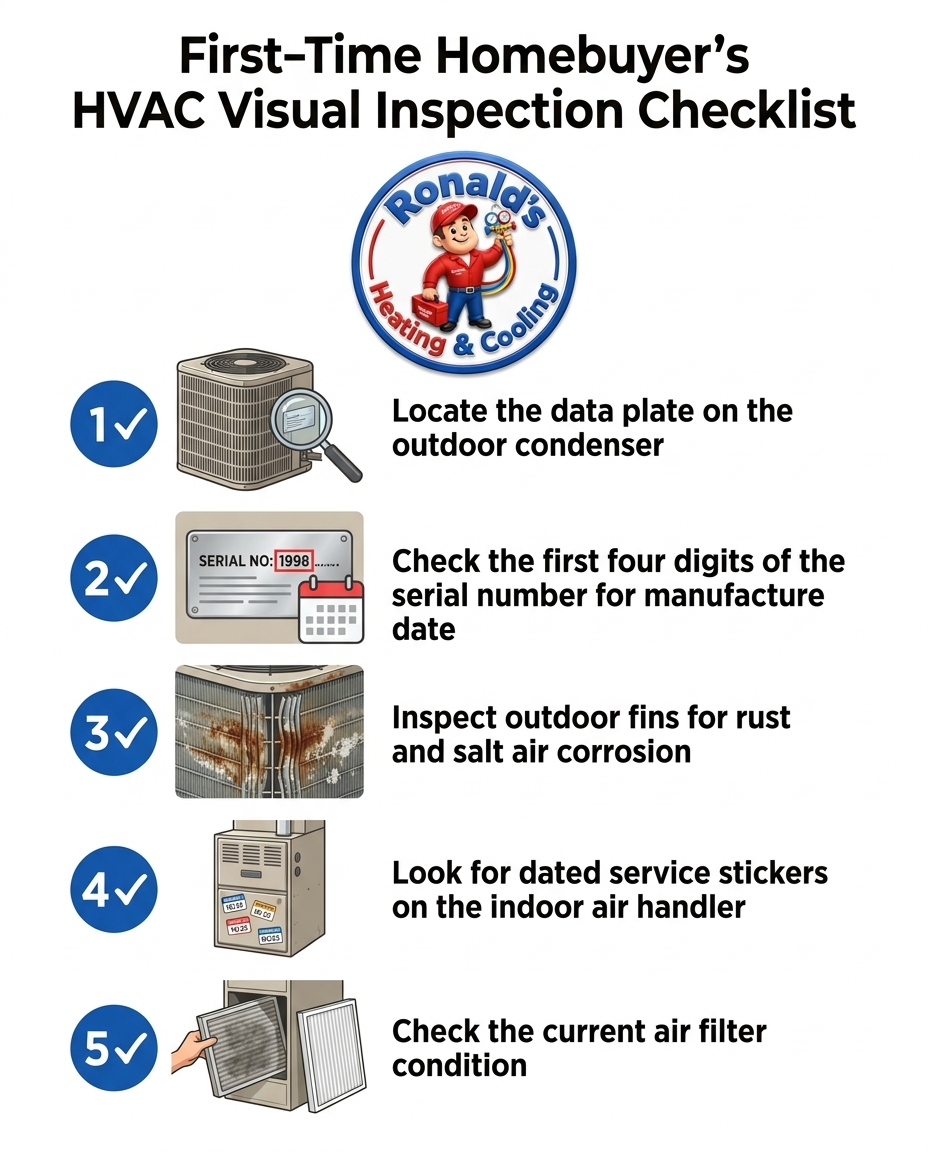
1. Locate the outdoor unit: Walk outside to your outdoor condenser unit (the large metal box with the fan on top).
2. Find the metal data plate: Look on the side or the back of the cabinet near where the refrigerant lines enter the unit. You will see a sticker or a riveted metal plate containing small text and barcodes.
3. Search for a printed date: Look for a clearly printed manufacture date on the condenser data plate. It is usually stamped on the top right or bottom of the plate, listed as a month and year (e.g., "MFR DATE: 08/2015").
4. Decode the serial number: If the date is not explicitly listed, you can often find it encoded in the serial number. For many major brands, the first four digits of the serial number represent the week and year, or the month and year of production.
5. Document your findings: Snap a clear photo of the data plate with your smartphone. You will want this information handy if you ever need to order parts or schedule a service call.
Knowing the exact age of your equipment helps you set realistic expectations. An older unit might still have life left in it, but it will certainly benefit from a proactive tune-up before winter.
Spotting Signs of Neglect and Coastal Weather Wear
Visual inspections should be strictly external. Never open sealed panels, remove safety covers, or attempt DIY electrical checks. Your goal is simply to observe the physical condition of the equipment to identify signs of degradation.
In our years of servicing homes across Virginia Beach, our team has seen firsthand how our unique environmental challenges affect outdoor equipment. Coastal salt air and lingering fall humidity can rapidly accelerate corrosion on outdoor units compared to inland averages. Heavy external wear often correlates directly with neglected internal maintenance.
External Warning Signs to Look For
• Heavy rust and corrosion: Examine the outdoor condenser for heavy rust or pitting on the metal casing. Salt air aggressively attacks the delicate aluminum fins that wrap around the unit. If the fins are crumbling or heavily oxidized, the system will struggle to transfer heat efficiently.
• Overgrown vegetation: Check for bushes, tall grass, or weeds crowding the outdoor unit. Condensers need at least two feet of clear space on all sides to pull in air. Debris or dirt packed into the external coils restricts airflow and forces the compressor to work overtime.
• Indoor water stains: Inspect the exterior of your indoor air handler or furnace. Look for water stains, rust spots, or signs of past condensation leaks around the base of the unit. These marks often indicate a history of clogged drain lines.
• Sinking concrete pads: Look at the base beneath the outdoor condenser. If the pad has shifted, settled, or sunk into the mud, the unit may be sitting at a severe angle, which can damage the internal compressor over time.
Decoding Past Service Stickers and Maintenance Records
The previous owner's maintenance habits will directly impact your comfort this winter. You can often piece together the system's history by looking for clues left behind by local technicians.
Gathering this history helps set expectations before the heavy winter workload begins. Here is a quick checklist to help you decode the past upkeep of your inherited system:
• Check for dated service stickers: Look on the front of the indoor air handler, furnace, or ductwork. Technicians usually leave a dated sticker after completing a tune-up.
• Look for consistency: A consistent log of spring and fall tune-ups indicates the previous owner prioritized preventative care and took the equipment's health seriously.
• Note missing or outdated records: Missing stickers entirely, or dates that are several years old, suggest a high likelihood of deferred maintenance.
• Pull the current air filter: This provides immediate insight into recent habits. A heavily clogged, gray, or bowing filter is a massive red flag for recent neglect. If the previous owner did not bother to change a simple filter before selling the house, they likely skipped more complex maintenance tasks as well.
Evaluating Your Home's Indoor Air Quality and Airflow
An inherited system does not just heat and cool the house; it dictates the respiratory environment of your entire new home. The physical condition of the equipment is directly connected to the actual comfort and air quality you experience in every room.
Addressing these issues early in the fall prevents indoor air quality problems from compounding when you finally seal the windows tight for winter. The ductwork in your new home holds the history of the previous occupants, including dust, pet dander, and trapped moisture.
Symptoms of Poor Airflow and Air Quality
Pay close attention to how the house feels and smells when the system kicks on for the first time:
• Musty odors: A damp, dirty sock smell when the blower activates can indicate lingering moisture or microbial growth in the ductwork or on the evaporator coil.
• Uneven temperatures: If the master bedroom is freezing while the living room is stuffy, this often points to underlying airflow restrictions, disconnected ductwork, or neglected blower components.
• Excessive dust accumulation: If you find yourself dusting your new home every other day, the system may be pulling unconditioned, dirty air from the attic or crawlspace through leaky ducts.
Understanding System Sizing for Your New Space
One of the most overlooked aspects of inheriting an HVAC system is verifying whether the equipment is actually the right size for the house. Previous owners may have installed equipment that was improperly sized for the home's square footage, or they may have made changes to the property without updating the mechanicals.
A pattern we see often is previous owners completing home additions, finishing garages, or undertaking major renovations that easily render the original equipment inadequate. If they added a sunroom but kept the original heating unit, the system is now struggling to condition more space than it was designed to handle.
The Dangers of Improper Sizing
Bigger is not always better when it comes to heating and cooling. An oversized system will short-cycle, blasting the house with air and shutting off rapidly before it has a chance to remove humidity. Conversely, an undersized system will run constantly, driving up your energy bills while still struggling to reach a comfortable temperature on cold nights.
Visual checks cannot determine if a system is sized correctly. Professional Manual J load calculations are the only way to verify if the inherited system is mathematically appropriate for the thermal envelope of your new space.
Seeking a Transparent Baseline Assessment Before Winter
Once your visual checks are complete, an older, undocumented, or visibly worn system warrants a professional baseline evaluation. Many new homeowners hesitate to call a technician because they fear a high-pressure sales pitch demanding a full system replacement.
However, establishing a relationship with a provider who offers a trustworthy HVAC opinion ensures peace of mind as the heating season approaches. You should seek technicians who prioritize accurate, honest diagnostics over immediate replacement pitches. Sometimes a malfunctioning or poorly performing system just needs a specific part replaced or reconnected, not a total overhaul.
For example, our team at Ronald's Heating & Cooling recently helped a local homeowner who experienced a sudden heating failure during a severe winter cold snap. A previous provider had inspected the system, claimed the equipment was outdated, and pushed for a complete replacement. However, our transparent, second-opinion diagnostic revealed that the system was simply failing due to a missing, unhooked part. Once the correct component was ordered and installed, the existing system ran perfectly.
Finding a provider committed to that level of integrity means you get an honest assessment of your inherited equipment, allowing you to plan for the future without unnecessary panic.
Frequently Asked Questions
How do I know how old my inherited HVAC system is?
The most accurate way to check the age is to look at the metal data plate on the side of your outdoor condenser unit. This plate usually features a clearly printed manufacture date (month and year). If the date is not explicitly printed, you can often decode the first four digits of the serial number to find the production month and year.
Should I get my HVAC serviced immediately when I buy a house?
Yes, scheduling a baseline assessment shortly after moving in is highly recommended. A professional tune-up establishes the current health of the system, catches deferred maintenance left by the previous owner, and ensures the equipment is safe to operate. This is especially vital if you are moving in right before a major seasonal transition like winter.
What should a first-time homebuyer look for in an older HVAC system?
You should look for signs of consistent maintenance and physical degradation. Check the indoor unit for dated service stickers, inspect the current air filter to see if it is heavily clogged, and look at the outdoor unit for heavy rust, sinking concrete pads, or overgrown vegetation. These visual clues indicate how well the previous owner cared for the system.
How long does a typical central HVAC system last?
A typical central air conditioner or heat pump generally lasts between 10 and 15 years, depending on maintenance and environmental factors. Furnaces often have a slightly longer lifespan, averaging 15 to 20 years. Once your inherited equipment enters these age ranges, it requires closer monitoring and proactive seasonal tune-ups.
How does coastal salt air affect my outdoor condenser unit?
Coastal salt air accelerates the corrosion process on exposed metal components, particularly the delicate aluminum fins on the outdoor condenser. This galvanic corrosion can cause the fins to become brittle, crumble, and block airflow. Because of this environmental wear, coastal units often require more frequent cleanings and protective treatments than inland systems.
What is the difference between a home inspection and an HVAC baseline assessment?
A standard home inspection is a surface-level check where the inspector simply turns the system on and off to verify basic function. An HVAC baseline assessment is a deep, mechanical diagnostic performed by a licensed technician. The technician will test electrical loads, check refrigerant pressures, inspect the heat exchanger, and evaluate the overall safety and efficiency of the equipment.
Taking ownership of an inherited system doesn't have to be overwhelming. By performing these simple visual checks and partnering with a transparent professional for a baseline assessment, you can head into the Virginia Beach winter with total confidence in your home's comfort.
