





Why That First Autumn Chill Makes the Emergency Heat Setting So Tempting
If you are currently decoding the emergency heat setting on your thermostat, you are likely staring at that switch wondering if it is the secret to warming up your house faster. At Ronald's Heating & Cooling, our team fields questions about this exact switch every autumn. The transition out of summer can be abrupt. One day you are running the air conditioning, and the next, you are reaching for a sweater indoors. During those early fall/September cold snaps, it is incredibly common for homeowners to want immediate relief from the chill. The thermostat sits on the wall, offering a setting labeled "Emergency Heat," and human nature suggests that an emergency override will deliver a massive, immediate blast of warmth to make the living room comfortable again.
The concrete problem is that this temptation leads to a critical decision point: do you manually switch to emergency heat to knock the chill off, or do you trust the system's normal heating cycle to do its job? Making the wrong choice here does not actually improve your indoor comfort, but it does lead to massive energy waste and an unpleasant surprise on your next utility bill. Understanding how your thermostat communicates with your equipment is the only way to stay comfortable without paying a premium. If you need professional guidance on your heating system, our team is here to help.
What the Emergency Heat Setting Actually Does to Your System
To understand why this switch is so misunderstood, we have to look at what happens behind the scenes when you activate it. The "Emergency Heat" setting is a manual override that completely bypasses your highly efficient primary heat pump. Instead of allowing the outdoor unit to operate, this setting forces your system to rely entirely on backup electric resistance heat strips located inside your air handler.
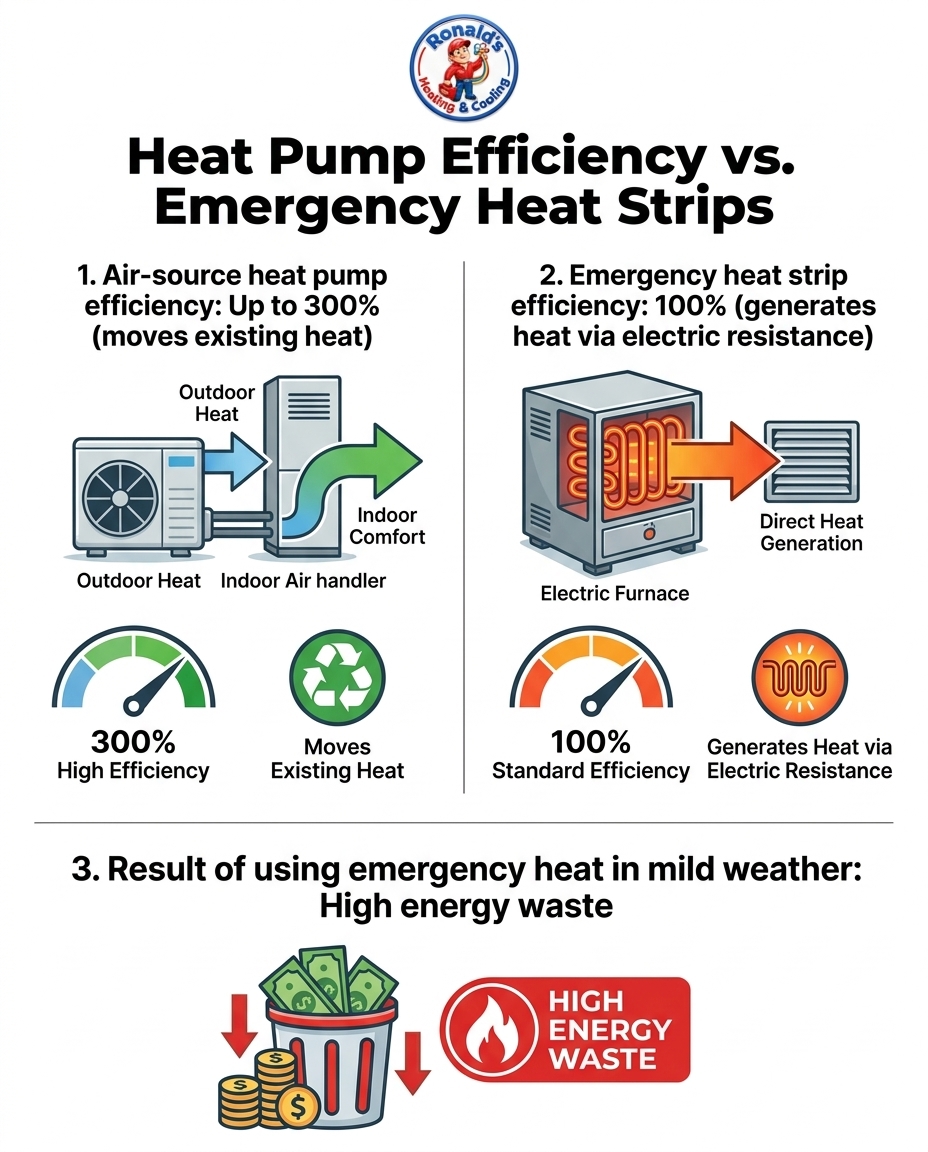
The mechanical difference between these two modes is staggering. Heat transfer is how your heat pump normally operates. It acts like an air conditioner in reverse, absorbing ambient thermal energy from the outside air and moving it indoors. Because it is simply moving existing heat rather than creating it from scratch, an air-source heat pump can deliver up to three times more heat energy than the electrical energy it consumes. In contrast, electric resistance heating operates much like a giant toaster. Electricity is forced through metal coils until they get glowing hot, and a blower fan pushes air over them. This method operates at a strict 100% efficiency—meaning for every unit of electricity you pay for, you get exactly one unit of heat, and nothing more.
In our years of serving coastal Virginia Beach homes, we have found that a properly maintained heat pump is more than capable of keeping the indoor environment perfectly comfortable year-round. The backup strips are designed strictly as a safety net to prevent pipes from freezing if the outdoor unit breaks down, not as a performance booster for everyday comfort. If you are constantly relying on this setting because your main unit is struggling to keep up, we typically see that as a sign you need professional heating repair in Virginia Beach rather than a heavier reliance on backup power.
The Costly Myth of the 'Heat the House Faster' Button
The Problem: The Psychological Need for Immediate Warmth
When the temperature drops suddenly, the psychological temptation to use the emergency setting is strong. You want to "knock the chill off" quickly, and the word "emergency" implies speed and power. Many homeowners assume that by activating this switch, they are turning on both the heat pump and the backup strips simultaneously to flood the house with warm air. This is a myth. You are not combining heat sources; you are actively turning off the most efficient part of your system.
The Cause: Misunderstanding the Coastal Climate Context
Our technicians often see this misunderstanding become particularly costly during early fall/September cold snaps. In the Virginia Beach coastal climate, mild September temperatures typically hover in the 60s. These temperatures are well above the threshold where a modern heat pump would ever struggle to extract heat from the outside air. Your primary heat pump thrives in this exact weather. By manually overriding it, you are forcing the system to use the most expensive, energy-heavy method of heating during a time when the highly efficient heat pump could easily handle the load.
Because electric resistance strips require substantially more electricity to generate heat, leaving the emergency setting on for even a few days can lead to unexpected utility spikes. Homeowners are often shocked when their monthly statement arrives, assuming their rates went up, when in reality, their thermostat habits caused the surge.
The Solution: Trust the System and Maintain the Equipment
Instead of relying on manual overrides to force your system to work harder, we recommend ensuring the equipment is operating at peak efficiency. Regular system upkeep prevents the sluggish performance that makes homeowners reach for the emergency switch in the first place.
• Normal Heat Pump Cycle — How It Works: Transfers existing ambient heat indoors — Efficiency Rating: Up to 300% — Impact on Utility Usage: Low, highly efficient operation
• Emergency Heat Setting — How It Works: Generates heat via electric resistance coils — Efficiency Rating: Strictly 100% — Impact on Utility Usage: High, causes significant energy spikes
If your home feels like it takes too long to warm up on a normal setting, the answer is not to bypass the heat pump. The answer is to have the system inspected. Enrolling in a preventative maintenance plan ensures that your blower motor, refrigerant levels, and thermostat calibration are all optimized so the home heats efficiently without the need for costly backup strips.
The Only Time You Should Actually Switch to Emergency Heat
To protect your equipment and your wallet, the emergency setting should be reframed in your mind as "System Failure Heat." It is not a convenience feature; it is a last resort. There is only one specific, rare scenario when we advise using this setting: when your primary heat pump has completely failed, suffered physical damage, or is entirely locked out due to a severe mechanical breakdown.
If you find yourself in a situation where the outdoor unit is completely unresponsive, follow these steps to protect your home:
1. Verify the failure: Check the outdoor unit. If it is making horrible grinding noises, is completely encased in a solid block of ice that will not defrost, or has been physically damaged by falling debris, the primary system has failed.
2. Switch the thermostat: At this point, turn your thermostat to the emergency heat setting. This locks out the broken outdoor unit, preventing further mechanical damage, and activates the indoor heat strips.
3. Protect your home: The backup strips will provide enough warmth to keep your family safe and prevent your indoor plumbing pipes from freezing while you wait for help.
4. Call for professional service immediately: Because the backup strips use so much power, you do not want to run them any longer than absolutely necessary. Schedule a repair right away.
Just last winter, our team at Ronald's Heating & Cooling responded to a local homeowner who experienced a complete heater failure unexpectedly. Because they needed urgent repair, they called us for help immediately. One of our technicians arrived within an hour, explained the issue, sourced the necessary parts, and completed the repair quickly, ensuring the system was back online in a short amount of time. This is exactly how the process should work. You use the backup heat just long enough to keep the house safe while expert heating services resolve the root problem.
Remember, if your system is functioning normally, you never need to touch this switch. Modern thermostats are incredibly smart. If the outdoor temperature drops so low that the heat pump needs a temporary boost, the thermostat will automatically cycle the auxiliary heat on and off without any manual intervention from you. For most coastal Virginia Beach homes, the system handles these transitions seamlessly.
Getting Honest Answers When Your Heat Pump Fails
When you are forced to use the emergency setting because your primary unit has stopped working, it is completely normal to feel stressed. A sudden heating failure leaves homeowners feeling vulnerable, especially when they need immediate repairs to restore comfort. During these moments, you need clear, factual information about what is happening inside your equipment.
Proper troubleshooting is vital. Sometimes a system that appears to be completely broken is actually suffering from a very minor issue. A blown fuse, a tripped breaker, a clogged filter, or a disconnected wire can all cause the outdoor unit to shut down. This is why a transparent diagnostic process is so important. At Ronald's Heating & Cooling, our technicians always prioritize repairing the existing equipment over replacing it whenever possible.
We see this pattern often. For example, we recently visited a homeowner whose system was not working, and another company had told them it required a full replacement. When our technician arrived to troubleshoot the non-functional system, they simply found an unhooked part. They ordered and installed the small component, and the system was working fine again, completely resolving the issue without a massive replacement project.
This highlights the importance of working with a company that provides transparent, honest advice designed to protect you from utility spikes and unnecessary expenses. You should always seek out professionals who explain the work clearly and show you exactly what has failed, rather than pushing high-pressure sales tactics when a system just needs basic diagnostics. Knowing the difference between a trustworthy HVAC opinion and a sales pitch can save you from replacing a system that only needed a minor adjustment.
If you do have to switch to your backup strips during those early fall/September cold snaps because of a genuine mechanical failure, rest assured that an honest diagnostic process will get your primary heat pump back online as efficiently as possible.
Frequently Asked Questions About Thermostat Heating Controls
When should I use emergency heat on my thermostat?
You should only use the emergency heat setting when your primary heat pump has suffered a complete mechanical failure or physical damage. Never use it simply because the house feels chilly or because you want to speed up the normal heating process. Using this setting manually bypasses your highly efficient outdoor unit and forces your system to rely entirely on energy-heavy backup strips. It is a safety net designed to keep your pipes from freezing while you wait for a repair technician, not a daily comfort feature.
Why does emergency heat use so much electricity?
Emergency heat relies on electric resistance heat strips, which operate at a 1-to-1 efficiency ratio, meaning they generate exactly one unit of heat for every unit of electricity consumed. This is drastically less efficient than a normal heat pump, which moves existing ambient heat from the outdoors into your home rather than generating it from scratch. Because the heat pump can move up to three times more heat energy than it consumes, switching to the resistance strips forces your system to consume significantly more power to achieve the same indoor temperature.
What is the difference between aux heat and emergency heat?
Auxiliary (aux) heat turns on automatically when the heat pump needs a temporary boost during extreme cold, while emergency heat is a manual switch that completely locks out the efficient heat pump. When your thermostat displays "Aux Heat," the system is intelligently running both the heat pump and the backup strips together in short bursts to maintain the temperature. When you manually select "Emergency Heat," you are forcing the backup strips to run continuously while the outdoor unit remains completely shut off.
What happens if I accidentally turn on emergency heat?
If you accidentally turn on the emergency setting, your home will still heat up and maintain the temperature you set, but the system will consume significantly more power to do so. You likely will not notice a difference in how the air feels, but you will notice a massive difference on your next utility bill. If you realize the switch has been flipped by mistake, turn it back to the normal "Heat" setting as soon as you notice to prevent an unusually high power bill. For most coastal Virginia Beach homes, the normal setting is all you ever need.
Will emergency heat warm my house faster during a mild cold snap?
No, emergency heat will not heat the home significantly faster than a properly functioning heat pump during mild weather. It will only result in wasted energy and higher operational costs. During a mild cold snap, there is plenty of ambient heat in the outside air for your primary heat pump to extract and move indoors quickly. If your home is taking too long to warm up on the normal setting, it points to an underlying maintenance issue with the equipment, not a need to use the manual override.
Stay Comfortable This Fall Without the Energy Waste
Leaving the thermostat on its normal heating setting is the smartest, most efficient choice you can make as the seasons change. Understanding how your thermostat communicates with your heat pump protects you from unnecessary energy waste, especially during those unpredictable early fall/September cold snaps. You do not need to rely on expensive backup heat strips just to knock the chill out of the air.
If you suspect your heat pump is not warming the house properly on its normal setting, do not reach for the override switch. Instead, schedule a pre-season inspection to ensure everything is running at peak efficiency. Reach out to our team at Ronald's Heating & Cooling today for honest advice, reliable service, and the peace of mind that your system is ready to handle the cold efficiently.
