





Preparing Your Home for the Fall Humidity Drop
The late September transition is fast approaching, which means it is time to start transitioning your humidifier for fall: when to change the water panel is the most important decision you can make before your furnace kicks into high gear. You might not be running your heating system constantly just yet, but the coastal air is already beginning to lose its heavy summer moisture. Right now, you are standing at a crucial decision point: do you swap out the water panel and prep the humidifier today, or wait until the house feels uncomfortably dry later in the season?
The short answer is that proactive preparation always wins. Whole-home humidifiers work directly in tandem with your central heating system to maintain proper indoor air quality throughout the colder months. At Ronald's Heating & Cooling, our team typically sees a massive spike in service calls for dry air discomfort, static shocks, and system strain the moment temperatures drop in Virginia Beach. Taking care of this simple task before the heavy heating season begins ensures your home remains comfortable from the very first chilly night.
• Summer — HVAC Operation Focus: Removing excess indoor moisture (Dehumidification) — Humidifier Status: Off, bypass damper closed, water supply shut off
• Late September Transition — HVAC Operation Focus: Mixed operation, preparing for heating cycles — Humidifier Status: Prep phase: change panel, open damper, turn on water
• Late Fall / Winter — HVAC Operation Focus: Adding heat, which dries out indoor air — Humidifier Status: Active, running with furnace to add moisture back
The Virginia Beach Climate Shift: Why Timing Matters
Living in the Virginia Beach coastal region means dealing with a very specific type of weather shift. We transition from highly humid, sticky summers to cooler, significantly drier autumns. During early fall, the outdoor humidity can fluctuate wildly from day to day. However, the moment you turn on your heating system, the moisture levels inside your home will plummet rapidly, regardless of what the weather is doing outside.
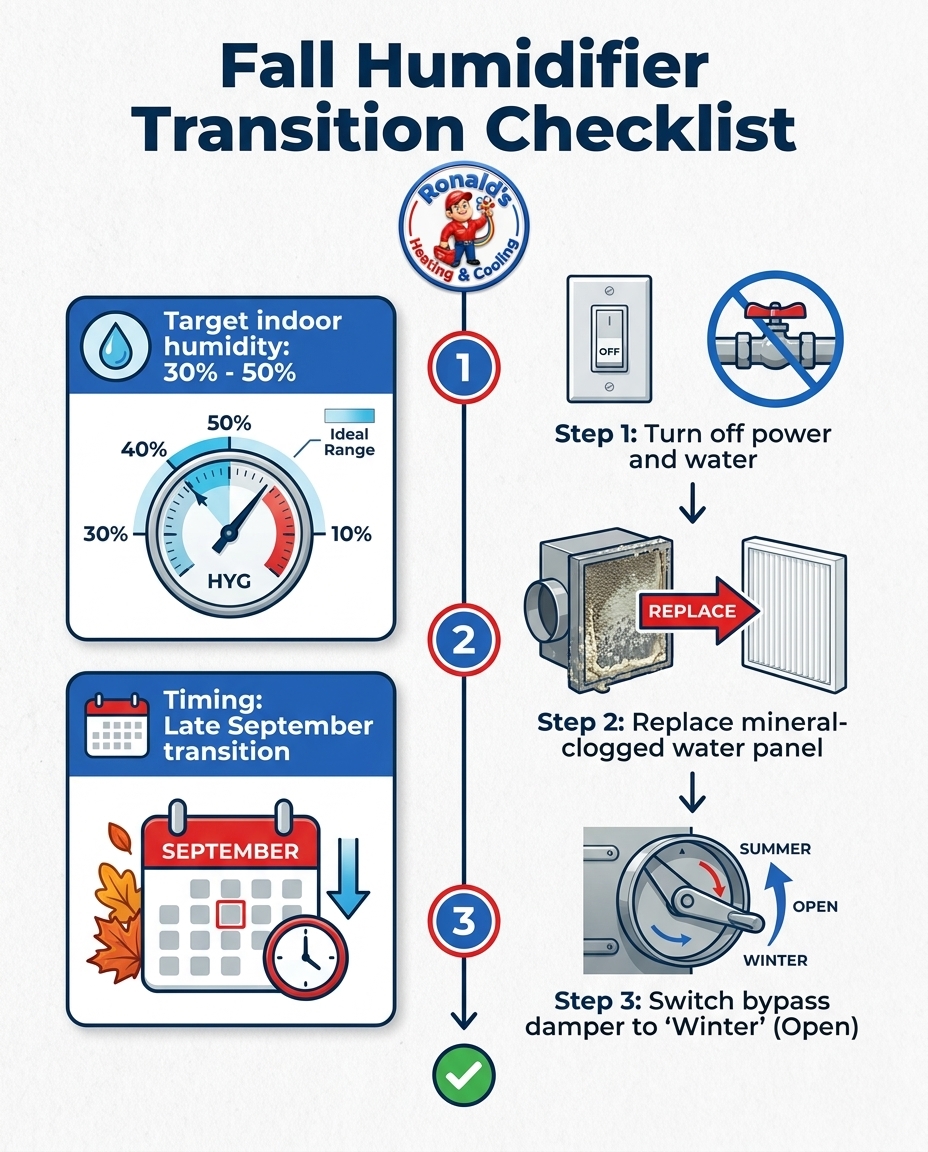
Here is the thing: heating air physically expands it, which lowers its relative humidity. If the air inside your home is 50 degrees with 60% humidity, heating that same air to 70 degrees drops the relative humidity down to a bone-dry 20%. Waiting for the first freezing night to service your whole-home humidifiers is simply too late. By the time the frost hits, your home will already be suffering from a severe lack of moisture. The EPA recommends keeping your indoor humidity in a target range of 30% to 50% year-round. Prepping your system now protects your home from the sudden dry, cold snaps that characterize our coastal autumns.
Signs your home's humidity is dropping too fast:
• Physical discomfort: Dry throat, itchy skin, and irritated nasal passages upon waking up.
• Static electricity: Frequent shocks when touching doorknobs or walking across carpets.
• Wood damage: Hardwood floors, wooden furniture, and door frames beginning to creak, shrink, or crack.
• Temperature perception: The house feels chilly even when the thermostat is set to a normal heating temperature.
Understanding the Role of Your Humidifier Water Panel
Your humidifier water panel, frequently referred to as a humidifier pad, is the heart of your whole-home moisture system. It features a dense, honeycomb-like structure made of aluminum mesh covered in a specialized, water-absorbent clay coating. When your furnace runs, water trickles down over this panel. The hot air from your furnace blows through the wet honeycomb, picking up moisture and distributing it evenly through your home's ductwork.
Over a season of use, the water evaporating off the panel leaves behind calcium, magnesium, and other hard water minerals. These minerals slowly build up, crusting over the honeycomb structure and blocking the tiny holes where air is supposed to flow. A clogged panel severely restricts airflow, which reduces your HVAC efficiency and prevents your home from reaching a comfortable humidity level.
The Hidden Costs of Mineral Buildup
Many homeowners do not realize that a heavily scaled water panel does more than just stop producing moisture. In our years of inspecting HVAC systems across Virginia Beach, a pattern we see often is furnace blower motors working incredibly hard just to push air through a completely blocked, mineral-encrusted panel. This added strain can lead to premature motor wear and higher energy consumption. Furthermore, you cannot simply wash these panels in the sink. Scrubbing or rinsing an old water panel destroys the specialized clay coating that allows it to hold water in the first place. Once the coating is gone, the water simply runs straight down the drain without evaporating into your air, which is why panels must be replaced entirely.
Crucial Step: Adjusting the Bypass Damper for Winter Mode
Changing the water panel is only half the job. You also need to adjust the bypass damper, a crucial step that many homeowners overlook during the fall transition. The bypass damper is a small duct with a lever or knob, usually located right next to the humidifier unit. Its purpose is to direct airflow from your furnace's supply duct, through the humidifier, and back into the return duct.
During the summer, this damper is set to "Summer" or "Closed" so your air conditioner doesn't push cold air through the humidifier. During the fall transition, you must switch this lever to "Winter" or "Open." If you install a brand-new water panel but leave the damper closed, no air will flow through the humidifier, rendering your new panel completely useless. Proper airflow is just as vital to your heating services as the mechanical equipment itself.
At Ronald's Heating & Cooling, we see how easily a single disconnected or improperly set component can derail an entire system. For example, during a recent winter service call, a local homeowner reached out because their heating system had stopped working completely during a cold snap. A previous provider had given up on the unit, telling the customer the equipment was outdated and parts were unavailable. When our technician arrived, they quickly found that a single part was simply unhooked. We ordered the correct replacement, installed it, and had the heat running perfectly again in no time. The bypass damper operates on the exact same principle—if it is "unhooked" from your system's airflow by being left in the closed position, the entire humidification process fails. Flipping that single switch makes all the difference.
Step-by-Step Guide to Changing Your Water Panel
Taking care of your water panel is a safe, straightforward maintenance task. We believe in empowering homeowners with transparent education so you understand exactly how your system works and why each step matters. Here is how to safely swap out your panel during the late September transition.
1. Turn off the power and water: Safety always comes first. Turn off the power switch to your furnace (usually a switch on the side of the unit or at the breaker box). Next, trace the small water line connected to the humidifier and turn the saddle valve clockwise to shut off the water supply. This prevents any accidental starts or water spills while you work.
2. Remove the humidifier cover: Most humidifier covers easily snap off or require loosening a single knob at the top or bottom. Lift the cover away to expose the internal components.
3. Slide out the scale control insert: Inside, you will see a plastic frame holding the water panel. This entire assembly, called the scale control insert, slides right out of the humidifier housing. Pull it out carefully, as it may contain loose, crusty mineral deposits.
4. Remove the old panel and inspect: Snap the top off the plastic frame and slide the old, stiff water panel out. Take a damp cloth and wipe down the inside of the plastic frame and the main humidifier housing to remove any excess mineral dust or scale buildup. Keeping the housing clean prevents debris from clogging the drain line later.
5. Insert the new water panel: Slide the fresh water panel into the plastic frame. Look closely at the new panel—most have a painted mark, a colored dot, or an arrow indicating which side should face up. This orientation is critical because the metal mesh is angled to slow down the water flow. If you put it in upside down, the water will rush through too quickly and go straight down the drain.
6. Reassemble and test: Snap the top of the plastic frame back on, slide the entire assembly back into the humidifier, and secure the outer cover. Turn the water supply back on, then restore power to the furnace. Turn your humidistat up until you hear a "click" to verify the water is flowing, and check around the bottom of the unit for any leaks.
When to Skip the DIY and Call a Professional
While swapping a water panel and flipping a damper are excellent homeowner tasks, our team at Ronald's Heating & Cooling always draws a hard line between safe DIY maintenance and issues that require a licensed professional. Your whole-home humidifier connects to your home's plumbing, electrical, and forced-air systems simultaneously. Attempting repairs on these interconnected systems without proper training can lead to significant water damage, electrical hazards, or a broken furnace during the coldest time of the year.
You should skip the DIY approach and call an expert if you notice any of these warning signs:
• Leaking water lines: If water is pooling around the base of the furnace or dripping from the copper or plastic water supply line, the saddle valve or internal solenoid valve may be failing.
• Frayed or damaged wiring: The low-voltage wires connecting the humidifier to your furnace control board must remain intact. If they look worn, chewed, or disconnected, do not touch them.
• Unresponsive humidistat: If you turn the humidity dial all the way up and hear no click, or if water never begins to flow across the panel, the electrical components need professional diagnosis.
• Clogged drain lines: If the drain tube at the bottom of the humidifier is completely blocked with hard water scale and backing up into the unit.
During the fall transition, there is immense value in scheduling a comprehensive system inspection. Routine check-ups as part of a preventative maintenance plan ensure that your humidifier, thermostat, and furnace all communicate and work together seamlessly. A professional technician will calibrate your humidistat, test the solenoid valve, inspect the water lines for slow leaks, and ensure your system is perfectly tuned for the winter ahead.
Maximizing Comfort and Efficiency All Season Long
Taking a few minutes during the late September transition to prep your humidifier pays massive dividends all winter long. A fresh water panel combined with an open bypass damper forms your primary defense against harsh, dry winter air. Maintaining optimal humidity levels actively protects your expensive wood fixtures, reduces static electricity, and keeps your family's skin and respiratory systems comfortable.
Beyond pure comfort, a well-maintained humidifier actually helps your heating system operate more efficiently. Moist air holds heat much better than dry air. When your indoor humidity is balanced properly, 68 degrees feels significantly warmer than 68 degrees in a bone-dry house. This allows you to feel perfectly cozy at lower thermostat settings, reducing the overall workload on your furnace.
By taking action now, you ensure your home is fully prepared before the heavy heating season begins. Do not wait for the first freezing night to realize your home is uncomfortably dry. Swap that panel, open that damper, and achieve perfect home humidity control so you can enjoy a warm, comfortable, and healthy home environment all season long.
Frequently Asked Questions
When should I change my humidifier water panel for winter?
The late September transition is the ideal time to replace your water panel. Changing it right before the heavy heating season begins ensures your system is ready to add moisture the moment your furnace starts running regularly. Waiting until winter means your home will already be suffering from dry air.
How do I set my humidifier bypass damper for fall?
You should switch your bypass damper lever from the "Summer" (closed) position to the "Winter" (open) position. This crucial step opens the ductwork, allowing hot air from the furnace to flow through the humidifier and pick up moisture. If you leave it closed, the humidifier cannot distribute moisture into your home.
What happens if I don't change my humidifier pad?
If you do not change the pad, hard water minerals will completely clog the honeycomb structure. A clogged pad restricts airflow, forces your furnace blower motor to work much harder, and prevents the humidifier from adding any meaningful moisture to your indoor air.
How often should I replace the water panel during the heating season?
Most manufacturers recommend replacing the water panel at least once a year, typically in the early fall. However, if your home has exceptionally hard water or if your heating system runs constantly, you may need to replace the panel twice a season to maintain proper airflow and moisture output.
Can I clean and reuse my old humidifier water panel?
No, you cannot clean and reuse a standard humidifier water panel. The aluminum mesh is coated in a specialized clay that absorbs and holds water; washing or scrubbing the panel removes this coating. Once the coating is gone, water will simply run down the drain without evaporating into your air.
Now is the time to prepare your home for the colder months ahead. Transitioning your humidifier for fall and knowing when to change the water panel prevents dry-air headaches before they start. If you are unsure about your system's condition or need a professional tune-up, schedule your fall maintenance with Ronald's Heating & Cooling today so you can enjoy a perfectly comfortable home all winter long.
