





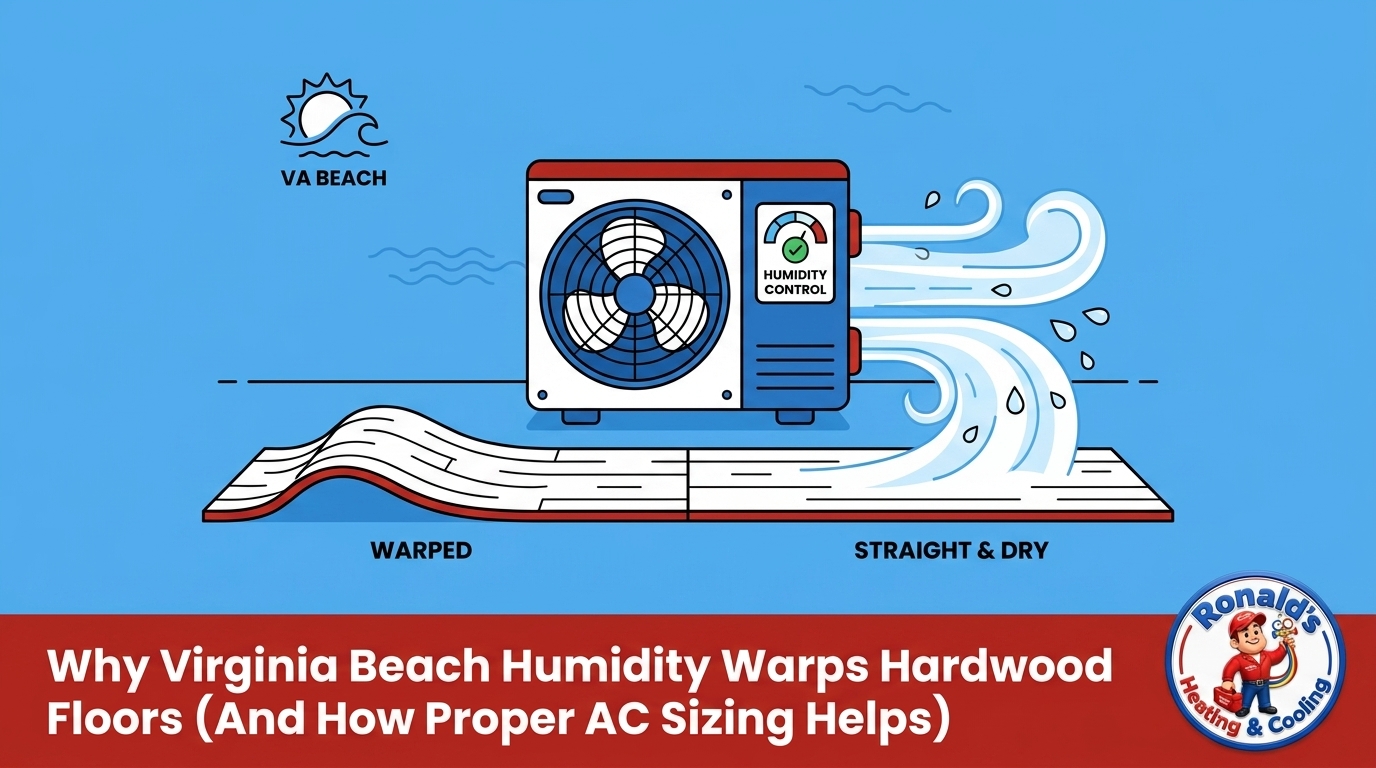
The Hidden Link Between Cupping Hardwood and Your HVAC System
In our years serving local homeowners, our team has seen countless living rooms where the wood floorboards feel wavy under bare feet. The thermostat says it is perfectly cool inside, but the air still feels thick, heavy, and uncomfortable. The impact of Virginia Beach humidity on hardwood floors and how your AC helps is a critical connection that many homeowners completely overlook when trying to solve this expensive problem. When the late-summer August heat sets in and families are busy with the back-to-school transition, that sticky indoor air is doing more than just making you sweat—it is actively altering the structural integrity of your home.
If you are struggling with poor indoor comfort, learning about modern air conditioning systems or exploring options for AC replacement in Virginia Beach can protect both your home and your health.
The misdiagnosis trap: We frequently get calls from homeowners who notice their hardwood floors buckling or cupping and immediately assume the worst about their plumbing. They tear into drywall looking for a hidden pipe leak, or they call the original flooring contractor to complain about poor installation. While water leaks certainly cause localized wood damage, a pattern we see often is that widespread waving across an entire room points to an environmental issue. The root cause in our coastal climate is frequently airborne moisture that has nowhere else to go.
Understanding the HVAC connection: Fixing warped hardwood floors requires first diagnosing the HVAC system—a step our technicians prioritize on every humidity-related service call. This is the critical first step to preventing permanent, irreversible damage to your property. An improperly operating AC fails to remove indoor humidity, leaving porous materials—like your expensive oak, hickory, or maple planks—to act as massive sponges that absorb the excess moisture floating in the air.
The role of your cooling system: Your air conditioner is designed to do two jobs simultaneously: lower the temperature and remove moisture. When it fails at the second job, the resulting dampness settles into the lowest points of your home. Because wood is a hygroscopic material, it naturally expands when exposed to moisture and contracts when it dries. Without a properly functioning HVAC system to wring that moisture out of the indoor air, your flooring bears the brunt of the coastal climate.
How Coastal Vapor Pressure Invades Your Home Environment
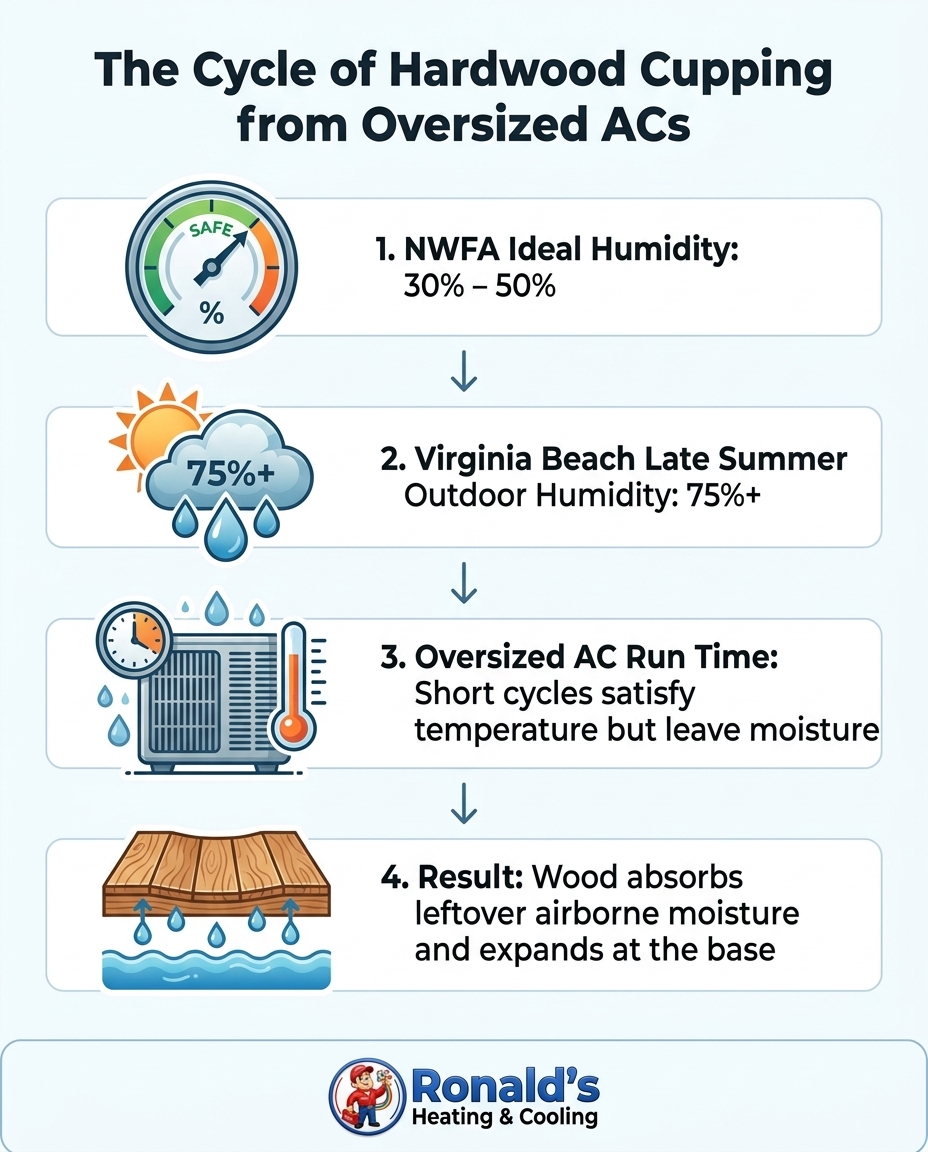
As local HVAC professionals, we know firsthand that Virginia Beach coastal properties frequently experience outdoor relative humidity levels exceeding 75% in late summer. This intense weather pattern creates a sustained, heavy moisture load that presses against the exterior of your house. It is not just about the air feeling muggy; it is about the physical science of how water vapor behaves when it encounters a conditioned indoor space.
The science of vapor pressure: Vapor pressure is a thermodynamic force that pushes moisture from areas of high concentration to areas of low concentration. When it is incredibly humid outside and cool inside, that pressure forces water vapor through building materials, crawlspaces, gaps around windows, and tiny air leaks in your siding. The moisture relentlessly seeks equilibrium, meaning the damp outdoor air is constantly trying to invade your dry indoor air.
Industry standards for protection: The National Wood Flooring Association (NWFA) recommends maintaining indoor relative humidity between 30% and 50%. This is the ideal range where wood planks remain stable. When indoor humidity exceeds 50% for prolonged periods, the environment becomes hostile to natural wood.
The absorption process: As the coastal vapor pressure forces moisture inside, untreated indoor air becomes saturated. The wood planks absorb this moisture primarily at their unsealed bases and edges. As the bottom of the board swells with water, it expands outward. Because the boards are packed tightly together, they have nowhere to go but up, causing the edges to push upward in a distinct "U" shape.
The Anatomy of a Cupped Floorboard
Understanding exactly how wood reacts to moisture helps you identify whether the problem is coming from the air or from a direct water spill. Porous wood acts as a sponge for untreated indoor air, but it changes shape depending on where the moisture originates.
• Cupping — Visual Appearance: Edges of the plank are higher than the center (U-shape). — Primary Cause: Excess moisture at the bottom of the board, usually from high indoor humidity or damp crawlspaces.
• Crowning — Visual Appearance: Center of the plank is higher than the edges (rainbow shape). — Primary Cause: Excess moisture on the top surface, or floors that were sanded flat while cupped and later dried out.
• Buckling — Visual Appearance: Wood literally lifts away from the subfloor. — Primary Cause: Extreme moisture events, such as flooding or severe, prolonged humidity failures.
The Short-Cycling Trap: Why Bigger Air Conditioners Perform Worse
A pattern we see often on service calls is homeowners mistakenly believing that a larger capacity AC will cool their home better and handle moisture more effectively. The logic seems sound: if you have a big humidity problem, you need a bigger machine to fight it. In reality, an oversized air conditioner is one of the leading culprits behind warped flooring and poor indoor air quality.
The problem with cooling too fast: An oversized AC cools the ambient air to the thermostat's set point far too quickly. If your thermostat is set to 72 degrees, a massive unit might blast the house with cold air and reach that temperature in just ten minutes. Once the thermostat senses the target temperature, it shuts the cooling cycle down.
Failing to extract moisture: Because the system shuts off prematurely, it doesn't run long enough to pull air across the cold evaporator coil. Dehumidification takes time. The indoor coil needs to get cold, stay cold, and have warm indoor air blow across it steadily so the moisture can condense into water droplets and drain away. If the system only runs for a few minutes, it leaves a significant percentage of airborne moisture completely untouched. If you are diagnosing high humidity inside your home, this rapid on-and-off process—known as short-cycling—is often the primary suspect our technicians look for.
The resulting environment: What you are left with is a house that is cold, but incredibly clammy. The air feels damp, your skin feels sticky, and your hardwood floors begin silently absorbing all the moisture that the oversized AC failed to remove.
Sensible Heat vs. Latent Heat
To understand why short-cycling is so destructive to your home, you have to look at the two different types of heat your system is trying to manage.
• Sensible cooling: This is the process of dropping the actual temperature in the room. It is the heat you can feel and measure with a standard thermometer.
• Latent cooling: This is the process of removing moisture from the air. It takes significantly more energy and time to extract water vapor than it does to simply lower the air temperature.
Short-cycling satisfies the sensible demand (cooling the room) while completely ignoring the latent demand (drying the room). The thermostat only measures sensible heat, so it has no idea that the latent heat is still high enough to warp your floors.
Solving the Root Cause with Precise HVAC Load Calculations
Preventing property damage like warped hardwood floors requires scientific equipment sizing, not guesswork. Swapping an old unit for a new one of the exact same size without doing the math often just repeats the short-cycling cycle. Professional load calculations are the only way to ensure a system is matched perfectly to your home's unique thermal dynamics.
During a recent late-summer service call, our team responded to a homeowner requesting AC repairs after noticing their system was struggling to maintain comfort. Our technician was thorough, explaining the necessary load calculation work and answering all questions to ensure the homeowner understood why their oversized system was short-cycling. The AC repairs were completed efficiently, ensuring the equipment's performance aligned with the actual needs of the house.
At Ronald's Heating & Cooling, we perform precise Manual J, D, & S calculations to prevent the short-cycling that leaves coastal homes cold but damp. Here is how our scientific sizing process works:
1. Manual J (The Load Calculation): This industry-standard calculation determines the exact heating and cooling loads of a specific home. It factors in the local climate, the square footage, the quality of insulation, the number of windows, and the direction the house faces. It tells our technicians exactly how much sensible and latent cooling the house requires.
2. Manual S (The Equipment Selection): Once the load is known, Manual S ensures the equipment selected matches those exact loads. This prevents the installation of oversized units that cool too fast and fail to dehumidify. (Note: Upgrading to qualifying energy-efficient equipment may also make you eligible for generally applicable federal tax credits or local utility incentives. We always advise checking with your utility provider or a tax professional for current programs.)
3. Manual D (The Duct Design): Even perfectly sized equipment will fail if the air cannot circulate properly. Manual D dictates the proper ductwork design for optimal airflow, ensuring the conditioned air reaches every room evenly.
4. Long, steady cycles: When these calculations are used to guide proper AC sizing calculations, the resulting system runs in long, steady cycles. It effectively wrings the humidity out of the air before it can settle into the flooring.
When Proper Sizing Isn't Enough: Supplemental Moisture Management
There are certain edge cases where even a perfectly sized air conditioner needs help. During specific transitional periods, outdoor temperatures may drop while humidity remains incredibly high. We see this frequently during late-summer coastal weather patterns in Virginia Beach, where it rains frequently but the temperatures remain mild.
The low-load dilemma: Because the house doesn't need much sensible cooling during these mild, rainy weeks, the thermostat won't signal the AC to turn on very often. Even a perfectly sized AC won't run frequently enough to manage the latent moisture load creeping in from outside. The indoor air becomes stagnant and damp, creating the perfect environment for late-summer August wood cupping.
The whole-home solution: Our team typically recommends integrating dedicated whole-home dehumidifier solutions to work in tandem with the central air to maintain optimal NWFA-recommended humidity levels. Unlike portable units that only dry out a single room and require constant emptying, a whole-home system ties directly into your existing ductwork.
Independent moisture control: These systems extract moisture independently of the cooling cycle. If the house is a comfortable 70 degrees but the humidity rises above 50%, the dehumidifier turns on without activating the AC compressor. It pulls the moisture out of the air, drains it automatically into your plumbing system, and circulates dry air back into the home, protecting your hardwood floors year-round regardless of the temperature outside.
Crucial Steps to Take Before Repairing Damaged Wood Floors
If you are currently looking down at wavy, cupped floorboards, your first instinct might be to call a flooring contractor to sand them flat. We always warn our clients that this is the most common—and most expensive—mistake homeowners make when dealing with humidity damage. You must address the environment before you address the wood.
Take these crucial steps before spending money on floor repairs:
• Halt all cosmetic repairs: Never sand, refinish, or replace cupped hardwood floors until the indoor humidity issue is permanently resolved. If the floors are repaired while the environment remains damp, the new or refinished wood will simply cup again.
• Beware of the crowning effect: If you sand a cupped floor flat while it is swollen with moisture, you are removing wood from the elevated edges. When the humidity issue is finally fixed and the floor dries out, those edges will shrink, leaving the center of the board permanently higher than the edges (crowning).
• Schedule an HVAC diagnostic: Have a qualified HVAC technician perform a comprehensive diagnostic on the current cooling system. They need to check for short-cycling, verify proper airflow, and assess whether the equipment is oversized for the space.
• Monitor the environment: Purchase a digital hygrometer to monitor indoor humidity levels. Place it in the room with the worst flooring damage. You need to ensure the levels stabilize consistently between 30% and 50% before scheduling any flooring contractors.
• Give the wood time to acclimate: Once the HVAC issue is resolved and the humidity drops, give the wood several weeks to dry out naturally. In many cases, slightly cupped boards will flatten out on their own once the excess moisture is removed from the air.
Protecting Your Coastal Home's Hardwood Investment
Protecting your home's structural integrity requires a clear, technical understanding of the relationship between AC sizing and indoor humidity. Virginia Beach coastal properties face unique weather challenges that demand precise climate control solutions, not just generic cooling power.
By addressing the HVAC-first steps, homeowners can solve the underlying environmental issues and avoid paying for repeat floor repairs. A system that runs in long, efficient cycles does more than just keep you cool—it acts as a shield against the heavy coastal moisture trying to invade your living space. Consulting with our local experts ensures your system is calibrated for optimal latent cooling, giving you peace of mind and preserving the beauty of your hardwood floors for years to come.
Frequently Asked Questions
Why are my hardwood floors cupping in the summer?
Hardwood floors cup in the summer because they are absorbing excess airborne moisture. When high outdoor humidity pushes into your home, and your cooling system fails to extract it, the unsealed bottom of the wood planks swells with water. This expansion at the base forces the edges of the boards upward, creating a wavy appearance.
Does my AC help with high humidity?
Yes, a properly functioning air conditioner is your primary defense against indoor humidity. As warm indoor air blows across the cold evaporator coil, the moisture in the air condenses into water and drains away. However, if the AC is oversized or malfunctioning, it will cool the air too quickly and shut off before it has time to extract the moisture.
What is the best indoor humidity for hardwood floors?
The National Wood Flooring Association recommends keeping indoor relative humidity between 30% and 50%. Maintaining this specific range ensures that the wood remains structurally stable, preventing it from drying out and cracking or absorbing moisture and cupping. Consistent monitoring with a digital hygrometer can help you stay within this safe zone.
Will cupped hardwood floors flatten out on their own?
In many cases, cupped floors will flatten out naturally once the environmental moisture issue is resolved. If you correct your HVAC system and bring the indoor humidity back down below 50%, the wood will slowly release the trapped water. You should wait several weeks after fixing the humidity problem before considering any sanding or refinishing.
How do I know if my air conditioner is oversized for my house?
An oversized air conditioner typically reveals itself through short-cycling, where it turns on, blasts cold air for a few minutes, and shuts off rapidly. You might also notice that your home feels uncomfortably cold but still damp and clammy. The only definitive way to know is to have a professional perform a Manual J load calculation to compare your home's needs against the unit's capacity.
Can running the AC fan constantly help reduce indoor humidity?
No, running the AC fan constantly actually increases indoor humidity. When the cooling cycle ends, the evaporator coil is still wet with condensed water. If you leave the fan running in the "ON" position instead of "AUTO," it will blow that captured moisture right back into your living space before it has a chance to drain outside.
