





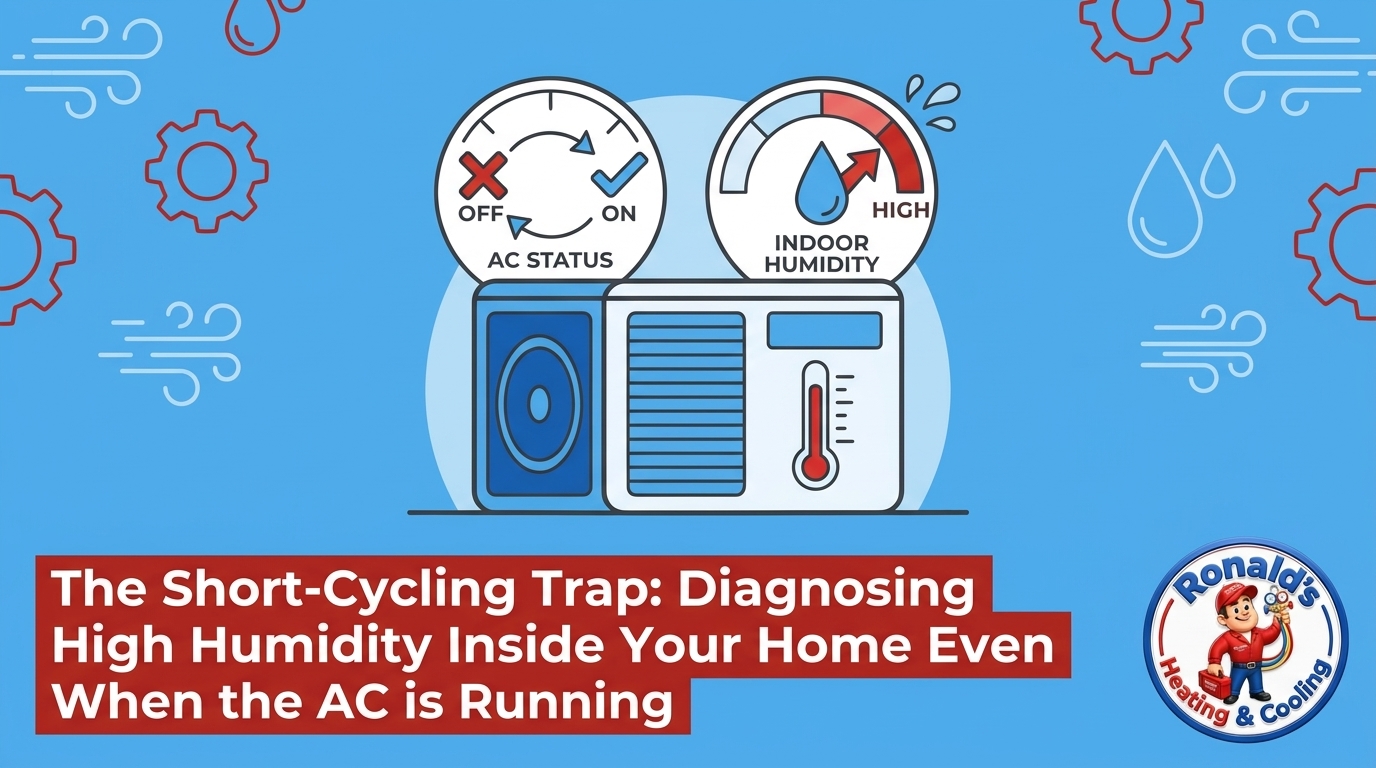
Why Does Your House Feel Clammy When the AC Is Running?
You keep dropping the temperature on your thermostat, but diagnosing high humidity inside your home even when the AC is running feels like a frustrating, unwinnable battle. At Ronald's Heating & Cooling, we see this exact scenario play out across Virginia Beach homes every July. Your vents are blasting cold air, the system seems to be working overtime, yet your living room feels like a damp, sticky cave. During the intense heat of a July peak summer, sitting in a room that is technically 70 degrees but physically clammy is incredibly uncomfortable. You are not alone in this frustration, and the standard reaction—pushing the thermostat down to 68 or even 66 degrees—rarely solves the underlying issue.
If you need immediate help with your air conditioning systems, schedule professional AC repair in Virginia Beach today.
To understand why this happens, you have to look at what true air conditioning actually means. Your system is designed to manage two very different types of heat. The first is sensible heat, which is the temperature you can read on a thermometer. The second is latent heat, which is the thermal energy trapped inside airborne moisture. When your home feels muggy despite the system running, your equipment is successfully addressing the sensible heat but completely failing to manage the latent heat.
A properly functioning HVAC system should strike a perfect balance between cooling the air and wringing out excess moisture. If indoor humidity levels remaining high despite low thermostat settings is a daily struggle for you, the problem goes much deeper than a simple temperature adjustment. It requires looking beyond the digital display on your wall to evaluate the mechanical operation, airflow, and sizing of your entire cooling system.
The Counterintuitive Reality: Colder Air Isn't Always Drier Air
The problem: Most homeowners assume that if an air conditioner is blowing cold air, it must be removing humidity. However, simply pushing cold air into a room does not guarantee moisture extraction, especially in our demanding Virginia Beach coastal climate where outdoor relative humidity frequently exceeds 70 to 80 percent.
The cause: Dehumidification is a byproduct of the refrigeration cycle, but it requires time to work. Warm, humid indoor air is pulled through your return ducts and passed over the indoor evaporator coil. This coil is filled with cold liquid refrigerant. Just like a glass of ice water sitting on a patio table in July, the cold surface of the coil causes moisture in the warm air to condense into liquid water. This water drips into a drain pan and flows safely out of your house. However, this physical process takes time. The air must have sufficient contact time with the cold coil, and the system must run in long, sustained cycles for a meaningful amount of water to be extracted from the indoor environment.
The solution: Understanding the difference between cooling and dehumidifying helps you recognize when your system is underperforming. Below is a breakdown of how your system handles these two distinct workloads:
• Sensible Heat Load — What It Means: The physical temperature of the air (measured in degrees). — How the AC Addresses It: Absorbs heat via the evaporator coil and lowers the thermostat reading.
• Latent Heat Load — What It Means: The moisture content suspended in the air (measured in relative humidity). — How the AC Addresses It: Condenses airborne water vapor into liquid and drains it outside.
If your system blasts freezing air but shuts off too quickly, the latent heat load remains untouched. The result is a cold, clammy house that feels deeply uncomfortable, proving that colder air is not always drier air.
The Short-Cycling Trap: When Oversized Units Fail to Dehumidify
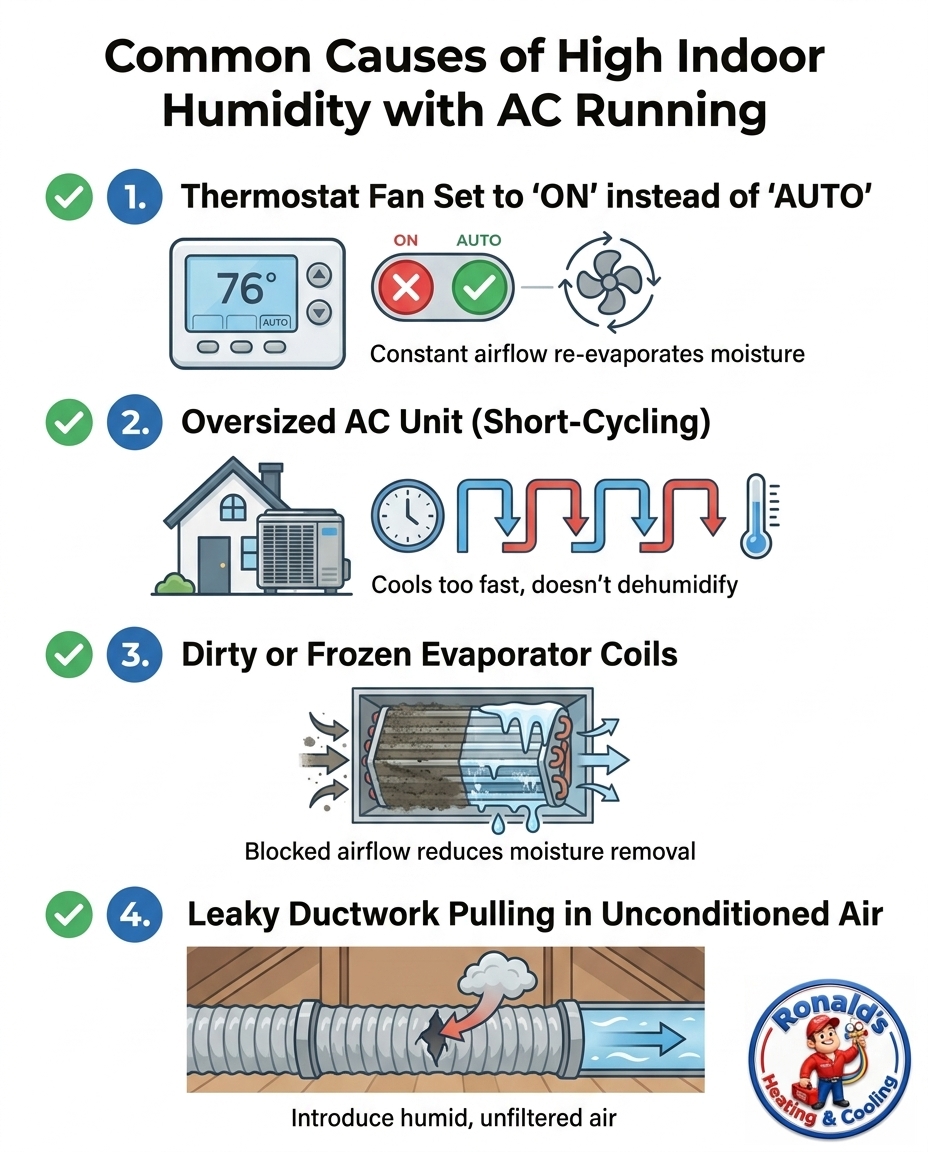
One of the most common structural reasons for indoor humidity levels remaining high despite low thermostat settings is an improperly sized air conditioning unit. In our years of installing and servicing HVAC systems throughout the area, we've found that bigger is absolutely not better. When an oversized unit is installed in a home, it falls into a destructive operational pattern known as short-cycling.
The Mechanics of Short-Cycling
An oversized air conditioner has too much cooling capacity for the square footage it serves. When it turns on, it blasts a massive volume of cold air into the living space, dropping the sensible temperature very quickly. The thermostat, sensing that the target temperature has been reached, shuts the system down after just ten or fifteen minutes.
While a quick cool-down might sound ideal, it is disastrous for humidity control. As discussed earlier, the evaporator coil needs sustained run times—often 20 to 30 minutes per cycle during peak summer—to effectively condense and drain away moisture. When the unit short-cycles, the compressor turns off before the dehumidification process can even get started.
The Clammy Cave Effect
The resulting environment is highly unpleasant. The air is cold, but the moisture is still trapped inside. This creates a "cave-like" feeling where your skin feels sticky, floors might feel slick, and the air smells slightly musty.
• Frequent starts and stops: You hear the compressor kicking on and off multiple times an hour.
• Uneven temperatures: Some rooms are freezing while others remain warm and sticky.
• High energy bills: Starting a compressor requires massive amounts of electricity, making short-cycling highly inefficient.
• Accelerated wear and tear: Constant cycling degrades electrical components and the compressor motor long before their expected lifespan.
Proper load calculation is mandatory to match a unit's capacity to a home's actual cooling and dehumidification needs. If an oversized unit is the root cause of your humidity issues, no amount of thermostat adjusting will fix the trapped moisture.
Thermostat Missteps: The Difference Between 'ON' and 'AUTO'
Before assuming you have a massive mechanical failure or an oversized system, you should check one simple setting on your wall. A remarkably common user error can drastically increase indoor humidity, leading to indoor humidity levels remaining high despite low thermostat settings. That error is leaving the thermostat fan setting on "ON" instead of "AUTO."
The Problem with Continuous Fan Operation
Most thermostats have a switch for the blower fan with two primary options. When set to "AUTO," the blower motor only runs when the outdoor compressor is running. When the cooling cycle finishes, the fan shuts off. When set to "ON," the indoor blower motor runs continuously, 24 hours a day, regardless of whether the system is actively cooling the air.
While circulating air constantly might seem like a good way to keep the house fresh, it actively sabotages your system's dehumidification efforts. During a cooling cycle, the evaporator coil becomes soaking wet as it pulls moisture out of the air. When the cooling cycle ends, that coil is still dripping wet, and the drain pan below it holds a small amount of standing water waiting to drain.
The Re-Evaporation Cycle
If the fan continues to blow air over that wet coil while the compressor is off, it picks up that moisture and evaporates it right back into your ductwork and living spaces. You are essentially paying electricity to pump the exact humidity you just removed back into your living room. Always ensure your fan is set to "AUTO." Additionally, modern smart thermostats can sometimes better manage fan cycles, allowing for slight delays that let the coil drain completely before circulating air again, optimizing your home's humidity control.
Restricted Airflow and Evaporator Coil Complications
The problem: Neglected maintenance is a silent killer of dehumidification. When airflow is restricted, your system loses its ability to transfer heat and extract moisture, turning a July peak summer afternoon into a miserable, sweaty experience indoors.
The cause: Your air conditioner requires a precise volume of air to move across the evaporator coil to function correctly. When an air filter is left unchanged for months, it becomes a solid wall of dust, pet hair, and debris. This severely chokes the airflow. Furthermore, if dust bypasses the filter, it coats the wet evaporator coil. This dirt acts as an insulating blanket, preventing the warm indoor air from actually touching the cold metal of the coil.
Because the coil cannot absorb heat from the air, its temperature plummets below freezing. The condensation that normally drips into the drain pan begins to turn to ice. Eventually, the entire coil becomes a solid block of ice, halting both cooling and dehumidification completely. Just this past summer, our team worked with a local homeowner who dealt with the installation of a new HVAC system after their old unit suffered severe airflow and coil issues. Our technicians ensured a quality installation, going above and beyond to verify proper airflow, leaving the new system operating to the customer's complete satisfaction.
The solution: Proactive upkeep is the only way to prevent these airflow complications. Regularly changing your air filters every 30 to 90 days is the first line of defense. Beyond filters, scheduling routine AC maintenance ensures that our professionals can deep-clean the evaporator coil, check blower motor amperage, and verify that the system is moving enough air to properly manage latent heat loads.
Hidden Intruders: Leaky Ductwork and Negative Air Pressure
Sometimes the equipment is perfectly sized and well-maintained, but the structural envelope of the home is working against it. The ductwork that winds through your attic, walls, and crawlspaces plays a massive role in humidity management, especially in our heavy Virginia Beach coastal climate.
The Threat of Unconditioned Air
Return ducts are responsible for pulling indoor air back to the air handler to be cooled and dehumidified. If there are gaps, cracks, or disconnected joints in a return duct located in an unconditioned space—like a sweltering 130-degree attic or a damp crawlspace—the system will suck that heavy, humid air directly into your ductwork. The AC is then forced to try and dehumidify the outside climate, a task it was never designed to handle. This overwhelms the system's natural capacity, leaving your living areas feeling sticky.
Understanding Negative Air Pressure
Another structural issue is negative air pressure. This occurs when your HVAC system pushes more air out of a room (or out of the house via exhaust fans and leaky supply ducts) than it pulls back in. Physics demands balance, so the house depressurizes. To replace the missing air, the house acts like a giant vacuum, sucking outdoor humidity in through gaps around windows, under doors, and through wall penetrations.
To combat these hidden intruders, consider the following steps:
1. Inspect exposed ductwork: Look for visible disconnections or degraded tape in attics and crawlspaces.
2. Seal duct leaks: Have a professional apply mastic sealant to joints to ensure the duct system is airtight.
3. Balance the airflow: Technicians can measure supply and return air volumes to ensure the house maintains neutral pressure.
4. Address ventilation: Ensure bathroom and kitchen exhaust fans are used appropriately and not left running continuously.
Sealing ducts and balancing pressure are critical steps in comprehensive humidity management and overall indoor air quality.
Why Professional Diagnostics Outperform Guesswork
The problem: When faced with indoor humidity levels remaining high despite low thermostat settings, many homeowners resort to guesswork. They might tape over vents, buy oversized standalone dehumidifiers, or attempt to modify their own ductwork, none of which addresses the root mechanical failure.
The cause: HVAC systems are highly complex, closed-loop networks that balance electrical loads, refrigerant pressures, and aerodynamic airflow. Attempting DIY fixes for complex sizing and airflow issues is not just ineffective; it can be dangerous. Handling refrigerants requires specialized licensing, and altering electrical components without training risks severe property damage or personal injury. Guessing at the problem often leads to replacing parts that aren't broken or, worse, prematurely replacing an entire system when a simpler fix was available.
The solution: True comfort restoration requires empirical data. A professional diagnostic visit involves measuring static pressure within the ductwork, evaluating compressor cycle times, checking refrigerant subcooling and superheat, and verifying that the equipment sizing matches a formal Manual J load calculation. At Ronald's Heating & Cooling, we provide expert diagnostics to ensure AC units are correctly sized and operating efficiently for coastal Virginia's demanding humidity.
During a busy summer season, our crew helped a local homeowner who faced a massive comfort crisis when both their upstairs and downstairs AC systems stopped working. Following a thorough diagnostic process, our technicians replaced both systems, honored the original quote, and completed the complex work in just two days with minimal disruption. Accurate diagnostics prevent unnecessary headaches and ensure you understand exactly what makes your AC circuit breaker trip or why your system fails to pull moisture from the air.
Restore Your Indoor Comfort with Expert System Evaluation
Achieving true indoor comfort requires a delicate, engineered balance between temperature control and moisture removal. If you are constantly battling a clammy home in the middle of a Virginia Beach coastal climate, turning the thermostat down is only masking a deeper operational issue. Whether your system is trapped in a short-cycling loop, suffering from restricted airflow, or fighting leaky ductwork, these problems will not resolve themselves.
Stop fighting a losing battle against your thermostat. Reclaim your living space by reaching out to our team for a comprehensive, professional system diagnostic to identify the exact cause of your high humidity and restore the crisp, comfortable environment you deserve.
Frequently Asked Questions
Why does my house feel damp when the AC is running?
Your house feels damp because the system is cooling the air without effectively removing the moisture (latent heat). This often happens when the unit is oversized and short-cycles, shutting off before the evaporator coil has time to extract water vapor. It can also be caused by leaving the thermostat fan set to "ON," which blows condensed moisture back into the home.
What causes an AC to short-cycle?
Short-cycling is primarily caused by an air conditioning unit that is too large for the square footage of the home. Because the unit has too much capacity, it cools the space rapidly and shuts off prematurely. Other causes include severely clogged air filters, malfunctioning thermostats, or refrigerant issues that trigger the system's internal safety switches to shut the compressor down early.
How does an air conditioner remove humidity?
An air conditioner removes humidity by pulling warm indoor air across a very cold evaporator coil. As the warm air touches the cold metal, the airborne moisture condenses into liquid water, similar to condensation forming on a cold glass of water. This liquid then drips into a drain pan and is routed outside your home, leaving the conditioned air drier as it returns to your rooms.
Is 60% humidity too high in a house with AC?
Yes, an indoor relative humidity of 60% is generally considered too high and will make the air feel sticky and uncomfortable. The ideal indoor humidity range for health and comfort is between 30% and 50%. Sustained humidity levels above 60% not only reduce comfort but can also encourage organic growth and damage wood furnishings over time.
Can a smart thermostat help lower indoor humidity?
Yes, a smart thermostat can help manage indoor humidity by offering advanced control over your system's blower fan and run cycles. Some models feature "overcool" settings that allow the AC to run a few degrees past the set temperature specifically to extract more moisture. They also prevent the fan from running continuously and re-evaporating water from the coil back into the house.
