





Avoiding Late-Summer Surprise Costs with a Transparent Quote
If you are trying to figure out exactly What Our Estimates Actually Include: No Hidden Fees on Virginia Beach AC Replacements, you are likely staring at a vague quote while your current system struggles to keep up. At Ronald's Heating & Cooling, our team typically sees this exact scenario during the intense heat of the August late-summer cooling season. Your AC is running nonstop, but the house still feels warm, and the piece of paper in your hand offers little more than a single, massive number at the bottom. Homeowners often rush to get their home comfortable again before the back-to-school transition begins. Unfortunately, that urgency makes it easy to accept an incomplete quote that hides unexpected upcharges.
An estimate should never be a mystery. It needs to serve as a detailed, line-by-line blueprint for your upcoming project, not just a bottom-line price tag. Evaluating an estimate is a critical decision point. You are not just buying a piece of equipment; you are investing in the labor, materials, safety checks, and long-term reliability of your home comfort system. If a contractor hands you a vague document, you have no way to protect yourself against end-of-season surprise costs.
Our goal is to break down exactly what a trustworthy quote looks like. When you understand the anatomy of a proper estimate, you can confidently compare your options and ensure you are getting the comprehensive air conditioning services your home requires. Let us walk through the essential elements that guarantee a smooth, transparent installation.
The Danger of the Single-Number HVAC Estimate
A "single-number" quote is exactly what it sounds like: a brief document or verbal offer that provides one total cost for the entire job, with zero breakdown of how that number was calculated. Rushed estimates are common during the busy August late-summer cooling season, as contractors try to move quickly from one emergency call to the next. In our years serving Virginia Beach neighborhoods, we have found that these rushed, vague quotes almost always omit crucial details, leaving the door wide open for hidden fees later in the project.
Common hidden fees in vague quotes:
• Old equipment disposal: Removing and safely disposing of heavy, refrigerant-filled outdoor units and indoor coils requires time and resources. If this is not listed, you might see a disposal fee tacked onto your final invoice.
• Ductwork modifications: Modern, high-efficiency systems often require larger airflow capacities. If your existing ductwork needs adjustments to accommodate the new unit, a vague quote will not include this necessary labor.
• Electrical upgrades: New air conditioners sometimes require updated wiring, new disconnect boxes, or different breaker sizes to meet current safety codes.
• Material shortages: Unlisted items like new refrigerant lines, custom sheet metal, or condensate pumps often become surprise "extras" on installation day.
When details are not itemized, it becomes impossible to accurately compare bids. One option might look significantly cheaper on paper, simply because the cost of essential electrical work and disposal was left out. By explaining every step before starting work and documenting every phase of the project, a transparent contractor ensures you are comparing apples to apples.
Comparing Quote Styles
• Equipment Details — Single-Number Quote: Basic brand name or just "new AC" — Comprehensive Estimate: Exact model numbers, SEER ratings, and capacity
• Labor & Materials — Single-Number Quote: Lumped into one vague total — Comprehensive Estimate: Itemized list of custom sheet metal, wiring, and labor hours
• Permits & Fees — Single-Number Quote: Rarely mentioned upfront — Comprehensive Estimate: Clearly listed as a separate line item
• Warranties — Single-Number Quote: Verbal promises of "full coverage" — Comprehensive Estimate: Written distinction between parts and labor coverage
Having every step documented before work begins is your best defense against bait-and-switch tactics. A professional estimate protects your investment by locking in the scope of work.
Essential Line Items on a Reliable HVAC Estimate
To protect yourself from surprise costs, you need to know exactly what to look for on the paperwork. A reliable quote for an AC replacement in Virginia Beach will always include a specific, itemized breakdown of the project.
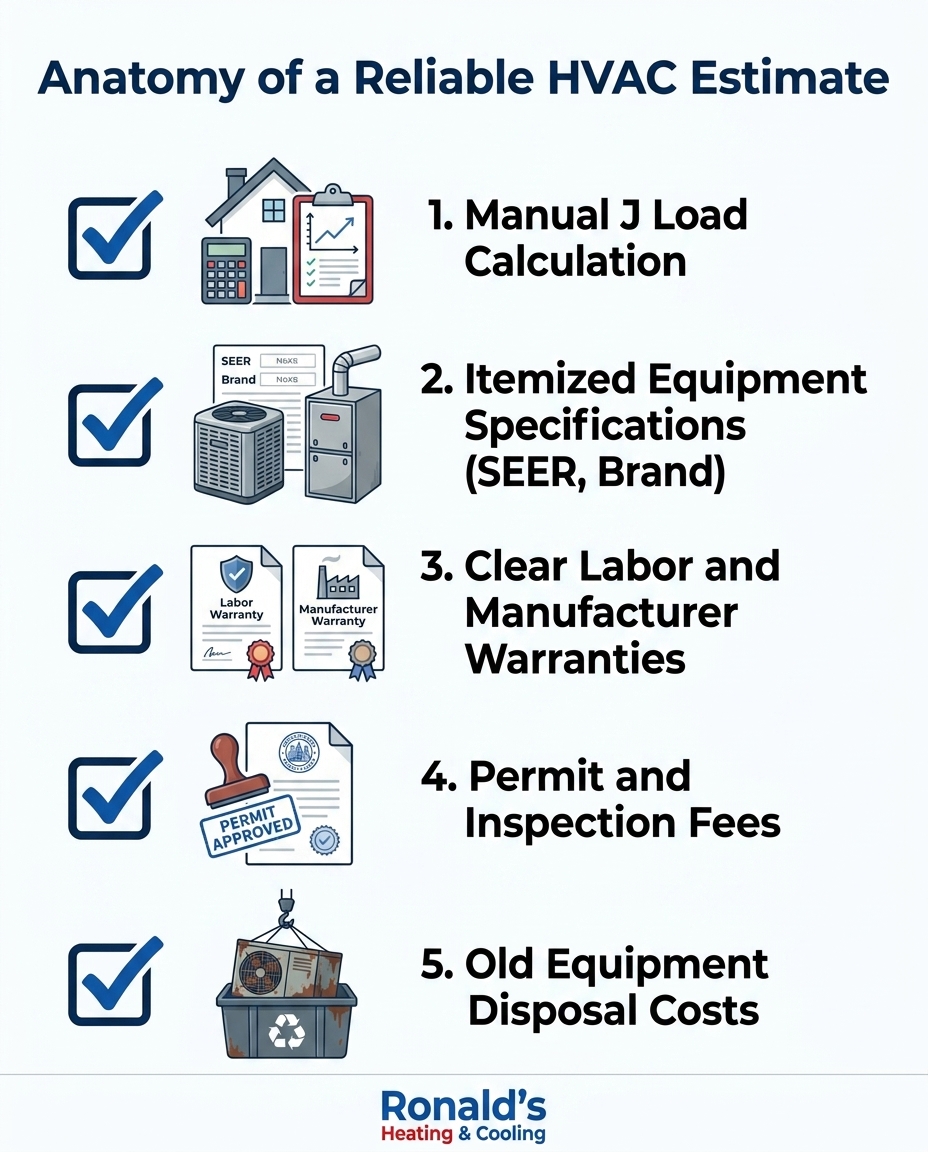
1. Proper Equipment Sizing Documentation: A trustworthy estimate will reference a Manual J load calculation. This calculation measures your home's square footage, window placement, insulation levels, and layout to determine the exact size of the air conditioner you need. Guessing the size based on the old unit often leads to short-cycling or inadequate cooling.
2. Specific Equipment Details: You should see the exact brand, model numbers, and performance specifications listed. This includes the SEER (Seasonal Energy Efficiency Ratio) rating, which tells you how efficient the unit is. The estimate must also confirm that the indoor coil and outdoor unit are a matched set, which is required for proper performance and warranty validity.
3. Clear Warranty Outlines: Warranties can be confusing if they are not clearly defined. Your estimate should explicitly separate the manufacturer's warranty (which covers defective parts) from the contractor's labor warranty (which covers the physical installation work). You need to know exactly how long you are covered for both.
4. Itemized Removal and Disposal: Safely recovering old refrigerant and hauling away bulky metal cabinets is a regulated process. The cost for this safe removal and environmental disposal must be clearly stated so it does not suddenly appear on your final bill.
Clear communication of these details is vital, no matter the season. For example, one local homeowner called us when their AC struggled to keep up during the humid back-to-school transition. A technician from Ronald's Heating & Cooling arrived within an hour, explained the exact issue, sourced the necessary parts, and completed the repair quickly. That same principle of explaining the specific parts, steps, and expectations upfront is exactly what makes a summer AC replacement estimate reliable. When a contractor takes the time to document the details, you know exactly what you are getting.
Factoring in the Unique Coastal Environment
Local geography dictates specific installation requirements that generic, out-of-the-box quotes completely miss. Our technicians at Ronald's Heating & Cooling know firsthand how the hot, humid summers and coastal environment of Virginia Beach accelerate wear and tear on standard outdoor units. Salt spray in the air, heavy seasonal storms, and constant moisture create a highly corrosive atmosphere for metal components.
A comprehensive quote for a home near the water should specify salt-spray ratings or explicitly list coastal-grade equipment. Standard aluminum fins and painted cabinets can begin to corrode within a few short years if they are not treated for coastal conditions. Your estimate should detail any specialized anti-corrosion coatings applied to the condenser coils to ensure the system survives the harsh elements.
Robust Hardware and Coastal Warranties
Beyond the air conditioner itself, the installation materials must be suited for the region. Your estimate needs to include robust mounting hardware. Standard screws and thin brackets will rust quickly in the Virginia Beach coastal environment. We use heavy-duty, weather-resistant mounting pads and hurricane-rated tie-downs to ensure the outdoor unit remains secure during severe weather events. If a quote does not specify the type of mounting hardware being used, the contractor may be cutting corners with cheap materials.
Furthermore, specialized coastal warranties should be explicitly listed on the paperwork. Many standard manufacturer warranties actually void coverage if the unit is installed within a certain distance of saltwater, unless specific coastal-grade models are purchased. A transparent estimate will clearly outline a warranty that remains valid in our unique coastal climate, giving you true peace of mind.
Permits, Inspections, and Code Compliance
Legitimate HVAC replacements require local permits and independent city inspections to ensure safety and code compliance. Unfortunately, some contractors try to win bids by suggesting you skip the permit process to lower the initial quote. This is a massive red flag that puts your home, your family, and your homeowner's insurance policy at risk.
Why local compliance matters:
• Safety verifications: City inspectors verify that high-voltage electrical connections and high-pressure refrigerant lines are installed safely, preventing fire hazards and leaks.
• Insurance requirements: If an unpermitted installation causes damage to your home, your insurance provider may deny the claim.
• Future home sales: Unpermitted major home improvements can stall or completely derail the sale of your home down the line.
Your estimate must reference adherence to the Virginia Uniform Statewide Building Code (VUSBC). This code governs exactly how ductwork must be sealed, how electrical disconnects must be placed, and how drainage systems must be routed.
The permit fees required by the local municipality should be clearly itemized on your quote rather than sprung on you later as an administrative fee. When an estimate includes the cost of permits and inspections, it shows that the contractor is committed to doing the job right the first time, with full accountability to local safety standards.
Navigating Payment Options and Generic Incentives
A professional estimate does more than list the equipment; it also outlines how you can manage the investment. High-efficiency systems often qualify for generic federal tax credits or utility incentives designed to encourage energy conservation. However, a trustworthy contractor will never promise you a specific dollar amount for a rebate, because these programs frequently change and depend on your unique tax situation.
To qualify for these incentives, the equipment installed must meet strict efficiency guidelines. Qualifying AHRI-matched equipment must be specifically listed on the invoice for rebate eligibility. The Air-Conditioning, Heating, and Refrigeration Institute (AHRI) provides a certificate proving that your specific indoor and outdoor units work together to achieve the advertised efficiency rating. If your estimate does not list matched model numbers, you could lose out on those generic incentives entirely.
Thorough Assessments Prevent Unnecessary Financing
A transparent estimate will clearly outline available payment structures and HVAC financing options, allowing you to choose a plan that fits your household budget. But financing is only helpful if you actually need a replacement. Another local homeowner recently assumed their AC system was outdated and needed total replacement. When our team at Ronald's Heating & Cooling troubleshot the system, we found an unhooked part in the attic, ordered it, and installed it—avoiding immediate replacement entirely.
A thorough assessment ensures that the estimate you are looking at is actually necessary. When it is time for a replacement, we advise readers to verify current rebate programs with their utility provider or a tax professional. An upfront quote gives you all the documentation you need to have those conversations confidently.
The Value of Upfront Pricing and Verified Trust
Upfront pricing is the ultimate protection for your investment. When every wire, permit, and piece of equipment is detailed before the job begins, you eliminate the stress of the unknown. A detailed presentation of the quote builds trust before the installation even begins, proving that the contractor respects your home and your budget.
Consistent, quality installations are closely tied to accurate initial assessments. If a contractor takes the time to measure your home, evaluate your ductwork, and check your electrical panel during the quoting phase, they are going to take that same careful approach during the installation. Accurate, upfront estimates with zero hidden fees serve as our core operational standard at Ronald's Heating & Cooling, building authority through transparency.
Real Results from Transparent Quotes
Verified feedback often highlights the relief of paying exactly what was quoted. One homeowner recently reached out for an estimate and installation for a new HVAC system. We provided a highly detailed estimate and completed the work exactly as described. The result was a quality installation with positive, noticeable cooling results just days later, all without a single surprise fee.
When you read through our customer reviews, you will see a consistent pattern of homeowners who appreciate knowing exactly what to expect. By demanding an itemized, comprehensive estimate, you protect your home from the stress of late-summer upcharges and secure a reliable cooling system for years to come.
FAQ
What should an AC replacement quote include?
A proper quote must include a detailed breakdown of the equipment, labor, and materials. Look for exact model numbers, SEER ratings, a Manual J load calculation, and clear warranty terms. It should also itemize costs for old equipment disposal, electrical modifications, and local permits.
Do HVAC quotes include permit fees?
A legitimate, transparent estimate will always include the cost of local permit fees as a specific line item. Some rushed quotes leave this out to appear cheaper upfront, only to add the cost to your final bill. Always verify that permits and inspections are explicitly covered in the document.
How do I compare HVAC installation estimates?
To compare estimates accurately, you must look past the bottom-line number and examine the line items. Ensure both quotes are for the same size and efficiency of equipment, and check that both include necessary extras like ductwork modifications, disposal fees, and labor warranties. Comparing detailed blueprints is the only way to avoid hidden fees.
Are there hidden fees in AC replacement?
Hidden fees typically arise when a contractor provides a vague, single-number quote without itemizing the scope of work. Common surprise charges include fees for hauling away the old unit, upgrading electrical disconnects, or modifying ductwork to fit the new system. A comprehensive upfront estimate eliminates these hidden costs.
Why is a Manual J load calculation important on an estimate?
A Manual J calculation ensures that the new air conditioner is perfectly sized for your specific home's square footage and layout. If this calculation is missing from your estimate, the contractor is likely guessing the size based on your old unit. Proper sizing is critical for energy efficiency, humidity control, and the lifespan of the system.
Ensuring Your Peace of Mind
Navigating an AC replacement during the heat of the season doesn't have to be stressful. By insisting on a comprehensive, itemized quote, you protect yourself from hidden fees and ensure your system is perfectly suited to your home. When you are ready for a clear, honest breakdown of your cooling needs, reach out to schedule your professional assessment today.
