





The Stress of Summer Breakdowns and 'Invoice Anxiety'
Your thermostat is set to 72 degrees, but the indoor temperature keeps climbing, and the house feels heavy with humidity. When you are facing a sudden cooling failure, you are likely looking for immediate answers. That is exactly why we insist on explaining every AC repair step before starting work. A broken air conditioner is more than just a mechanical failure; it is a highly stressful event that disrupts your entire household. Homeowners often feel incredibly vulnerable when their comfort systems fail, especially during the intense, sweltering days of summer.
When the July peak summer heat and coastal humidity settle over the region, the urgency to get a broken system running again can be overwhelming. There is often immense pressure to approve repairs quickly just to restore a comfortable indoor environment. However, this rushed decision-making frequently leads to a secondary problem: "invoice anxiety." This is the persistent dread of surprise bills, hidden fees, and unauthorized work that many homeowners experience when they blindly hand over control to a service technician.
The psychology of a rushed repair:
• Loss of control: You are relying entirely on a stranger's expertise to fix a complex, expensive piece of equipment.
• Fear of the unknown: Without a clear explanation, every minute the technician spends working feels like the final bill is climbing higher.
• Post-repair regret: Approving a fix without understanding it often leaves homeowners wondering if they actually needed the repair at all.
A proper diagnostic process must address the mechanical failure of the equipment while simultaneously alleviating the homeowner's stress. If a technician fixes the machine but leaves you feeling confused or financially ambushed, they have failed at their job. Whether you are researching a full system replacement or just need routine air conditioning maintenance, the foundation of the service must always be clear, unhurried communication.
The Critical Pause: What Happens Immediately After Diagnostics
In the home service industry, there is often a rush to move from diagnosing the problem straight to turning a wrench. Technicians are frequently pressured to complete jobs quickly and move on to the next house. We fundamentally reject this approach. Diagnostics are only the first step of the process; the mandatory pause to consult the homeowner is equally, if not more, important.
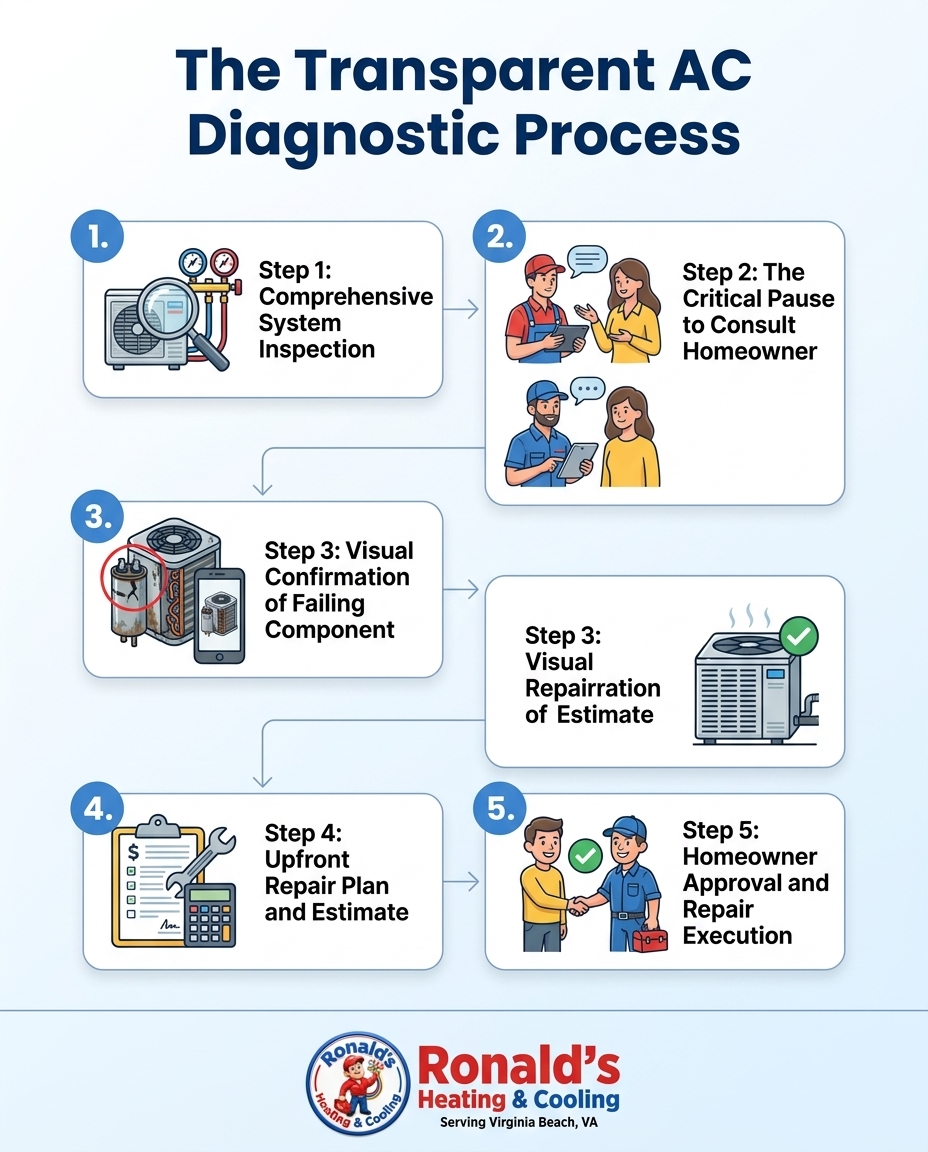
This deliberate stoppage in work is what we call the "Critical Pause." It is a non-negotiable part of our service protocol designed to ensure complete transparency and thorough explanations before starting work, ensuring no surprise bills and building permanent trust. Here is exactly what happens during this crucial window of time:
1. The Comprehensive Evaluation: The technician completes a full system diagnostic, testing electrical loads, measuring refrigerant pressures, and inspecting mechanical components.
2. The Deliberate Stop: Instead of retrieving replacement parts from the truck and beginning the repair, the technician stops all mechanical work and locates the homeowner.
3. The Visual Walkthrough: The technician physically shows the homeowner the failing component. If the part is in a difficult-to-reach area, such as a hot attic, they will provide clear, high-resolution photos or video of the damage.
4. The Educational Briefing: The root cause of the failure is explained in plain language, detailing exactly how the broken part affects the rest of the system.
5. The Final Approval: A firm, upfront repair plan is presented. Work only begins after the homeowner completely understands the situation and gives explicit authorization.
This step ensures that you remain in complete control of the process at all times. Rushing past this consultation phase is a massive red flag for poor communication and potential hidden costs. If you are scheduling AC repair in Virginia Beach, you should expect—and demand—this level of intentional, unhurried communication before any tools are used.
Why Coastal Environments Make Thorough Explanations Essential
Virginia Beach's hot, humid summers and coastal salt air make AC systems work significantly harder than systems located further inland. This unique environment makes accurate and transparent diagnostics absolutely essential for local homeowners. A generic "it's broken" diagnosis is completely insufficient when specific environmental factors are actively deteriorating your equipment.
The Problem: Saltwater coastal environments severely accelerate wear and tear on outdoor HVAC components. The constant exposure to salt-laden moisture attacks the metal surfaces of your condenser unit, leading to rapid degradation if the system is not properly maintained or protected.
The Cause: When salt air interacts with the copper tubes and aluminum fins of an outdoor coil, it triggers galvanic corrosion. Over time, this corrosion literally eats away at the metal, causing the fins to crumble into a white powder and the copper lines to weaken, eventually leading to catastrophic refrigerant leaks. This is a very different, more complex issue than a simple electrical fault like a blown fuse or a failed capacitor.
The Solution: Because these regional issues are so destructive, specific problems like coil corrosion require detailed explanations. If a technician simply tells you that your system is low on refrigerant without explaining that coastal corrosion has compromised the entire coil, you cannot make an informed decision. Understanding the true root cause helps homeowners decide whether a repair is a wise investment or if a full system replacement makes more financial sense.
• Dust and pollen buildup on condenser coils — Coastal Virginia Beach Wear & Tear: Salt air corrosion deteriorating aluminum fins
• Standard electrical component fatigue — Coastal Virginia Beach Wear & Tear: Accelerated rusting on electrical contactors and terminals
• Occasional clogged condensate drains — Coastal Virginia Beach Wear & Tear: Heavy biological growth in drains due to extreme coastal humidity
• Standard lifespan expectations apply — Coastal Virginia Beach Wear & Tear: System lifespan often shortened without specialized coastal coatings
When environmental factors are at play, understanding exactly what is happening inside your unit is critical. For example, if you are wondering what makes your AC circuit breaker trip, a thorough explanation might reveal that a corroded, failing compressor is drawing too much power, rather than just a weak breaker in your electrical panel.
Translating Technical Jargon Into Clear Repair Plans
The HVAC industry is filled with complex terminology that means nothing to the average homeowner. Words like "contactor," "capacitor," "TXV," and "evaporator coil" can sound intimidating. A professional technician's job is not just to fix the machine, but to translate this technical jargon into a clear, understandable repair plan. When you are dealing with July peak summer heat and coastal humidity, the last thing you need is a confusing lecture on thermodynamics.
One Virginia Beach homeowner recently reached out to us when their system required repairs. Because they had a prior positive experience with our team, they knew what to expect. Instead of just handing over a clipboard with a total at the bottom, our technician thoroughly explained the necessary work. He broke down the complex technical terms into plain language, outlined the immediate repair needs, and answered every single question the homeowner had. The outcome was exactly what we strive for: the customer felt completely confident in the repair plan and knew their home was in good hands.
How we translate the technical details:
• Explaining the 'why', not just the 'what': We do not just say "your capacitor is dead." We explain that the capacitor acts like a battery to jumpstart your compressor, and without it, the motor cannot turn on.
• Separating immediate needs from future recommendations: We clearly outline what must be fixed today to restore your cooling, versus preventative steps you might want to consider down the road.
• Encouraging questions: We actively encourage homeowners to ask questions until they feel completely confident in the proposed solution. There is no such thing as a bad question when it comes to your home comfort.
Clear communication is just as important during routine maintenance. During an annual AC tune-up, we use the same educational approach, showing you exactly how your system is performing and what steps you can take to improve its efficiency.
Eliminating Surprise Bills Through Upfront Transparency
The most significant benefit of the "Critical Pause" and our commitment to thorough explanations is the complete elimination of surprise bills. Financial anxiety is a major component of the stress homeowners feel during an HVAC breakdown. By connecting the detailed explanation process directly to accurate, upfront estimates, we provide true financial peace of mind.
Taking the time to explain the repair plan guarantees that the estimate you receive is accurate and final. When a technician rushes a diagnosis, they often miss secondary issues. This leads to the dreaded mid-repair phone call where the technician informs you that they found "something else" and the price has suddenly doubled. Detailed explanations prevent these misunderstandings and eliminate hidden fees entirely.
During a recent summer heatwave, another local customer experienced a sudden system failure. Our technician arrived promptly and quickly diagnosed the issue. However, before touching any tools, he took the time to explain the necessary repairs and exactly what he was doing to restore the system. Because the customer received clear, upfront explanations, they approved the work with absolute confidence. They knew exactly what the final invoice would look like before the work even began.
The pillars of our transparent pricing process:
• No hidden fees: What we quote is what you pay. There are no mysterious "shop fees" or unexplained labor charges tacked on at the end.
• Long-term trust over quick fixes: Building a long-term relationship based on trust is infinitely more valuable to us than rushing a quick fix for a fast invoice.
• Guaranteed alignment: A transparent diagnostic process ensures that the final invoice matches the initial agreement perfectly, every single time.
When you know exactly what you are paying for and why it is necessary, the anxiety of home repairs disappears. You are no longer crossing your fingers and hoping for a fair price; you are making an informed, confident investment in your home's comfort.
Your Role in the Diagnostic Process
While it is the technician's job to diagnose the problem and explain the solution, you also play a vital role in this process. We want to empower you to take an active role during the diagnostic pause. Knowing what to ask and what to look for ensures that you are getting the transparent service you deserve, no matter who you hire to work on your home in Virginia Beach.
When a technician finishes their evaluation and presents their findings, use this checklist to ensure you have all the information you need:
• Ask to see the broken part or the diagnostic readout: A trustworthy technician will gladly show you the pitted contactor, the leaking coil, or the multimeter reading that proves a part has failed.
• Inquire about how the failure impacts the rest of the system: Ask, "Did this broken part cause damage to anything else?" Understanding the domino effect of HVAC failures helps you gauge the overall health of your unit.
• Request a clear timeline for the repair work: Know how long your home will be without cooling. Ask if the parts are on the truck or if they need to be ordered from a local supply house.
• Verify that all costs are finalized before giving approval to begin: Ask directly, "Is this the final price, or could this number change once you start working?" Do not sign anything until you have a firm, upfront commitment.
• Ask about preventative measures: Inquire if there is anything you could have done to prevent this specific failure, such as changing filters more frequently or scheduling earlier seasonal maintenance.
By asking these questions, you transition from a passive bystander to an active participant in your home's maintenance. A true professional will welcome these questions and take the time to answer them thoroughly.
Frequently Asked Questions About AC Diagnostics
What happens during an AC diagnostic?
During an AC diagnostic, a technician performs a thorough inspection of the system's mechanical and electrical components to identify the root cause of a failure. This involves testing for proper airflow, measuring refrigerant levels, and checking for component wear using specialized diagnostic tools. Once the evaluation is complete, a detailed report of the findings is presented to the homeowner so they understand exactly what is wrong.
What should a contractor explain before fixing an AC?
Before any repair work begins, a contractor must explain the exact component that failed and the underlying reason why it failed. They should present the proposed repair plan, discuss any alternative options (such as repairing versus replacing an older unit), and explain how the failure impacts the rest of the system. Most importantly, they must provide a firm, upfront estimate for the total cost of the work before asking for your approval.
How long does an AC diagnostic take?
A proper AC diagnostic typically takes between 45 minutes to an hour, depending on the complexity of the issue and the accessibility of the equipment. Rushing this process often leads to misdiagnoses or missed secondary issues. The technician needs enough time to test the thermostat, inspect the indoor air handler, evaluate the outdoor condenser, and then sit down with you to explain their findings.
How can I avoid hidden HVAC repair fees?
The best way to avoid hidden HVAC repair fees is to insist on a flat-rate, upfront pricing model rather than paying by the hour. Require the technician to provide a written estimate that details the total cost of the repair before any work is authorized. Refuse to work with contractors who offer vague estimates or claim they will not know the final price until they "open the system up and see what happens."
Why is it important to physically see the failing component?
Physically seeing the failing component removes the mystery from the repair process and builds immediate trust between you and the technician. When you can see the burnt wiring, the rusted coil, or the swollen capacitor with your own eyes, you do not have to blindly take the contractor's word for it. It provides visual proof that the recommended repair is genuinely necessary.
Partnering with a Team That Values Your Peace of Mind
Dealing with an air conditioning breakdown is stressful enough without having to worry about poor communication and surprise bills. A clear, thorough explanation puts you back in control of your home's comfort. You deserve to know exactly what is happening with your equipment, why it failed, and what it will take to fix it before any tools are used.
By insisting on the "Critical Pause" and taking the time to educate our customers, we ensure that every Virginia Beach homeowner we serve feels confident and respected. If you are tired of vague answers and rushed service calls, explore options for transparent, stress-free diagnostic services. We believe that an informed homeowner is our best customer, and that is exactly why we insist on explaining every AC repair step before starting work.
