





The Myth of the Thermostat: Why 72 Degrees Still Feels Clammy
When Virginia Beach homeowners ask us, "Single-Stage vs. Two-Stage Cooling: Which Handles Coastal Humidity Better?", we always explain that cranking your thermostat down to 68 degrees does not magically erase indoor humidity—it usually just creates a colder, damper living space. At Ronald's Heating & Cooling, our team typically sees this exact frustration as families prepare for the late-summer back-to-school transition. The short answer is that standard air conditioners are designed primarily to lower the air temperature, not to act as heavy-duty dehumidifiers. When you drop the thermostat setting in a sticky house, the system blasts cold air until the target temperature is reached, but it often shuts off long before it has a chance to pull the heavy moisture out of the air.
This is a common frustration for homeowners dealing with August late-summer mugginess. The air inside feels heavy, your floors might feel slightly slick, and you still feel uncomfortable despite the system running constantly. To fix this, we have to look at how your equipment actually manages moisture. If your current setup is struggling, professional air conditioning services can help you evaluate whether your existing unit needs attention or if it is time to upgrade to a system built specifically for heavy moisture loads.
Understanding Sensible vs. Latent Cooling
To understand why your home still feels sticky, you need to know the difference between the two types of cooling your air conditioner performs:
• Sensible cooling: This is the straightforward process of dropping the actual temperature of the air. When your thermostat drops from 75 degrees to 72 degrees, that is sensible cooling in action.
• Latent cooling: This is the process of removing moisture from the air. It takes significantly more energy and time for an air conditioner to extract water vapor (humidity) than it does to simply cool the air down.
The myth that lowering the thermostat further will fix your humidity issue stems from a misunderstanding of latent cooling. Forcing a standard system to run at a lower temperature often results in a house that feels like a cold, damp cave. The real decision point for many homeowners is evaluating whether to replace a struggling, aging unit with a standard single-stage system or to invest in a specialized two-stage upgrade that physically wrings the water out of your indoor air.
Single-Stage Cooling: The Short-Cycling Dilemma
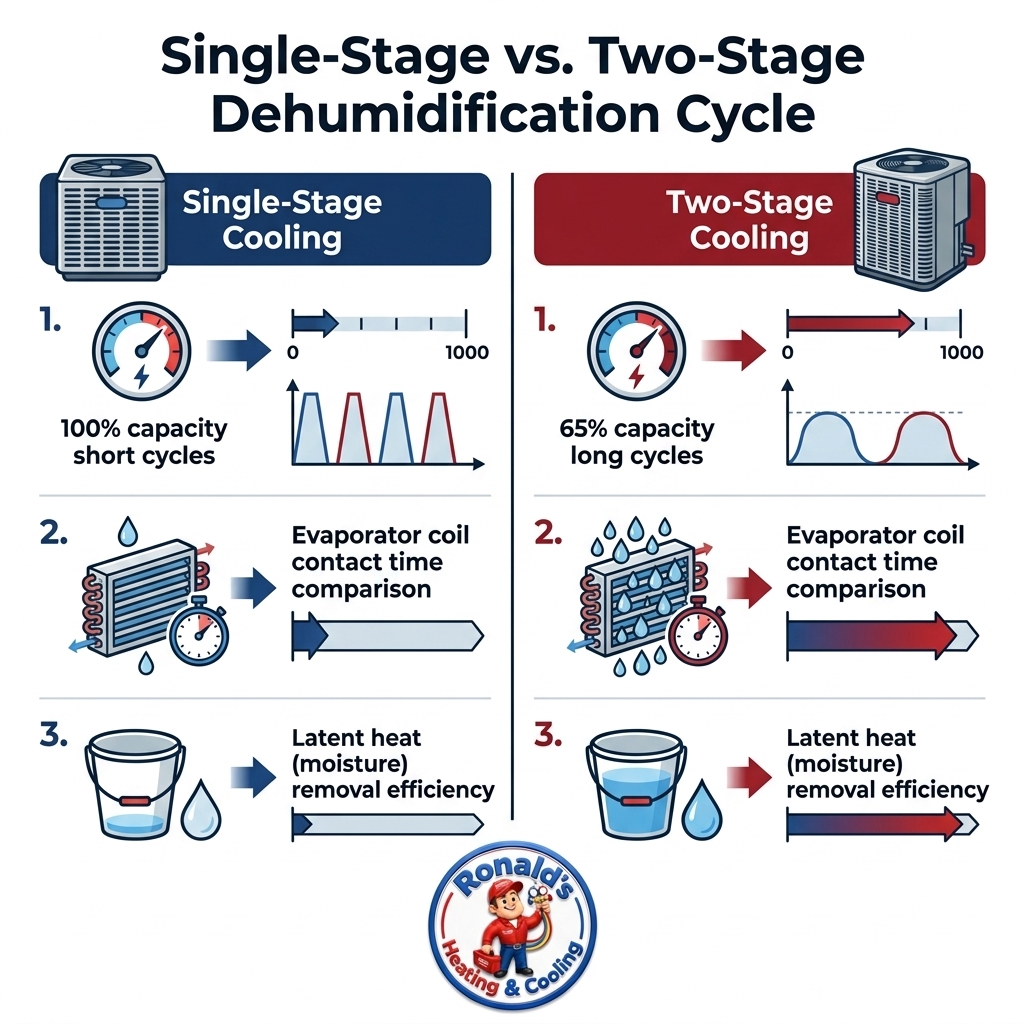
To understand why standard systems struggle with deep dehumidification, we have to look at how they operate. A single-stage compressor is the traditional standard for most residential air conditioners. It operates exactly like a light switch: it is either 100 percent on or 100 percent off. There is no middle ground, no low gear, and no energy-saving mode.
When the thermostat detects that the house has warmed up, it sends a signal to the single-stage compressor. The system kicks on at maximum capacity, blasting the home with a high volume of cold air. Because it is operating at full power, it satisfies the thermostat's temperature setting very quickly. While this sounds like a good thing, it is actually the root cause of poor humidity control in the Virginia Beach / Hampton Roads coastal zone.
The Mechanics of Short-Cycling
When an air conditioner cools a home too quickly, it creates a phenomenon known as short-cycling. Here is why short-cycling ruins indoor comfort:
• Insufficient coil contact time: For an air conditioner to remove humidity, warm indoor air must blow across the freezing cold evaporator coil. The moisture in the air condenses on the coil—just like water droplets forming on the outside of a cold glass of iced tea on a hot day.
• Premature shut-off: If the single-stage system blasts cold air and satisfies the thermostat in just ten or fifteen minutes, it shuts down. This simply is not enough time for the heavy, moist air to pass over the coil, condense, and drain away outside.
• The damp aftermath: The temperature drops, but the water vapor remains trapped inside your home, leaving you with that distinct cold and clammy feeling.
Aging systems often exacerbate this problem. As parts wear down and airflow becomes restricted, older units struggle to maintain consistent cycles. In our years of providing HVAC services across Virginia Beach, our technicians frequently see systems that were poorly sized from day one, leading to these exact short-cycling pitfalls. One local homeowner managing cooling needs for both new construction properties and their personal residence realized how critical proper equipment operation is after consulting with our team. They needed professional, friendly, and reliable service to ensure their systems were installed correctly and functioned as intended from day one, avoiding the pitfalls of poorly sized or failing equipment. If your current system is constantly turning on and off without actually making your home comfortable, it might be time to look into professional AC repair to rule out mechanical failures before considering a replacement.
How a Two-Stage Compressor Wrings Out Coastal Moisture
If a single-stage system acts like a light switch, a two-stage compressor acts more like a ceiling fan with different speed settings. Instead of blasting at 100 percent capacity every single time it turns on, a two-stage system can operate at a lower, energy-conserving speed—usually around 65 to 70 percent of its total capacity. It only ramps up to 100 percent during extreme heat waves when the lower speed cannot keep up with the temperature demand.
This mechanical advantage fundamentally changes how the system handles the heavy, persistent moisture demands of the Hampton Roads area. By running at a lower speed, a Two-stage compressor directly attacks latent heat (humidity) through a highly effective mechanical process.
The Step-by-Step Dehumidification Process
1. The initial low-speed start: When the thermostat calls for cooling, the two-stage system starts in its first stage, running at roughly 65 percent capacity. This uses less electricity and creates a gentle, consistent flow of cool air.
2. Extended evaporator coil contact: Because the system is not blasting cold air at maximum volume, it takes longer to drop the temperature in the house. This extended run time is exactly what you want for dehumidification. The indoor air is continuously pushed over the cold evaporator coil for 30 to 45 minutes instead of just 10 minutes.
3. Maximum condensation extraction: The longer the air spends moving across the cold coil, the more moisture is physically wrung out of it. The water condenses on the metal fins and drips down into the condensate drain pan, safely exiting your home.
4. The comfort shift: By the time the thermostat is satisfied, the system has successfully removed a massive amount of latent heat. The resulting indoor environment shifts entirely from feeling "cold and clammy" to "crisp and dry."
The science is simple: longer, slower run times mechanically remove more water vapor from your living space without aggressively overcooling the rooms. This is the exact technological solution required for coastal climates where the air feels thick enough to cut with a knife.
Head-to-Head: Single-Stage vs. Two-Stage Dehumidification Performance
When you are weighing your options for a system upgrade, seeing the differences laid out clearly can help you make an informed choice. Below is a direct comparison of how these two distinct technologies handle the heavy lifting of keeping a coastal home comfortable.
• Evaporator Coil Contact Time — Standard Single-Stage System: Short bursts (10-15 minutes). Not enough time to extract heavy moisture. — Advanced Two-Stage System: Extended cycles (30-45 minutes). Maximizes condensation and drainage.
• Energy Consumption — Standard Single-Stage System: High-draw starts. Pulls maximum electricity every time it kicks on. — Advanced Two-Stage System: Low-draw continuous operation. Uses significantly less power in stage one.
• Temperature Swings — Standard Single-Stage System: Noticeable fluctuations. Blasts cold air, shuts off, lets the house warm up again. — Advanced Two-Stage System: Even, consistent cooling. Maintains a steady temperature without dramatic spikes.
• Long-Term Value — Standard Single-Stage System: Lower upfront investment, but higher utility costs and lower overall comfort. — Advanced Two-Stage System: Higher upfront investment, balanced by superior comfort, humidity control, and efficiency.
Analyzing the Performance Gap
Evaporator Coil Contact Time: As we discussed earlier, the amount of time your indoor air spends touching the cold metal of the evaporator coil dictates how dry your house will feel. A Two-stage compressor wins this battle effortlessly because its lower speed forces the air to circulate over the coil for much longer periods.
Energy Consumption During Peak Humidity: Single-stage units draw a massive surge of electricity every time they start up. Because they short-cycle, they start up frequently. Two-stage systems avoid this electrical surge by starting in a lower gear and staying on longer, which is generally much easier on your electrical panel and your monthly utility usage.
Temperature Swings: Have you ever noticed that one room in your house is freezing while another is warm? Single-stage systems often fail to mix the air evenly throughout the house before shutting off. Two-stage systems run long enough to thoroughly mix and distribute the conditioned air, eliminating hot and cold spots.
Beyond Comfort: Indoor Air Quality and System Efficiency
While eliminating sticky, humid air is the primary goal of upgrading your equipment, the benefits of advanced dehumidification extend far beyond basic physical comfort. The moisture levels in your home directly dictate the health of your indoor environment. High indoor humidity is a notorious breeding ground for poor air quality, mold risks, and trapped allergens.
The Link Between Humidity and Home Health
When the humidity inside your home consistently stays above 60 percent, you are creating an ideal environment for biological growth. Mold and mildew thrive in damp, dark places—like the inside of your ductwork or the corners of a poorly ventilated bathroom. Dust mites, which are a leading cause of indoor allergies, also absorb moisture directly from the air to survive. By utilizing a multi-stage system to keep your indoor humidity comfortably between 40 and 50 percent, you actively suppress these indoor air quality threats.
Passive Filtration Benefits
There is also a mechanical advantage to longer cooling cycles when it comes to air filtration. Your HVAC system is the lungs of your home. Every time the system runs, it pulls air through your return vents and pushes it through your air filter. Because single-stage systems short-cycle, they only filter the air in short bursts. A two-stage system, running for 40 minutes at a time, naturally pushes the home's air through your HVAC filters significantly more times per hour. This passively improves air cleanliness by trapping more dust, pet dander, and pollen.
For homeowners in the Virginia Beach / Hampton Roads coastal zone, pairing multi-stage cooling with advanced indoor air quality solutions—such as high-MERV media filters or UV purification—maximizes the health of the home. Furthermore, higher SEER (Seasonal Energy Efficiency Ratio) ratings are typically found in two-stage and variable-speed units. These advanced systems use electricity much more effectively than standard units. If you are researching efficiency ratings, choosing between 14 SEER and 18 SEER AC replacements often naturally leads you to a two-stage setup, as standard single-stage units rarely reach the higher tiers of energy efficiency.
Making the Right Equipment Choice for Your Home
Upgrading your air conditioning system is a major decision, and it requires more than just picking a box out of a catalog. To truly conquer the August late-summer mugginess, the equipment must be perfectly matched to your home's specific thermal envelope and ductwork.
The Importance of Proper Load Calculations
You cannot guess the right size for an air conditioner. A unit that is too large will cool the house too fast and short-cycle, leaving you with the exact same humidity problems you started with. A unit that is too small will run non-stop at 100 percent capacity and still fail to keep the house cool on the hottest days.
A proper load calculation (often called a Manual J calculation) takes into account your home's square footage, ceiling height, window quality, insulation levels, and even the direction your house faces. This scientific approach ensures the new system is sized correctly for both sensible cooling (temperature) and latent cooling (humidity removal).
Evaluating the Investment
When weighing the upfront investment of a two-stage system against a standard single-stage unit, it is important to look at the long-term gains. You are not just buying cold air; you are buying deep dehumidification, quieter operation, and more even temperatures across every room. Generic federal tax credits or utility incentives may also apply to high-efficiency two-stage or variable-speed upgrades, which can help offset the initial investment (always consult a tax professional or your local utility provider for current eligibility details).
What should you expect during a professional consultation with us? When a local customer recently reached out for a full AC installation quote, our installation crew took the time to thoroughly explain exactly how the new equipment would work and what the homeowner was actually paying for. The result was a fair, reasonable installation process built on trust. Ronald's Heating & Cooling provides transparent, educational estimates with no hidden fees, avoiding high-pressure sales tactics so you can make the best choice for your family's comfort.
Frequently Asked Questions About Coastal AC Upgrades
Does a 2-stage AC dehumidify better?
Yes, a two-stage air conditioner provides vastly superior dehumidification compared to a standard unit. Because it runs longer at a lower speed (usually around 65 percent capacity), it allows significantly more time for moisture to condense on the cold evaporator coil. This extended cycle physically wrings the humidity out of the air before it is circulated back into your living space.
Why does my house feel humid even with the AC on?
If your house feels cold but sticky, your AC is likely short-cycling. An oversized or single-stage unit cools the air too fast, shutting off before it can extract the latent heat (humidity) from the space. The thermostat registers that the target temperature has been reached, but the water vapor is left behind, resulting in a clammy indoor environment.
What is the disadvantage of a 2-stage air conditioner?
The primary disadvantage of a Two-stage compressor is a higher initial equipment and installation investment compared to standard single-stage units. Because the technology is more advanced and requires specialized control boards and thermostats, the upfront cost is higher. However, this is often offset over time by increased energy efficiency and vastly improved daily comfort.
Does a two-stage AC run constantly?
It runs more frequently and for longer cycles than a single-stage unit, but it does not run constantly unless the outdoor temperatures are extreme. During mild weather, it will run low and slow to maintain perfect humidity and temperature, eventually shutting off when the exact conditions are met. This longer operation is an intentional design feature, not a sign that the system is struggling.
How does a two-stage compressor affect indoor air quality?
By running for longer, continuous cycles, a two-stage system pushes your home's air through the HVAC filter much more frequently than a system that turns on and off in short bursts. This constant circulation traps more dust, pollen, and pet dander. Additionally, by keeping humidity levels lower, it prevents mold and dust mites from thriving in your home.
Ready to Conquer Coastal Humidity?
Living in the Virginia Beach / Hampton Roads coastal zone means dealing with heavy, oppressive moisture for months on end. Upgrading to a two-stage system provides the exact mechanical advantage needed to physically remove that heavy moisture from your home. True comfort is about comprehensive humidity control, not just blasting a room with cold air until you need a sweater.
If you are tired of setting your thermostat lower only to feel cold and clammy, it is time to look at equipment designed for our specific climate. We invite you to schedule a transparent, no-pressure consultation for AC replacement in Virginia Beach. Let us help you find the right system to keep your home crisp, dry, and perfectly comfortable all summer long.
