





The Late-Summer AC Failure: Beating the Heat and the HOA Board
Your air conditioner is running nonstop, but the house still feels warm, and that strange grinding noise from the compressor tells you a total breakdown is imminent. When you are facing a sudden cooling failure, navigating HOA rules for AC unit replacements in Virginia Beach neighborhoods can feel like an impossible hurdle. At Ronald's Heating & Cooling, we know firsthand how relentless the late-summer heat can be, and your first instinct is to get a new system installed as quickly as humanly possible. However, rushing into a major exterior home improvement project without the proper approvals can turn a stressful situation into a bureaucratic nightmare.
If you find yourself in this exact situation and need immediate guidance, you can learn more about the process for an AC replacement in Virginia Beach to get your home cooling again.
A sudden cooling failure during late August end-of-season cooling creates an immediate emergency for coastal Virginia homeowners. As students head back to school and afternoon temperatures remain sweltering, indoor temperatures can rise to uncomfortable and even unsafe levels within hours. But in our experience working across deed-restricted communities, bypassing the Architectural Review Committee (ARC) is never a viable shortcut. Installing a new condenser unit without formal board approval can lead to steep daily fines, forced stop-work orders, or even a legal mandate to remove the brand-new equipment at your own expense.
Understanding exactly what your local neighborhood association requires is the first critical step to avoiding weeks of frustrating delays. Every community has a specific set of bylaws governing exterior modifications, and air conditioning units are heavily regulated due to their size, visibility, and noise output. Partnering with a knowledgeable local contractor ensures you have the exact technical paperwork needed to submit your application immediately, streamlining the approval process so you can restore your home's comfort without violating community guidelines.
Understanding Virginia Beach Noise Ordinances vs. Neighborhood Limits
One of the most common reasons an architectural review board rejects a new cooling system proposal—a pattern our team sees often—is a lack of clarity regarding noise output. Homeowners often assume that if a piece of equipment is legally permitted to be installed in the city, it automatically meets their neighborhood's standards. This is a risky misconception. Municipal city codes set a broad baseline for residential noise, but private community rules are almost always much stricter.
Working with a trusted HVAC company in Virginia Beach ensures that you are selecting equipment that complies with both local municipal laws and the hyper-specific regulations of your particular neighborhood association.
City ordinances typically measure noise at the property line and allow for a certain amount of ambient mechanical sound. However, HOA bylaws often dictate strict outdoor unit decibel (dB) limits that fall well below the city's legal threshold. Because homes in planned communities are often built close together, a noisy compressor can easily disturb a neighbor's patio or bedroom window, making acoustic compliance a top priority for the board.
Why Decibel Ratings Matter to Your ARC
Proximity to property lines makes outdoor unit noise a highly sensitive issue. When you submit your proposal, the review committee does not want to guess how loud the new system will be. Providing the exact decibel rating directly from the manufacturer's specification sheet builds immediate trust with the board and eliminates subjective debates about potential noise pollution.
Fortunately, modern ultra-quiet condenser units typically operate between 55 and 65 decibels. To put that into perspective, 60 decibels is roughly equivalent to the volume of a normal conversational background noise. This level of quiet operation usually satisfies even the strictest ARC requirements.
• Municipal City Code — Typical Focus Area: Broad public nuisance and zoning — Common Restrictions: General daytime and nighttime decibel limits measured at the property boundary.
• HOA Architectural Guidelines — Typical Focus Area: Neighborly harmony and aesthetics — Common Restrictions: Strict manufacturer dB ratings, continuous noise caps, and specific placement rules.
• Manufacturer Specifications — Typical Focus Area: Equipment performance — Common Restrictions: Certified acoustic ratings (often between 55-65 dB for premium models).
A seasoned local professional knows exactly how to highlight these acoustic specifications in your submission packet. Our team ensures the board sees the hard data they need to stamp your approval without unnecessary hesitation.
Navigating Property Line Setbacks and Unit Footprints
Another major hurdle we frequently help homeowners face during an unexpected replacement is the physical size of modern cooling equipment. Older systems manufactured a decade or more ago often have a much smaller physical footprint than the newer models required by current federal energy standards. As efficiency mandates have increased, the internal coils have grown larger, resulting in taller and wider exterior cabinets.
This size difference becomes a significant issue when dealing with Virginia Beach HOA communities that enforce rigid property line setbacks. A setback is the mandatory minimum distance required between a physical structure (like your condenser unit) and the boundary of your property or a neighboring fence. Increasing the physical size of the condenser pad to accommodate a modern, high-efficiency unit can easily push the equipment over these strict boundaries, triggering an automatic rejection from the review board.
Furthermore, the local climate plays a major role in equipment selection. Virginia Beach's salt air accelerates corrosion on standard metal components, making coastal-rated units a necessity rather than a luxury. We always recommend these robust systems to our coastal customers because they are built with specialized protective coatings and heavier-duty fan motors to withstand the harsh marine environment. Because of these structural reinforcements, coastal-rated equipment often has different dimensional requirements than standard inland units, further complicating the footprint equation.
Mapping the New Condenser Pad
To prevent setback violations, your submission packet must clearly demonstrate how the new equipment will fit into the existing space. Providing detailed placement diagrams ensures the committee understands exactly where the new footprint will sit relative to the property lines.
1. Measure the existing boundaries: Identify the exact distance from the current concrete pad to the nearest property line, fence, or structural wall.
2. Compare manufacturer dimensions: Review the exact width and depth of the proposed coastal-rated condenser unit.
3. Calculate the required pad expansion: Determine if the concrete or composite base needs to be widened to support the larger cabinet safely.
4. Draft a site map: Work with our team to create a simple, accurate overhead diagram showing the new unit's placement, proving it remains within the allowable setback zone.
When the architectural committee can visually verify that the new, larger system will not encroach on neighboring properties or violate setback rules, they are far more likely to expedite your approval.
Visual Screening and Service Clearance Requirements
Even if your new system is whisper-quiet and perfectly positioned within the property lines, you still have to address the visual impact. Most neighborhood bylaws require outdoor mechanical equipment to be entirely obscured from street view, neighboring windows, or adjacent golf courses. Homeowners are usually required to use approved fencing, custom enclosures, or specific landscaping to hide the unit.
However, this aesthetic requirement creates a direct conflict with the mechanical needs of the system. Homeowners must balance these strict visual screening rules with the manufacturer's required clearance zones. As installers, we strictly adhere to the requirement of a minimum of three feet of unobstructed space around the coil to allow for proper airflow and routine service access.
Failing to account for service clearance is a critical mistake we see too often. If a fence or dense shrubbery is placed too close to the cabinet, the system cannot pull in enough air to dissipate heat. This will cause the compressor to work harder, consume more energy, and eventually overheat—especially during the grueling late August end-of-season cooling period. Furthermore, restricting access can completely void your manufacturer's warranty.
Approved Methods for Hiding Outdoor Units
When planning your screening, you must choose options that satisfy the board's aesthetic standards while allowing the system to breathe.
• Louvered lattice fencing: Wood or vinyl panels with angled slats are highly popular in Virginia Beach HOA communities because they block the line of sight while allowing air to flow freely between the gaps.
• Salt-tolerant shrubbery: Planting approved regional shrubs at a safe distance (at least 36 inches away) provides a natural, attractive screen that blends into the existing landscape.
• Custom breathable enclosures: Some communities allow slatted composite enclosures designed specifically for mechanical equipment, provided they match the home's exterior trim colors.
Submitting clear photos of the proposed screening materials, along with a diagram showing the required three-foot airflow clearance, speeds up the review process and proves to the board that you are prioritizing both aesthetics and safety.
Compiling the Perfect Architectural Review Submission Packet
The single most common reason for a delayed HOA approval is an incomplete application. Committees are made up of volunteer residents who meet infrequently, and if your application is missing a single technical detail, they will simply push it to the next month's agenda. A comprehensive, technically complete packet is your best defense against a frustrating 30-day wait.
When your system fails in the heat of late summer, you cannot afford to wait weeks for a decision. You need a contractor who understands that providing an AC installation in a strict neighborhood requires more than just showing up with a truck and a wrench. It requires upfront administrative diligence.
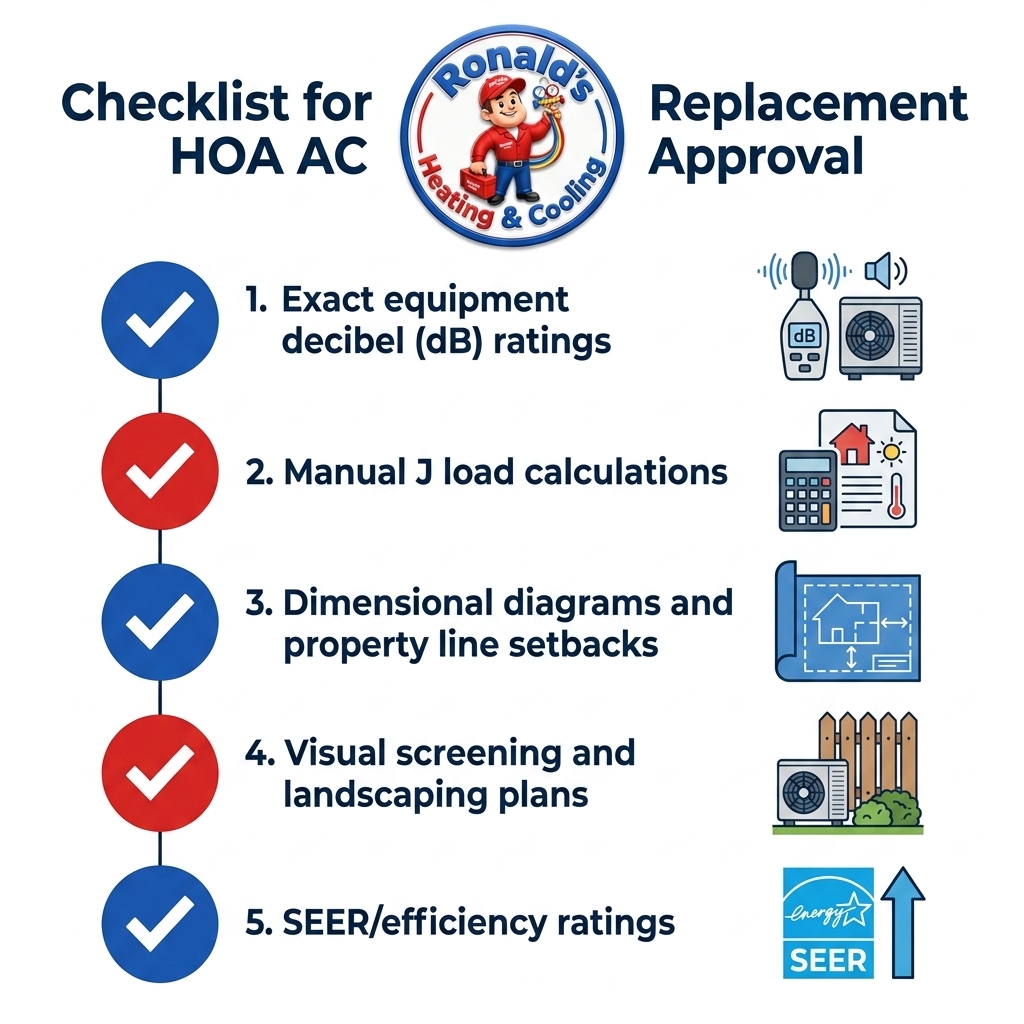
Essential documents for a flawless submission include Manual J load calculations (proving the system is sized correctly for the home), exact SEER efficiency ratings, certified outdoor unit decibel (dB) limits, and precise dimensional diagrams. Having a contractor like Ronald's Heating & Cooling supply this technical data proactively saves you hours of frustrating research and prevents the board from asking time-consuming follow-up questions.
The Contractor's Role in HOA Compliance
Generic, one-page quotes routinely fail ARC reviews because they lack the specific data board members are trained to look for. Our team at Ronald's Heating & Cooling stands out by providing detailed, transparent estimates and comprehensive system specs upfront, making it significantly easier for homeowners to submit accurate paperwork and secure fast HOA approval.
Clear, upfront system specifications empower you to hand over a complete dossier to your community manager the very same day your old system breaks down.
Executing the Project Once Approved
Once the architectural review board signs off on your packet, the focus immediately shifts from paperwork to execution. However, the rules do not disappear just because you have an approval letter in hand. Completing the work quickly and cleanly without disturbing your neighbors is vital to staying in the HOA's good graces.
Professional contractors must adhere strictly to community work hours, which often prohibit loud mechanical work before 8:00 AM or after 5:00 PM. Additionally, there are usually strict parking regulations for commercial service vehicles, preventing large box trucks from blocking neighborhood streets or parking on the grass. Debris removal is another highly regulated factor; old ductwork, rusted condenser cabinets, and packaging materials must be hauled away immediately rather than sitting in your driveway overnight.
Our installation crews go above and beyond to ensure the final setup matches the approved diagrams exactly, right down to the inch. For instance, one local homeowner reached out to us late last summer when they urgently needed a new HVAC system installed before the new school year started. We provided a detailed estimate outlining the exact scope of the work, which made navigating neighborhood approvals straightforward. Our installation team completed the job while adhering to all community guidelines, and within five days, the homeowner reported entirely positive results with their new, compliant system.
Swift, respectful execution means returning your home to a comfortable temperature quickly. If you want to understand what installation day actually looks like, review a typical one-day HVAC replacement timeline so you know exactly what to expect when our trucks arrive.
Common Questions About Neighborhood HVAC Regulations
Do I need HOA approval to replace my AC unit?
Yes, in almost all deed-restricted communities, you must obtain formal approval before replacing exterior mechanical equipment. Because modern units are often larger and have different footprints than older models, the architectural review committee must verify that the new system complies with current setback and visual screening rules. Proceeding without approval can result in steep fines or a mandate to remove the equipment.
What is the noise limit for AC units in neighborhoods?
While city ordinances vary, strict Virginia Beach HOA communities often cap continuous mechanical noise much lower than municipal laws. Many neighborhood associations require outdoor equipment to operate below 60 to 65 decibels to prevent disturbing adjacent properties. Always check your specific community bylaws and provide exact manufacturer acoustic ratings in your submission packet.
Can an HOA restrict air conditioning?
An HOA cannot completely deny your right to have functional air conditioning, but they possess broad legal authority to restrict where the unit is placed, how loud it can be, and how it must be visually screened. If your proposed replacement violates established aesthetic or setback guidelines, they can reject the application until you submit a compliant alternative. Proper documentation is the key to preventing unreasonable pushback.
How do I hide my AC unit from the HOA?
You must use community-approved screening methods that also allow for a minimum three-foot airflow clearance around the equipment. Popular approved methods include louvered vinyl or wood lattice fencing, custom breathable composite enclosures, and dense, salt-tolerant regional shrubbery. Never wrap the unit tightly or block the fan exhaust, as this will cause the system to overheat and void your warranty.
What documentation does an Architectural Review Committee need for HVAC replacement?
A complete submission packet should include a detailed contractor estimate, exact manufacturer specification sheets detailing the SEER rating and decibel output, and a dimensional property map showing the new unit's footprint. Additionally, you should include a clear plan or photographs demonstrating how the new equipment will be visually screened from the street. Providing all this information upfront is the best way to avoid a 30-day delay.
Streamline Your Next Cooling Project Today
Don't let strict neighborhood rules leave you sweltering at the end of the season. Navigating the red tape of an architectural review committee can feel overwhelming, especially when your home is uncomfortably hot, but it doesn't have to be a roadblock. With the right technical specifications, accurate dimensional diagrams, and a knowledgeable local partner like Ronald's Heating & Cooling, navigating the review process is straightforward and predictable.
By compiling a comprehensive packet that addresses noise limits, property setbacks, and visual screening upfront, you can secure fast approval and get your home back to normal. Reach out to our team today to discuss your community's specific requirements and ensure your next Air Conditioning upgrade is fully compliant, beautifully installed, and completely stress-free.
