





The Early Fall HVAC Replacement Dilemma: Precision vs. Guesswork
When local homeowners ask us about How We Size a New HVAC System: The Truth About Manual J Calculations, we always explain that mathematical precision is the only way to solve the frustrating problems caused by an aging, failing unit. In our years serving Virginia Beach coastal homes, our team at Ronald's Heating & Cooling has noticed a troubling pattern as families gather replacement quotes during this September pre-heating-season transition. One contractor walks through your front door, asks for your home's total square footage, and instantly hands you a quote for a new air conditioner and furnace. Another contractor spends over an hour measuring windows, checking insulation levels, and inspecting your ductwork before ever discussing equipment size.
This stark contrast represents the biggest decision point you will face as a homeowner: accepting a fast, "rule of thumb" guess, or insisting on industry-standard Manual J, D, and S calculations to protect your home's comfort.
The problem with guessing:
• Inaccurate load matching: Square footage alone tells a contractor nothing about how much heat your home actually gains or loses.
• Wasted energy: An improperly sized system consumes significantly more electricity and gas.
• Poor comfort: Guesswork leads to systems that cannot properly manage indoor temperature fluctuations.
Proper sizing is the absolute foundation of reliable heating and cooling. Without detailed math, any new equipment you install is set up to fail before it is even turned on.
Why the 'Square Footage' Rule of Thumb Fails Homeowners
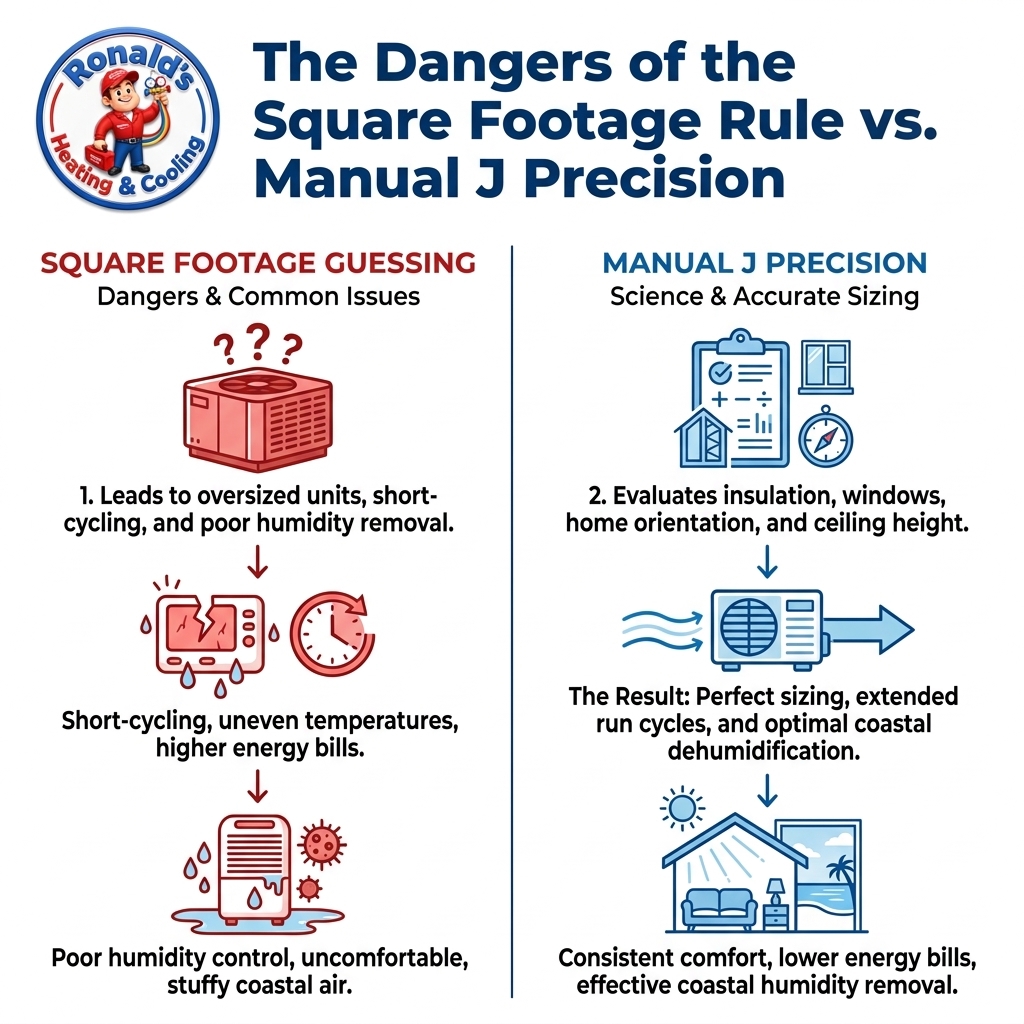
For decades, many contractors relied on a simple formula: take the square footage of a house, divide it by a set number, and use that result to determine the required tonnage of the air conditioner. This outdated rule of thumb completely ignores modern building science.
Consider two Virginia Beach coastal homes sitting side-by-side. Both are exactly 2,000 square feet.
• Home A was built in 1980, has original single-pane windows, minimal attic insulation, and faces west, taking the brunt of the afternoon sun.
• Home B was built five years ago, features double-pane low-E windows, spray foam insulation, and is shaded by large oak trees.
Despite having the exact same floor space, Home A requires significantly more cooling capacity than Home B. If a contractor uses the square footage rule, they will either install a system that is too small for Home A, leaving the family sweating all summer, or too large for Home B, creating a completely different set of mechanical issues.
Historically, contractors used this guesswork to "play it safe" by intentionally oversizing the equipment. They assumed that installing a larger unit would guarantee the house stayed cold, reducing the chance of a callback. Unfortunately, this practice comes at the homeowner's expense. One local homeowner our team worked with during a previous transition season needed a new system. Rather than just guessing, we provided a detailed presentation and quote based on actual thermal data. The result? Our technicians completed the installation efficiently in a day and a half, leaving them with excellent, reliable comfort because the system was matched perfectly to their home.
The Myth of 'Bigger is Better'
Most homeowners assume that a larger HVAC unit will cool or heat a home faster and better. The short answer is that oversizing is incredibly destructive.
When an air conditioner is too large for the space it serves, it blasts cold air and drops the indoor temperature very rapidly. The thermostat registers that the target temperature has been reached and shuts the system down after only a few minutes. This rapid on-and-off cycle causes immense mechanical wear and tear on the compressor, the most expensive component in the system. Just like a car driving in stop-and-go city traffic burns more gas and wears out its brakes faster than a car cruising on the highway, an oversized HVAC system degrades much faster than a properly sized one.
What Exactly is an ACCA Manual J Calculation?
A Manual J calculation is the only nationally recognized standard created by the Air Conditioning Contractors of America (ACCA) for properly sizing residential HVAC systems. Instead of guessing based on floor space, a Manual J calculation is a comprehensive mathematical evaluation of your home's unique thermal envelope.
To perform this calculation accurately, a trained technician must measure and input dozens of specific variables into specialized software.
Key factors evaluated during a Manual J calculation include:
• Insulation levels: The R-value of the insulation in your attic, walls, and crawlspace dictates how easily heat transfers into or out of your living space.
• Window type and placement: The size, glazing type (single vs. double pane), and direction your windows face drastically impact solar heat gain.
• Roof color and material: A dark asphalt roof absorbs far more heat than a light-colored metal roof, transferring different amounts of radiant heat into the attic.
• Ceiling height: High vaulted ceilings increase the total volume of air that needs to be conditioned, which square footage measurements completely ignore.
• Physical orientation: How your home sits relative to the sun determines which rooms will be naturally warmer during different parts of the day.
• Occupancy and appliances: The number of people living in the home and the heat generated by major appliances are factored into the final thermal load.
By compiling all this data, the Manual J calculation determines the exact amount of heat that enters your home during the summer (heat gain) and escapes during the winter (heat loss). For Virginia Beach coastal homes, this level of detail is the only way to ensure a new system is perfectly matched to the property. It removes all the guesswork and replaces it with undeniable building science.
The Hidden Danger of Oversized Systems: Short-Cycling and Humidity
The consequences of skipping a load calculation go far beyond energy efficiency. In our region, improper sizing directly impacts your daily comfort and indoor air quality.
The problem: An oversized air conditioner cools the air too quickly. This leads to a phenomenon known as "short-cycling," where the system turns on, blasts cold air, satisfies the thermostat in under ten minutes, and shuts off prematurely.
The cause: Air conditioners perform two distinct jobs: they lower the air temperature (sensible heat removal) and they pull moisture out of the air (latent heat removal). Lowering the temperature happens very quickly. Removing humidity, however, takes time. The indoor coil needs to get cold, and indoor air needs to blow across that cold coil for an extended, steady period so condensation can form and drain away.
The solution: Virginia Beach's high coastal humidity requires an HVAC system that runs in long, steady cycles to properly dehumidify the sticky air. An oversized, short-cycling system never runs long enough to extract that moisture. The result is a home that feels cold but clammy—a "cave-like" environment where 72 degrees feels damp and uncomfortable.
When planning an HVAC installation in Virginia Beach, precise sizing is a major liability if ignored. A correctly sized unit will run for longer, more efficient cycles, thoroughly stripping the humidity from the air and leaving your home feeling crisp and comfortable at a higher, energy-saving thermostat setting.
Beyond Sizing: How Manual D Ensures Proper Airflow
Sizing the equipment correctly with a Manual J calculation is only half the battle. Once you know the exact capacity required, you must ensure your home's ductwork can actually deliver that conditioned air. This is where the ACCA Manual D standard comes into play.
Manual D is the industry standard for residential duct design. It calculates the necessary size, layout, and configuration of your ductwork to ensure the right volume of air reaches every single room in the house.
Why ductwork math matters:
• Static pressure management: Think of your ductwork like a plumbing system. If you attach a massive, high-powered pump to a tiny, narrow garden hose, the pressure builds up, the water struggles to flow, and the pump eventually burns out. The same physics apply to HVAC systems.
• Blower motor protection: Mismatched ductwork chokes a new, high-efficiency system. The blower motor has to work twice as hard to push air through ducts that are too small, leading to premature motor failure.
• Eliminating hot and cold spots: Manual D ensures that the bedroom at the farthest end of the house receives the exact same level of comfort as the living room right next to the indoor unit.
A comprehensive approach evaluates the entire air distribution network, not just the metal box sitting outside. If a contractor installs a perfectly sized air conditioner on an undersized, poorly designed duct system, you will still suffer from increased noise, reduced efficiency, and uneven temperatures across your Virginia Beach coastal home.
Navigating the Fall Transition: Why Accurate Load Calculations Matter Now
The importance of proper sizing becomes painfully obvious during the September pre-heating-season transition. Early fall brings unpredictable temperature swings. You might experience a chilly 55-degree morning followed by an 80-degree afternoon with lingering coastal humidity.
During these mild transition periods, the overall cooling demand on your home is significantly reduced, but the need for humidity removal remains high. An oversized, improperly sized system will struggle the most right now. Because it doesn't have to work hard to lower the temperature, it will short-cycle even faster than it did in July, failing completely to dehumidify your home.
If you are planning a heating system replacement before winter arrives, accurate sizing is just as critical for your furnace or heat pump.
Steps to prepare for a successful fall replacement:
1. Document current issues: Note which rooms are consistently too hot or too cold, and share this with your technician.
2. Demand load calculations: Do not accept a quote for a winter heating system without verifying that a Manual J calculation will be performed.
3. Evaluate the whole system: Ensure the contractor plans to inspect your ductwork and insulation, not just the mechanical equipment.
4. Prioritize steady performance: Look for equipment recommendations that focus on long, steady run times rather than sheer blast power.
One local family experienced this firsthand last fall when their entire HVAC system was malfunctioning. Our technicians came out, assessed the true load requirements using precise math, and replaced the entire system. Because it was sized correctly for their specific thermal envelope, the new system works perfectly with no issues, easily handling the unpredictable temperature shifts of the changing seasons.
Recognizing Honest Quotes over High-Pressure Sales Tactics
Understanding the science behind HVAC sizing is also one of your best consumer protection tools. Performing a proper Manual J calculation takes time, specialized training, and genuine effort. These are things a high-pressure salesperson usually wants to avoid.
Many "fast-pitch" contractors want to get into your home, glance at the data plate on your old unit, quote a replacement of the exact same size, and pressure you into signing a contract before they leave. If your original system was oversized when it was built twenty years ago, this practice just guarantees you will be paying for another oversized, inefficient system for the next two decades.
How to vet a trustworthy contractor:
• Ask to see the math: A reputable technician will gladly show you the load calculation data and explain what it means for your home.
• Beware the "rule of thumb": If a contractor tells you they "just know" what size you need based on square footage or neighborhood averages, politely decline their services.
• Look for comprehensive evaluations: Honest quotes include an inspection of your ductwork, attic insulation, and window quality.
At Ronald's Heating & Cooling, we believe that the mathematical precision of these calculations is the ultimate defense against pushy, inaccurate sales pitches. Our commitment to precision means we perform actual Manual J and D calculations instead of guessing. Another homeowner reached out last fall needing an HVAC system installed. We provided a detailed, honest estimate backed by real data, and completed the work exactly as described. Within five days, the quality work was fully validated, with the system functioning exceptionally well. That is the difference between a trustworthy HVAC opinion and a high-pressure sales pitch.
Frequently Asked Questions About HVAC Sizing
What is a Manual J calculation?
A Manual J calculation is the nationally recognized standard protocol developed by the Air Conditioning Contractors of America (ACCA) for sizing residential HVAC systems. It uses specialized software to evaluate factors like your home's insulation, window types, orientation to the sun, and ceiling height. This mathematical approach determines the exact amount of heating and cooling capacity your home needs, eliminating the risks of guesswork.
Do I really need a Manual J calculation for a new HVAC system?
Yes, performing a Manual J calculation is the only way to guarantee your new system will operate efficiently and keep you comfortable. Skipping this step often results in installing an incorrectly sized unit, which leads to higher energy bills, frequent breakdowns, and poor temperature control. Professional contractors consider this calculation a mandatory part of any proper installation.
Why is square footage not enough to size an HVAC unit?
Square footage only measures floor space; it ignores the critical variables that dictate how much heat enters or leaves your home. Two houses with the exact same square footage can have drastically different heating and cooling needs based on their insulation quality, window efficiency, and sun exposure. Relying solely on square footage almost always results in an improperly sized system.
What happens if my HVAC system is oversized?
An oversized HVAC system will cool or heat your home too quickly and shut off prematurely, a process known as short-cycling. This rapid on-and-off operation causes severe wear and tear on the system's components, leading to a shorter lifespan. Additionally, an oversized air conditioner will not run long enough to remove humidity, leaving your home feeling clammy and uncomfortable.
What is the difference between a Manual J and a Manual D calculation?
Manual J calculates the exact heating and cooling load required for your home, determining the proper size of the mechanical equipment. Manual D, on the other hand, calculates the proper design and sizing of your ductwork system. Both are necessary; Manual J ensures you have the right equipment, while Manual D ensures the ductwork can properly deliver the air that equipment produces.
How does an oversized air conditioner affect indoor humidity?
An oversized air conditioner lowers the indoor temperature very rapidly but shuts off before it has time to extract moisture from the air. Because dehumidification requires long, steady cooling cycles, an oversized unit leaves excess moisture suspended in your living space. This results in a cold but highly humid environment, which is especially problematic in coastal climates.
Protect Your Coastal Home's Comfort with Science-Backed Sizing
A new heating and cooling system is one of the most significant investments you will make in your home. That level of investment demands mathematical precision, not outdated guesswork. Whether you are dealing with the September pre-heating-season transition or preparing for the peak of summer, relying on the square footage rule of thumb is a risk you do not need to take.
Proper Manual J and D calculations are the foundation of a healthy, efficient home. They ensure optimal humidity control, lower monthly energy costs, and protect your equipment from the damaging effects of short-cycling. By insisting on science-backed sizing, you guarantee that your new system is perfectly calibrated to your home's unique thermal envelope.
If you are ready to experience the difference that precision math makes, learn more about our comprehensive air conditioning services. We prioritize accurate sizing over quick sales, ensuring you receive a clear understanding of your home's needs and the lasting comfort you deserve.
