





Is Skipping Your Fall Furnace Tune-Up Worth the Risk?
Have you ever wondered if the risks of skipping your pre-winter furnace inspection are truly as serious as professionals claim, or if your system can just coast through another year? You are certainly not alone in asking this question. Many homeowners face a familiar dilemma every autumn: the furnace ran perfectly fine at the end of last winter, it hasn't made any strange noises while sitting idle, and spending money on a system that isn't currently broken feels unnecessary. During the mild September pre-heating transition, when the weather is comfortable and indoor temperatures are easy to manage, it is incredibly tempting to push furnace maintenance to the bottom of your to-do list.
However, assuming your equipment is safe simply because it turns on is a dangerous gamble. A professional tune-up is not just a quick cleaning to help your equipment run a little more efficiently. At its core, it is a critical, comprehensive safety evaluation designed to protect your home and your family. Modern heating systems are complex machines that burn combustible fuel to generate warmth, and the byproducts of that combustion must be safely managed and vented outside.
When you skip this annual evaluation, you aren't just risking a slightly higher utility bill. You are bypassing the only opportunity to detect hidden, invisible dangers that develop silently over the summer. By the time the first real freeze arrives and forces your system to run continuously, those minor, undetected flaws can escalate into complete mechanical failures or severe health hazards. Understanding what actually happens inside your unit during an inspection changes the conversation from "can I afford to do this?" to "can I afford not to?"
The Invisible Danger of Cracked Heat Exchangers
To understand why a pre-winter inspection is so vital, you have to understand the most critical component inside your furnace: the heat exchanger. This metal chamber is the heart of your heating process. When your furnace turns on, burners ignite fuel inside the heat exchanger, making the metal extremely hot. Your blower motor then pushes your home's indoor air across the outside of this hot metal chamber, warming the air before circulating it through your vents. Most importantly, the heat exchanger acts as an impenetrable physical barrier between the toxic combustion gases inside the chamber and the clean breathing air circulating through your home.
The Mechanics of Metal Fatigue
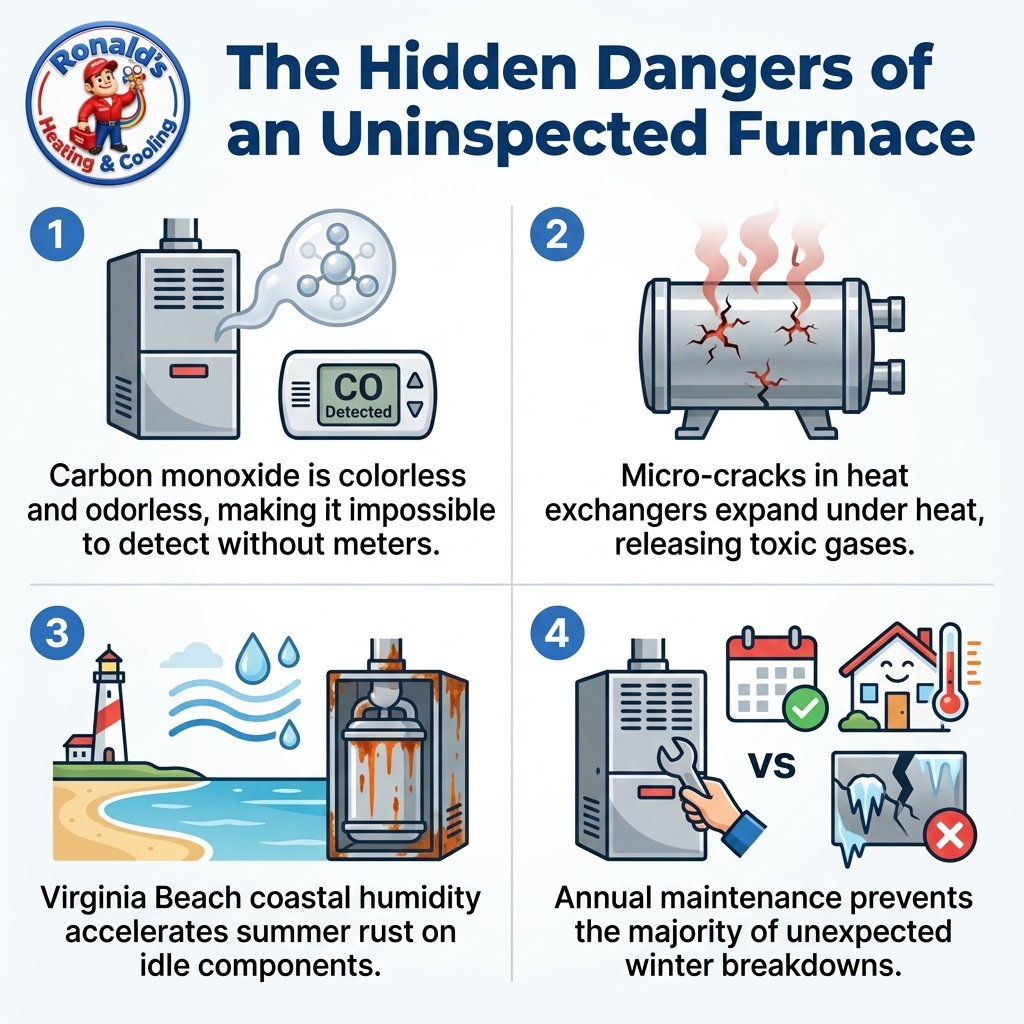
Every time your furnace cycles on, the heat exchanger gets incredibly hot and the metal expands. When the cycle ends, the metal cools and contracts. Over thousands of heating cycles, this constant expansion and contraction causes metal fatigue. Eventually, the stress on the metal can lead to the formation of micro-cracks. These cracks are incredibly insidious because they are often completely invisible when the furnace is turned off and the metal is cold. It is only when the burners ignite and the metal expands under intense heat that these micro-cracks open up.
The Carbon Monoxide Threat
When a crack opens in the heat exchanger, the toxic gases produced by combustion—most notably carbon monoxide (CO)—can escape the chamber and mix with the air being blown into your living spaces. Carbon monoxide is entirely colorless, odorless, and tasteless, making it impossible for a homeowner to detect without specialized equipment. Exposure to even low levels of CO over time can cause headaches, dizziness, nausea, and fatigue, while high concentrations can be fatal.
Why Visual Inspections Fail
Because micro-cracks only reveal themselves under active thermal expansion, a simple visual once-over with a flashlight is dangerously insufficient for detecting them. You cannot simply look at a cold furnace and declare the heat exchanger intact. This is why certified technicians rely on professional combustion analyzer readings. These highly sensitive, calibrated diagnostic meters are inserted into the system's exhaust stream to measure the exact chemical makeup of the gases. If even a trace amount of carbon monoxide or abnormal oxygen levels are detected where they shouldn't be, the meter proves that a breach exists, long before it becomes a tragedy.
How Coastal Off-Seasons Accelerate Furnace Corrosion
The environment where your furnace lives plays a massive role in how quickly it deteriorates, even when it isn't running. Homeowners often assume that because their heating equipment is turned off from May through September, it isn't experiencing any wear and tear. In reality, the idle summer months can be incredibly harsh on your system's internal components, especially in our specific region.
The Impact of High Humidity on Idle Metal
Living in the Virginia Beach coastal climate introduces a unique set of challenges for HVAC equipment. Throughout the long, hot summer, the air is thick with moisture. Even if your furnace is located indoors in a utility closet, basement, or attic, it is still exposed to ambient humidity. When warm, damp coastal air circulates around the cold, idle metal components of your furnace, condensation naturally forms on the surfaces.
The Chemistry of Accelerated Rust
This persistent moisture acts as a catalyst for oxidation. Over the course of the summer, rust begins to quietly eat away at critical components, including the burners, the ignition sensors, and most dangerously, the heat exchanger. The salty, humid nature of coastal air only accelerates this corrosive process. By the time the September pre-heating transition arrives, the structural integrity of that metal may be significantly compromised compared to the previous spring.
The Breaking Point
When the first cold snap hits and you finally turn your thermostat to "heat," that rusted, weakened metal is suddenly subjected to blasts of intense fire. The rapid thermal expansion forces the compromised metal to flex. Rust lacks the flexibility of healthy steel, making it highly susceptible to snapping and fracturing under pressure. What began as a little bit of off-season surface moisture quickly evolves into a cracked heat exchanger and a severe safety hazard. A proactive fall inspection catches this corrosion while the system is still safely offline, allowing technicians to clean away minor oxidation or recommend repairs before the metal completely fails under thermal stress.
Diagnostic Safety Checks vs. Subjective Sales Pitches
One of the most common reasons homeowners hesitate to schedule a pre-winter inspection is the fear of being pressured into an unnecessary purchase. It is a valid anxiety: nobody wants to invite a technician into their home only to be handed a laundry list of expensive, confusing upgrades based on someone's subjective opinion. However, understanding the difference between a high-pressure sales tactic and a genuine, data-backed safety evaluation changes the entire dynamic of a maintenance visit.
A true professional inspection is rooted in objective science, not guesswork. When a technician evaluates your system, they aren't just looking around and making assumptions; they are gathering hard data to ensure your equipment meets strict operational safety standards. If you are ever in doubt, looking for a trustworthy HVAC opinion means looking for a technician who relies on diagnostic proof rather than scare tactics.
Comparing Inspection Approaches
To illustrate the difference, here is a breakdown of what a basic visual check looks like compared to a comprehensive diagnostic evaluation:
• Heat Exchanger Testing — Basic Visual Inspection: Shining a flashlight into the chamber to look for obvious, gaping holes. — Professional Diagnostic Evaluation: Using professional combustion analyzer readings to detect invisible micro-cracks and gas leaks.
• Electrical Components — Basic Visual Inspection: Checking to see if the wires are connected and the unit powers on. — Professional Diagnostic Evaluation: Testing capacitors and motors with a multimeter to measure exact voltage and amperage draw.
• Gas Pressure — Basic Visual Inspection: Looking at the color of the burner flames to guess if the mixture is right. — Professional Diagnostic Evaluation: Using a manometer to precisely measure and adjust gas pressure to the manufacturer's exact specifications.
• The Final Verdict — Basic Visual Inspection: Subjective opinions based on the age of the unit or the way it sounds. — Professional Diagnostic Evaluation: Objective, data-driven reports that prove exactly how the system is performing against safety baselines.
When a technician uses tools like a combustion analyzer, a multimeter, and a manometer, they remove the guesswork. If they tell you a part is failing, they can show you the exact reading on their meter that proves it. This level of transparency transforms the inspection from a stressful sales encounter into an objective safety requirement that provides genuine peace of mind.
Preventing Unexpected Heating Failures During Winter Storms
Beyond the invisible dangers of carbon monoxide and heat exchanger cracks, skipping your fall tune-up dramatically increases the risk of a sudden, catastrophic breakdown exactly when you need your heat the most. Furnaces rarely fail on a mild, sunny afternoon. They fail when they are under maximum stress—typically during the first major winter storm or deep freeze of the year, when the system is forced to run continuously for days on end to keep up with the plummeting outdoor temperatures.
The Strain of Continuous Operation
An unmaintained furnace is forced to work much harder to achieve the same level of comfort. Dust buildup on the blower motor, a clogged air filter, or a failing capacitor forces the system to draw more electricity and generate more internal heat. This added strain wears down weakened components rapidly. A blower belt that is slightly frayed in September will inevitably snap under the heavy workload of a January cold snap. A dirty flame sensor that struggles to read the burner in the fall will completely lock the system out when the temperature drops below freezing.
The Reality of Emergency Wait Times
When a neglected system fails during a winter storm, it creates an immediate crisis for the household. Furthermore, because extreme weather events stress everyone's heating equipment simultaneously, emergency repair wait times peak during these cold snaps. HVAC companies are flooded with calls, and you may find yourself waiting in a freezing house for a technician to become available.
One local homeowner experienced this exact scenario during a bitter winter cold snap when their heater unexpectedly went out. Because they reached out immediately, a technician was able to arrive within an hour, diagnose the failing components, retrieve the necessary parts, and restore their heat quickly. While a rapid response is always the goal for furnace repair in Virginia Beach, avoiding that stressful, freezing emergency altogether through proactive fall maintenance is always the safer, more comfortable route.
Frequently Asked Questions About Pre-Winter Furnace Safety
Homeowners often have specific concerns about what exactly goes into an inspection and why it matters so much for their daily comfort and security. Prioritizing seasonal furnace maintenance is the best way to keep your equipment running smoothly, but it helps to understand the reasoning behind the recommendations. Here are the answers to the most common questions regarding furnace safety and upkeep.
Is annual furnace maintenance really necessary?
Yes, annual furnace maintenance is absolutely critical for the safety, efficiency, and longevity of your equipment. Beyond preventing unexpected breakdowns, regular inspections ensure that all gas connections and exhaust flues are operating safely. Additionally, the vast majority of equipment manufacturers explicitly require documented annual maintenance to keep your system's warranty valid; skipping it can leave you financially responsible for major repairs.
Can a dirty furnace cause carbon monoxide leaks?
A severely dirty furnace can indirectly lead to carbon monoxide leaks over time. When dust and debris clog the air filter, the blower motor, or the internal airflow pathways, the system cannot breathe properly, causing it to overheat. This chronic overheating puts immense thermal stress on the heat exchanger, which can eventually lead to the micro-cracks that allow carbon monoxide to escape into your home's breathing air.
What happens if you don't clean your furnace?
If you don't clean your furnace, dust, pet dander, and debris will build up on critical internal components like the burners and the ignition system. This buildup acts as an insulator, causing the system's efficiency to plummet and leading to significantly higher utility bills. Furthermore, heavy dust accumulation inside the combustion chamber can become a serious fire hazard when the burners ignite after months of sitting idle.
How do professionals check for a cracked heat exchanger?
Professionals check for a cracked heat exchanger by using specialized diagnostic tools, most notably a combustion analyzer. This highly sensitive meter is inserted into the exhaust stream to read the exact chemical makeup of the gases being vented. Because micro-cracks are often invisible to the naked eye when the metal is cold, visual inspections alone cannot reliably identify them; the meter proves whether toxic gases are escaping the chamber.
How often should a furnace be inspected?
A furnace should be inspected by a certified professional at least once a year. The ideal time to schedule this evaluation is in the early fall, before the heating season begins in earnest. Catching minor wear and tear, corrosion, or safety hazards while the weather is still mild prevents emergency breakdowns and ensures your system is safe to operate before the first freeze forces it to run continuously.
Secure Your Home's Safety Before the First Freeze
Ultimately, deciding to schedule your annual tune-up during the mild September pre-heating transition is one of the smartest investments you can make in your home's security. It is not just about making sure the warm air blows; it is about verifying that the invisible, complex mechanical processes happening inside that metal cabinet are functioning exactly as designed. The risks of carbon monoxide exposure, accelerated coastal corrosion, and sudden winter breakdowns are simply too high to leave to chance.
By relying on professional diagnostic tools rather than guesswork, a certified technician provides the objective data you need to trust your equipment. Don't wait until the first freezing night of the year to find out if your heating system is safe and reliable. Take action while the weather is still comfortable, and schedule your furnace maintenance plan visit today to secure your family's comfort and peace of mind for the entire winter season.
