





Surviving the Heat: Evaluating Your System's Late-Summer Performance
As August draws to a close and the back-to-school transition begins, it is time for an End-of-Summer AC Post-Mortem: Did Your System Barely Survive? At Ronald's Heating & Cooling, we know your air conditioner has been working overtime for months to keep your home comfortable, and the sheer exhaustion of relentless late-summer heat takes a massive toll on residential cooling equipment. Just because your system made it to the end of August does not automatically mean it is healthy, efficient, or prepared to handle another brutal season next year. Now is the time to evaluate its current health and determine if proactive planning is your best next step.
If you are looking for reliable air conditioning services or suspect it might be time to discuss an AC replacement in Virginia Beach, taking stock of your equipment's performance today can save you from a major headache tomorrow.
The Value of an End-of-Season Assessment
Most homeowners only think about their air conditioner when it completely stops blowing cold air. However, waiting for a total breakdown is a stressful and often expensive way to manage your home's comfort. An end-of-summer post-mortem is a proactive approach. It involves looking back at how well your system handled the peak load of the season and identifying any lingering red flags that popped up when the temperatures spiked.
Key areas our technicians recommend evaluating during your post-mortem include:
• Overall comfort levels: Did certain rooms stay stubbornly warm no matter how low you set the thermostat?
• Energy consumption: Did your utility bills spike significantly compared to the same time last year?
• System reliability: Did you have to call for emergency repairs, or did the system frequently trip your circuit breaker?
• Indoor air quality: Did the air inside your home feel sticky, stale, or damp during the hottest weeks?
By assessing these factors now, while the memory of the summer heat is still fresh, you empower yourself to make a logical decision. You can figure out if your system just needs a thorough cleaning, a few minor repairs, or if you need to start budgeting for a new unit before the next cooling season begins.
The Coastal Toll: Why Coastal Humidity Pushes Systems to the Brink
Living near the water offers incredible lifestyle benefits, but it also creates a uniquely harsh environment for mechanical equipment. In Virginia Beach, intense late-summer coastal humidity drastically increases the workload on residential cooling systems. Your air conditioner is not just lowering the temperature of the air; it is also acting as a massive dehumidifier. When the air is thick with moisture, your system is forced to work twice as hard to achieve the same level of comfort. Our team sees the brutal effects of this coastal environment on HVAC equipment every single day.
The Hidden Workload of Dehumidification
To understand why coastal humidity is so punishing, it helps to know how your system actually cools your home. Warm indoor air is blown over the cold evaporator coils inside your unit. As the air cools, the moisture in that air condenses into water droplets on the coils—much like condensation forming on the outside of a cold glass of water on a hot day. That water then drains away, leaving the air drier and cooler.
When humidity levels are exceptionally high in Virginia Beach, your system has to extract gallons of water from the air every single day. If your aging air conditioner struggles to remove that moisture, your home will feel uncomfortable, sticky, and warm, even if the thermostat reads a perfectly cool 72 degrees. This relentless demand for dehumidification exposes underlying weaknesses in older systems.
The cascading effects of high coastal humidity include:
1. Extended run cycles: The system has to stay on much longer to pull enough moisture out of the air to make the home feel comfortable.
2. Accelerated mechanical wear: Moving parts like the blower motor and compressor endure significantly more friction and heat due to the extended run times.
3. Increased risk of frozen coils: If the system is running constantly to fight humidity but airflow is slightly restricted, the excessive condensation can freeze solid on the coils, shutting the whole system down.
This relentless runtime directly translates to accelerated wear and tear. A system that might easily last 15 years in a dry, mild climate will age much faster when forced to battle heavy, moisture-laden coastal air day in and day out.
Performance Check: Did Your AC Run Nonstop This Summer?
One of the most telling signs that your air conditioner struggled through late summer is its cycling behavior. Pay close attention to how often the unit turns on, how long it stays on, and how quickly it shuts off. When our team gets called out for late-August breakdowns, abnormal run times are a primary indicator that a system is experiencing diminished cooling capacity and mechanical fatigue.
Diagnosing Abnormal Cycling
There are two main types of abnormal cycling that signal trouble: short cycling and constant running. Both are massive red flags, but they point to different underlying issues.
• Short Cycling — What It Looks Like: The system turns on, runs for only 5 to 10 minutes, shuts off, and immediately turns back on. — Common Underlying Causes: Overheating compressor, severe refrigerant leaks, oversized equipment, or a failing thermostat.
• Constant Running — What It Looks Like: The system runs for hours on end without ever satisfying the temperature set on the thermostat. — Common Underlying Causes: Diminished cooling capacity, severe airflow restrictions, heavily soiled coils, or an undersized unit.
An air conditioner that runs non-stop without reaching your desired temperature is essentially waving a white flag. It means the system has lost its ability to transfer heat effectively. The compressor is working as hard as it can, but it simply cannot keep up with the heat load of the house. Ignoring these runtime red flags is a dangerous game. Pushing a fatigued compressor to run continuously will eventually cause it to overheat and burn out entirely, leading to sudden and catastrophic mechanical failure.
Identifying these issues early provides a crucial window of opportunity. If you noticed your system running endlessly through August, scheduling an AC repair assessment now allows a professional to address the root cause before a total breakdown leaves you stranded.
The Silent Threat: How Salt Air Corrosion Accelerates Aging
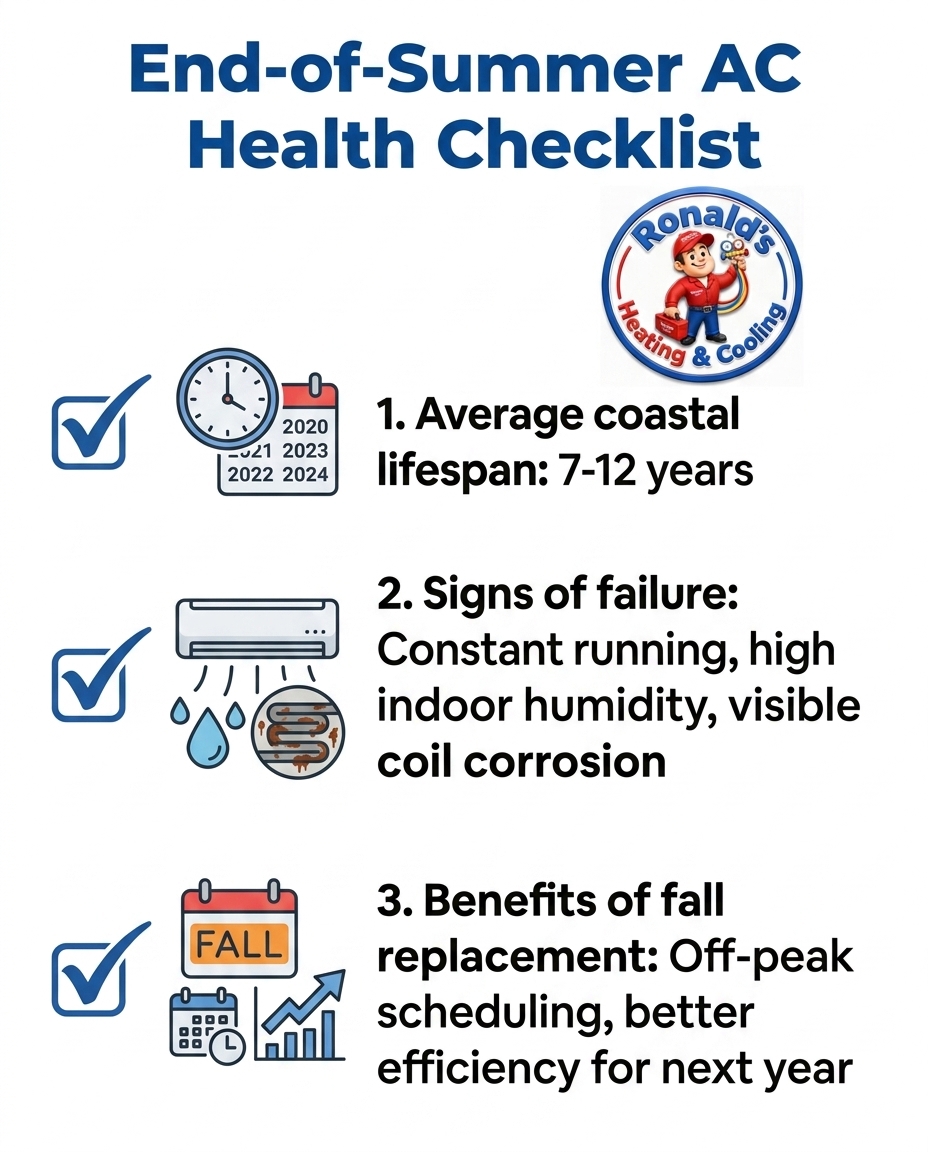
Beyond the heavy workload of dehumidification, homeowners in Virginia Beach face another invisible enemy: coastal salt air. The salty moisture carried by ocean breezes is highly corrosive to the metal components of your outdoor condenser unit. In our years of servicing local neighborhoods, we've found this environmental factor is a primary reason why coastal AC units typically have a significantly shorter lifespan—often lasting only 7 to 12 years—compared to the 15-plus years expected from standard inland units.
The Science of Coastal Corrosion
Your outdoor air conditioning unit is packed with delicate metal parts, primarily copper tubing and extremely thin aluminum fins. These metals are highly susceptible to galvanic corrosion when exposed to salt and moisture. Salt acts as an electrolyte, accelerating the chemical reaction that causes metal to break down and rust.
When salty air constantly washes over the outdoor unit, it begins to eat away at the aluminum fins that surround the condenser coil. These fins are critical for dissipating the heat pulled from your home. As they corrode, they become brittle, crumble, and literally turn to dust.
Visual signs of salt air corrosion include:
• White, powdery residue: Often the first sign of aluminum oxidation on the exterior casing or the fins themselves.
• Brittle or missing fins: Sections of the metal fins that easily flake away when lightly touched.
• Rust on the cabinet: Orange or brown flaking on the painted metal exterior of the unit, particularly near the base.
• Pitted copper lines: Small, dark divots on the exposed copper refrigerant lines connecting to the unit.
The impact of this corrosion is severe. When the fins deteriorate, the coil loses its ability to transfer heat efficiently. The system has to run longer and consume more electricity to achieve the same cooling effect, compounding the system's struggle and driving up your utility bills. If you live within a few miles of the coast and your unit is approaching a decade old, salt air corrosion is likely already taking a heavy toll.
Honest Diagnostics: Deciding Between Maintenance, Repair, or Replacement
When your air conditioner shows signs of severe late-summer fatigue, it is easy to assume the worst. However, not every strange noise, extended run cycle, or dip in performance requires a full system overhaul. Providing a transparent, objective framework for evaluating your next steps is crucial, ensuring you never feel pressured into an immediate sale when a simpler fix might suffice.
Finding the Root Cause
The difference between needing a basic tune-up and requiring a major intervention often comes down to a single failing component. A trustworthy professional assessment will explore all viable options to restore your comfort. At Ronald's Heating & Cooling, we see this pattern often in our service area. Consider a recent scenario our team handled: a local homeowner was dealing with a system that simply wouldn't run. Another provider had quickly inspected it and insisted the equipment was entirely outdated and required an immediate, full replacement. When our technicians performed a thorough, honest diagnostic instead, the real culprit was discovered—a single, unhooked missing part. Once that specific part was ordered and installed, the system worked perfectly again.
This highlights the massive value of having a professional troubleshoot the exact cause before you jump to conclusions.
Here is a general framework for how our team usually categorizes issues:
• Likely a Tune-Up: The system is running constantly but the air feels moderately cool, utility bills are slightly elevated, or there is minor debris around the outdoor unit. This often points to dirty coils or a clogged filter that routine AC maintenance can resolve.
• Likely a Repair: The system is short-cycling, making intermittent rattling noises, or blowing warm air. This usually indicates a specific failing part, like a bad capacitor, a worn contactor, or a minor refrigerant leak that can be patched and recharged.
• Likely a Replacement: The compressor is loudly grinding, the coils are heavily corroded and leaking, or the unit uses outdated R-22 refrigerant and has suffered a major failure.
By relying on an honest diagnostic process, you ensure that you only invest in a replacement when it is absolutely the most financially sound and logical decision for your home.
Signs Your AC Needs Replacement After Summer
If your end-of-summer post-mortem reveals that your system is truly on its last legs, recognizing the definitive signs of failure is the first step toward planning your upgrade. While a professional diagnostic is always recommended, there are several clear indicators that an air conditioner has reached the end of its usable life in a coastal environment.
Watch for these definitive signs our technicians look for that indicate your system barely survived the summer:
• Age of the equipment: The unit is approaching or exceeding 10 to 12 years old, which is the typical maximum lifespan for systems exposed to harsh coastal salt air.
• Escalating repair frequency: You have had to call for repairs multiple times over the past cooling season, and the cost of keeping the unit running is becoming financially impractical.
• Total loss of humidity control: The system runs continuously but fails to manage indoor humidity levels, leaving your home feeling sticky, damp, and uncomfortable.
• Extensive visible corrosion: The outdoor condenser coils and metal fins are heavily rusted, crumbling, or coated in white oxidation, severely limiting heat transfer.
• Persistent mechanical noises: The unit makes loud grinding, squealing, or heavy clanking noises that do not go away, strongly indicating that the compressor is failing internally.
• Rising energy consumption: Your summer electric bills have skyrocketed compared to previous years, even though your usage habits and thermostat settings have not changed.
Looking Ahead: Navigating Your Replacement Options
If your assessment clearly shows that your air conditioner is failing, coming to that realization now is actually a significant advantage. Bridging the gap between a failing system and a brand-new installation is much easier when you are not in the middle of a mid-July heatwave. Planning your next steps carefully ensures you get the right equipment for your specific needs.
Why Fall is the Perfect Time to Plan
We always advise our customers that there is a massive strategic advantage to planning an AC replacement in the fall. During the peak summer rush, homeowners are often forced to make rushed, panicked decisions simply to get cold air blowing again as fast as possible. By planning in the autumn months, you avoid the emergency rush. You have the time to carefully evaluate different brands, explore financing options, and schedule the installation at your convenience without suffering through days of intense heat.
Furthermore, modern air conditioning systems offer incredible advancements over units built just a decade ago. Today's variable-speed compressors provide significantly better humidity control by running at lower speeds for longer durations, extracting massive amounts of moisture from the air without overcooling the space. They are also vastly more energy-efficient. Additionally, federal tax credits or local utility incentive programs may apply to qualifying high-efficiency heat pump or AC installations. We recommend verifying current programs with your utility company or a tax professional to maximize your investment.
As you begin your research, take the time to understand how different efficiency ratings impact your long-term operating costs. For instance, comparing 14 SEER vs 18 SEER AC replacements will help you find the sweet spot between upfront installation costs and long-term monthly energy savings. Position this proactive replacement not as an unexpected expense, but as a calculated investment in uninterrupted comfort, lower utility bills, and true peace of mind for the years ahead.
Frequently Asked Questions
Should I replace my AC at the end of summer?
Replacing your AC at the end of summer or early fall is often the smartest timing. It allows you to avoid the chaotic peak-season rush and gives you ample time to research your options without the pressure of a hot, uncomfortable house. Plus, it ensures your new, efficient system is fully installed and tested long before the next year's heatwave hits.
What are the signs my AC is failing?
Key signs of a failing AC include constant running without reaching the set temperature, a sudden spike in your energy bills, and an inability to control indoor humidity. You might also notice strange grinding noises from the outdoor unit or frequent tripped circuit breakers. If you are experiencing multiple issues simultaneously, the system is likely nearing the end of its life.
How long do AC units last in coastal areas?
Air conditioners in coastal areas typically last between 7 and 12 years. This is significantly shorter than the 15-plus years expected in inland regions. The constant exposure to salty ocean air accelerates the corrosion of the metal coils and fins, leading to faster mechanical degradation.
Is fall a good time to buy a new air conditioner?
Yes, fall is an excellent time to invest in a new air conditioner. Because the intense summer demand has subsided, scheduling an installation is usually much more flexible. Homeowners can take their time selecting the right unit and exploring high-efficiency models without the stress of an ongoing breakdown.
How does salt air affect my air conditioner?
Salt air acts as an electrolyte that rapidly accelerates galvanic corrosion on the metal components of your outdoor unit. It eats away at the thin aluminum fins surrounding the condenser coil, causing them to become brittle and crumble. Once those fins deteriorate, the system loses its ability to release heat effectively, forcing it to work much harder.
Can high humidity damage my AC system?
High humidity forces your air conditioner to run for much longer cycles to extract moisture from the air. While AC units are designed to dehumidify, the relentless workload of extreme coastal humidity causes accelerated wear and tear on moving parts like the compressor and blower motor. Over time, this constant strain significantly shortens the lifespan of the equipment.
Secure Your Comfort for Next Year
Do not wait until the first heatwave of next year to find out your air conditioner didn't survive the winter. Schedule your end-of-summer diagnostic with Ronald's Heating & Cooling today to get a clear, regionally-aware framework of your system's health. We will help you evaluate its performance honestly, so you can decide if a proactive replacement is necessary to keep your home perfectly comfortable.
