





Facing the Fall HVAC Dilemma: To Add Gas Backup or Not?
Your aging heating equipment is struggling, and you know it will not survive another winter. This brings up a critical question: is upgrading to a dual fuel system vs. sticking with a standard heat pump in coastal Virginia the right move for your home? Making this choice during the September pre-heating season gives you the time to evaluate your options before emergency conditions set in. At Ronald's Heating & Cooling, our team has helped countless local homeowners navigate this exact dilemma. You need a system that balances our region's mostly mild coastal weather with the real threat of sudden, unexpected deep freezes. Navigating this decision means looking past basic equipment definitions and focusing on how these systems actually perform under pressure. If you are considering heating replacement in Virginia Beach, understanding the operational differences between these two setups is the first step toward securing reliable, efficient comfort for your family.
How Unpredictable Coastal Freezes Test Your Heating Equipment
Our region presents a unique challenge for residential heating systems. In Coastal Virginia Beach, the baseline winter climate is relatively moderate. Average winter lows typically hover between 32 and 35 degrees Fahrenheit. During these mild stretches, our technicians see standard heating equipment operate with minimal strain. However, the true test of your home's heating infrastructure does not happen on an average day. It happens when unpredictable polar vortex dips send temperatures plummeting into the teens.
These sudden extreme weather events place an immense burden on HVAC equipment. We frequently encounter systems that run flawlessly at 45 degrees but suddenly struggle to maintain a comfortable indoor temperature when the mercury drops below freezing. The challenge is not just the absolute temperature; it is the speed at which these cold snaps arrive and the duration they linger. When a severe winter storm hits, your heating system must work overtime to compensate for the rapid heat loss through your home's walls, windows, and roof.
The Impact of High Humidity on Cold Weather Comfort
Temperature alone does not tell the full story of our local winter weather. Coastal Virginia Beach is characterized by high humidity, which significantly impacts both human comfort and mechanical performance. Moisture in the air makes lower temperatures feel much more biting and intrusive than dry cold. A 30-degree day with high humidity feels significantly colder than a 30-degree day in an arid climate, prompting homeowners to push their thermostats higher.
For heat pumps, this humid cold introduces a mechanical hurdle. As the system pulls thermal energy from the outside air, the moisture in that air condenses and freezes on the outdoor unit's coils. To prevent this ice buildup from crippling the system, the unit must frequently enter a defrost cycle. During a defrost cycle, the system temporarily reverses its operation, using energy to melt the ice rather than heating your home. Frequent defrost cycles reduce overall heating efficiency and can lead to uneven indoor temperatures.
The Standard Heat Pump: Everyday Efficiency with a Freezing Catch
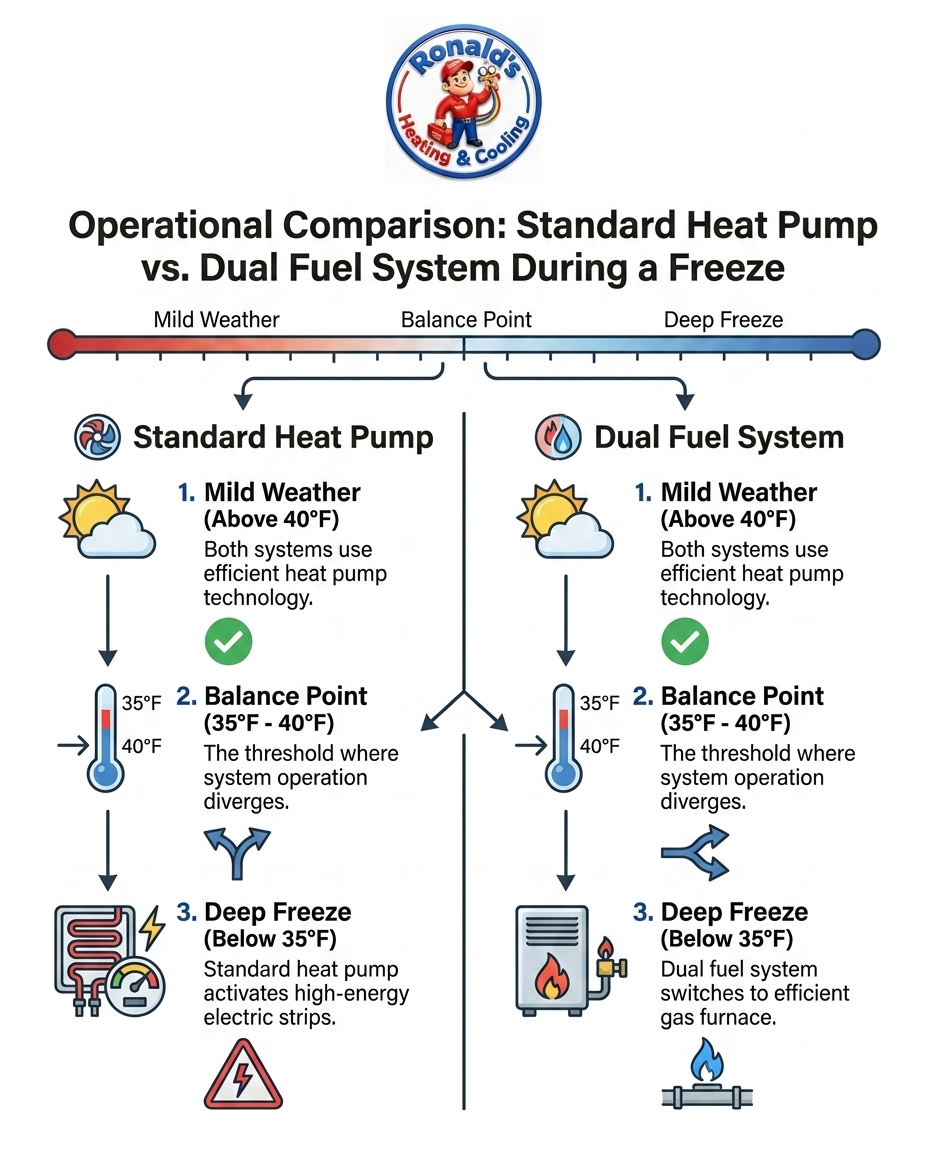
The Problem: A standard heat pump is an incredibly efficient piece of machinery for the vast majority of mild coastal winter days. Because it moves existing heat from the outside air into your home rather than burning fuel to create heat, it operates at a high coefficient of performance. However, this efficiency plummets when outdoor temperatures fall below 35 to 40 degrees Fahrenheit. There simply is not enough ambient thermal energy in the freezing air for the system to extract efficiently.
The Cause: When the heat pump cannot pull enough heat from the freezing outdoor air to satisfy your thermostat setting, it falls behind. The indoor temperature begins to drop, and the system runs continuously without reaching the set point. To prevent your home from becoming uncomfortably cold, standard heat pumps are equipped with a backup mechanism known as auxiliary or emergency heat.
The Solution: If you rely on a standard system for your Heating Services, the system automatically activates auxiliary electric heat strips to bridge the gap. While this solves the immediate problem of a cold house, it comes with a significant freezing catch. Electric resistance heating uses a massive amount of electricity compared to the heat pump's compressor. When these strips activate during a prolonged freeze, your system is essentially heating your home with giant toaster coils, leading to a sharp spike in winter utility bills.
When Auxiliary Electric Heat Takes Over
In our experience servicing coastal homes, standard systems use intelligent thermostats to detect when the primary compressor is losing ground. Once the indoor temperature drops a degree or two below your set point, the thermostat signals the electric heat strips to turn on. The stark difference in energy efficiency is immediate. While the heat pump might provide three units of heat for every one unit of electricity consumed, electric resistance strips provide a strict one-to-one ratio. Over the course of a multi-day cold snap, relying on these strips can drastically inflate your energy consumption.
The Dual Fuel Advantage: Strategic Warmth for Extreme Cold Snaps
A dual fuel system offers a strategic alternative to relying on inefficient electric heat strips. This setup pairs a high-efficiency electric heat pump with a robust gas furnace. During the mild days of the September pre-heating season and throughout the moderate portions of winter, the system operates exactly like a standard heat pump, delivering highly efficient, electric-based heating. The advantage reveals itself when the weather takes a severe turn.
Instead of falling back on energy-hungry electric resistance strips, a dual fuel system seamlessly transitions to the gas furnace when temperatures drop into the freezing zone. Natural gas or propane furnaces generate intense, reliable heat regardless of how cold or humid the outside air becomes. This results in faster heating recovery times and a much warmer stream of air coming from your registers. One local homeowner reached out to our team at Ronald's Heating & Cooling during our coldest winter storm when their older furnace failed completely. We were able to replace the system right away, restoring reliable warmth quickly and affordably right in the middle of the freeze. That peace of mind is exactly what a gas backup provides.
Setting the Perfect Balance Point
The brain of a dual fuel system is its specialized thermostat, which uses an outdoor temperature sensor to determine the exact moment to switch fuel sources. This threshold is known as the balance point. Our technicians calibrate this switchover temperature based on the unique characteristics of your home, including its insulation levels, square footage, and overall layout.
If your home is highly insulated, the heat pump may be able to carry the heating load down to 35 degrees before the furnace needs to take over. If your home is older and draftier, the balance point might be set closer to 40 degrees. This precise calibration ensures that you are always using the most efficient and effective heating method for the current weather conditions, maximizing comfort while minimizing energy waste.
Side-by-Side: Standard Heat Pump vs. Dual Fuel System
To make an informed decision this fall, it helps to look at how these two systems compare directly across several key performance metrics. Whether you are choosing between SEER ratings for coastal Virginia cooling or evaluating heating performance, understanding the operational differences is vital.
• Mild Weather Efficiency — Standard Heat Pump: Excellent. Operates using high-efficiency electric heat transfer. — Dual Fuel System: Excellent. Uses the exact same electric heat pump technology.
• Deep Freeze Performance — Standard Heat Pump: Relies on high-energy auxiliary electric heat strips. — Dual Fuel System: Switches to a powerful, reliable gas furnace.
• Air Temperature at Registers — Standard Heat Pump: Warm (around 90-95°F), which can feel cool to the touch. — Dual Fuel System: Hot (around 120°F+ when the gas furnace is active).
• Installation Requirements — Standard Heat Pump: All-electric setup; requires proper electrical panel capacity. — Dual Fuel System: Requires an active natural gas line or propane tank on the property.
• Energy Consumption Profile — Standard Heat Pump: Low during mild weather; spikes sharply during severe cold snaps. — Dual Fuel System: Consistently optimized by switching to the cheapest/best fuel source.
Evaluating the Upfront Investment and Long-Term Value
Upgrading your HVAC infrastructure is a significant commitment, and evaluating the financial aspects requires looking at both the initial installation and the long-term operational costs. Generally, a dual fuel system requires a higher upfront investment than a standard heat pump. This is because you are essentially purchasing and installing two distinct heating technologies—a heat pump and a gas furnace—along with the specialized controls required to manage them. If your home does not already have a gas line routed to the equipment location, the cost of modifying your gas plumbing will also factor into the initial investment.
However, the upfront costs can often be mitigated. Generic federal tax credits and local utility rebates may apply to qualifying high-efficiency heat pump and dual fuel installations. These incentives are designed to encourage energy-efficient upgrades and can help offset the initial expense. It is always wise to consult with a tax professional or check with your local utility provider to see what current generic programs you might qualify for when planning your upgrade during the September pre-heating season.
Beyond the initial installation, the long-term value of a dual fuel system becomes apparent during severe winters. By avoiding the massive energy spikes associated with running electric heat strips for days on end, a dual fuel system can provide more consistent and manageable utility bills. At Ronald's Heating & Cooling, we believe in providing fair, clearly explained quotes without high-pressure tactics. For example, a homeowner recently asked our team for a quote for a full HVAC system installation. We provided a transparent estimate and performed a friendly, professional installation where the customer fully understood the work and the value they were receiving. Exploring HVAC financing options can also help structure the investment in a way that aligns with your household budget.
Making an Objective, Pressure-Free Decision This Fall
Synthesizing all this information comes down to evaluating your specific home and your personal comfort preferences. Our team at Ronald's Heating & Cooling is committed to providing trustworthy HVAC opinions and objective frameworks rather than simply pushing the most complex or expensive system. A standard heat pump is a fantastic, highly efficient choice for many homes in Coastal Virginia Beach. A dual fuel system is a strategic upgrade for those who want absolute certainty during a freeze. Use this checklist to guide your decision:
• Assess your current infrastructure: Does your home already have natural gas access? If you already have a gas line for a stove or water heater, upgrading to dual fuel is much more straightforward. If you are entirely electric, adding gas lines will increase the project's scope.
• Evaluate your comfort preferences: How sensitive are you to the temperature of the air coming from your vents? Heat pumps produce air that is warm enough to heat the room but can feel cool against your skin. Gas furnaces produce a noticeably hotter, cozier blast of air that many homeowners prefer during a freeze.
• Consider your long-term plans: How long do you plan to stay in this house? If this is your forever home, the long-term energy management and comfort benefits of a dual fuel system are highly attractive.
• Factor in maintenance: Both systems require consistent upkeep to perform well. Enrolling in an HVAC maintenance plan ensures that whether you have electric strips or gas burners, your backup heat is ready to deploy safely when winter weather strikes.
Frequently Asked Questions About Heat Pump Upgrades
At what temperature does a dual fuel system switch to gas?
The switchover happens at a specific temperature known as the balance point. This is typically set between 35 and 40 degrees Fahrenheit, depending on the specific balance point configured for your home. A technician calibrates this setting based on your home's insulation and layout to ensure the gas furnace activates exactly when the heat pump begins to lose its efficiency.
Is a dual fuel system necessary in coastal Virginia?
It is not strictly necessary, but it is highly beneficial for comfort and efficiency. Because our region experiences mostly mild winters, a standard system works well most of the time. However, during unpredictable deep freezes, a dual fuel system prevents the high energy costs associated with electric heat strips and provides faster, more reliable warmth.
How does auxiliary heat work on a standard heat pump during a freeze?
When the heat pump cannot extract enough heat from freezing outdoor air, the thermostat triggers the auxiliary heat. It activates electric resistance strips, which use significantly more energy to generate heat when the outside air lacks sufficient thermal energy. This process is similar to how a space heater or a toaster works and can cause utility bills to spike during a long cold snap.
What are the disadvantages of a dual fuel system?
The primary drawbacks are related to the initial setup rather than performance. They have a higher initial installation cost because you are installing both a heat pump and a gas furnace. Additionally, they require the home to have an active natural gas or propane supply line, which may not be available or cost-effective to install on every property.
Can I upgrade to dual fuel if I currently have an all-electric system?
Yes, transitioning from an all-electric setup to a dual fuel configuration is entirely possible. This can be done provided a gas line can be safely and compliantly routed to the heating equipment location. You will need to consult with a professional to determine the logistics and costs of adding a gas line to your specific property.
Take Control of Your Winter Comfort With Confidence
Choosing the right heating system means balancing everyday mild weather efficiency with deep freeze readiness. Whether you prioritize the streamlined operation of a standard unit or the robust backup power of a gas furnace, taking action during the September pre-heating season ensures your home is prepared. Upgrading to a dual fuel system vs. sticking with a standard heat pump in coastal Virginia doesn't have to be a stressful choice. Schedule an objective evaluation with our team today to find the perfect climate-specific framework for your home's winter comfort.
