





The Problem with Vague 'Pass/Fail' Maintenance Grades
You just received a basic invoice with a simple checkmark, leaving you wondering what actually happens during an AC tune-up: beyond the checklist your technician hands over. A strange noise from your outdoor unit might prompt a service call, or maybe you are just trying to stay ahead of seasonal wear and tear. Either way, a generic "pass" grade on a piece of paper tells you almost nothing about the actual health of your cooling equipment. After your system runs continuously through peak summer heat, a quick visual inspection simply does not provide enough information to protect your home.
During the September post-summer transition, your air conditioner has just finished its most grueling workload of the year. Looking at the outside of the metal cabinet will not reveal internal electrical degradation, slow refrigerant leaks, or worn-out motor bearings. Professional diagnostics require exact electrical and pressure measurements to determine how much life your components actually have left. If your technician only changes the filter and wipes down the cabinet, you are missing out on the core benefits of preventative maintenance.
Understanding these exact diagnostic metrics empowers you to make informed decisions about your cooling equipment. When you know the actual numbers, you stop guessing and start planning. Instead of wondering if your system will survive another week of unexpected heat, you have hard data to rely on. At Ronald's Heating & Cooling, our team believes that comprehensive air conditioning services must include this level of transparent, data-driven testing to give you true confidence in your home's comfort.
Why the Early Fall Transition Demands Deeper Diagnostics
Your air conditioner endures a massive amount of thermal and mechanical stress from May through August. By the time early fall arrives, every moving part and electrical connection has experienced thousands of start-and-stop cycles. This continuous operation takes a heavy toll on the internal components, making the September post-summer transition the ideal time to measure exactly how much degradation has occurred.
In our years serving the Virginia Beach area, we've found that catching this wear and tear early prevents unexpected breakdowns during those stubborn, late-season heat waves that often catch homeowners off guard. A thorough diagnostic visit acts as a critical reset for your equipment rather than just a routine chore. By evaluating the system now, our technicians can identify minor issues before they cascade into major motor failures or compressor lockouts over the winter.
To understand the difference between a basic check and a true diagnostic visit, consider this breakdown of what actually happens during a comprehensive preventative HVAC maintenance plan visit:
• Basic Visual Check — Technician Actions: Looks for obvious dirt, listens for loud noises, changes the air filter. — What You Learn: The system is currently running, but no internal health data is gathered.
• Deep Diagnostic Tune-Up — Technician Actions: Connects gauges, uses a multimeter, measures exact voltages and pressures. — What You Learn: You receive precise data on motor health, electrical efficiency, and refrigerant levels.
Accumulated Summer Wear and Tear
Continuous cycling causes microscopic wear on moving parts inside your air conditioner. Every time the thermostat calls for cooling, the compressor and blower motor jolt into action. This constant starting and stopping creates friction, which slowly degrades the bearings and mechanical linkages inside the unit. Over a long summer, this friction adds up, requiring professional evaluation to ensure the motors are not overworking.
Extended heat exposure also degrades electrical tolerances. Wires, contactors, and capacitors sit inside a metal box baking in the sun while managing high-voltage electricity. This intense heat causes metal connections to expand and contract, which can loosen terminal screws and create electrical resistance. A deep diagnostic tune-up specifically targets these heat-stressed areas to tighten connections and verify that electricity is flowing smoothly.
Translating the Multimeter: What Electrical Readings Actually Mean
The digital multimeter is the technician's most vital diagnostic tool. This handheld device allows professionals to see the invisible electrical forces powering your air conditioner. Instead of guessing if a part looks old, the technician uses the multimeter to measure the exact electrical current flowing through the wires. These precise numbers provide a factual baseline for system health, replacing subjective guesses with hard data.
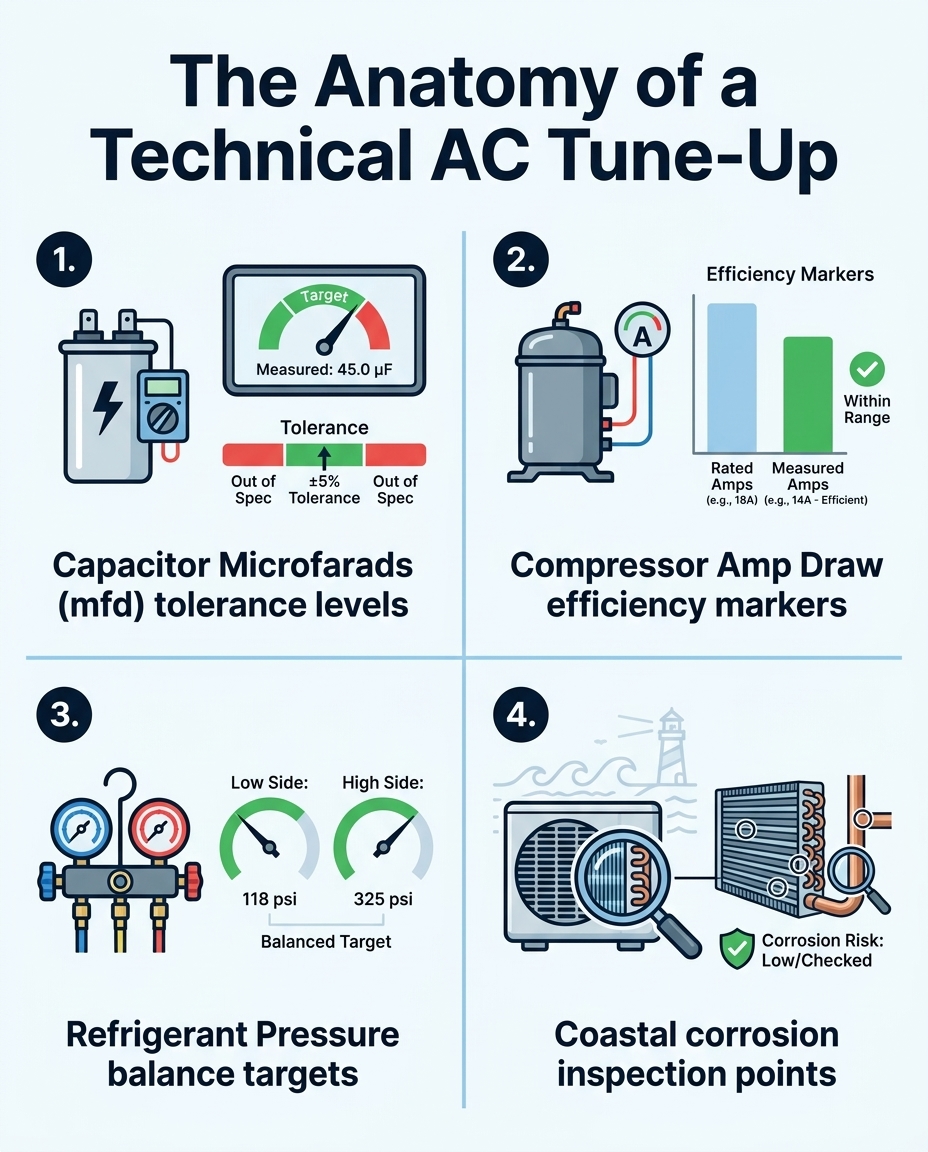
When our technicians at Ronald's Heating & Cooling test your system, we focus heavily on two specific measurements: capacitor microfarads (mfd) and compressor amp draw. These readings tell a detailed story about how hard your equipment is working and whether a failure is imminent. By translating these numbers into plain English, you can understand exactly what is happening inside the metal cabinet sitting in your backyard.
Capacitor Microfarads (MFD)
Your air conditioner's capacitor acts like a large battery that stores the energy needed to jump-start the compressor and fan motors. Technicians measure this stored energy in microfarads (mfd). Every capacitor has a specific manufacturer tolerance rating printed on its side. For example, a capacitor might be rated for 45 mfd.
• The baseline test: The technician connects the multimeter to the capacitor terminals to read the current microfarads (mfd).
• The warning sign: If the reading drops below the manufacturer's acceptable range (often a 5% to 6% variance), the capacitor is losing its ability to hold a charge.
• The consequence: A weak capacitor forces the compressor motor to pull too much electricity during startup, which can permanently damage the motor windings over time.
Compressor Amp Draw
The compressor amp draw measures the amount of electrical current required to pump refrigerant through your system. Think of amp draw like a heart rate monitor for your air conditioner. Just as a high resting heart rate indicates stress in a human, a high amp draw indicates that the compressor motor is struggling to do its job.
If the compressor amp draw exceeds the manufacturer's maximum rating, the motor is overworking and at serious risk of overheating. High amp draws often point to underlying mechanical problems, such as tight bearings, restricted airflow, or failing electrical components. By measuring the compressor amp draw, our team can catch a struggling motor long before it completely burns out and stops cooling your home.
Battling Coastal Elements: Inspecting for Hidden Corrosion
In our experience working on HVAC systems throughout the Virginia Beach coastal environment, we see a unique set of environmental challenges daily. The heavy salt-laden moisture blowing in off the water settles directly onto your outdoor condensing unit. This salty air is highly corrosive, aggressively attacking the metal components that keep your system running. Because this environmental wear happens continuously, specialized maintenance steps are required to protect your investment.
Coastal humidity accelerates a process called galvanic corrosion on electrical terminals and contactors. When dissimilar metals come into contact with salt water and electricity, they begin to break down rapidly. This corrosion creates a layer of resistance on the electrical contact points, which forces the system to pull more electricity to bridge the gap. Over time, this resistance creates excess heat that can melt wires and destroy expensive electrical boards.
Standard visual checks completely fail to catch this type of hidden corrosion. A technician must perform rigorous cleaning and precise multimeter testing to ensure electricity is flowing safely through the system. During a professional AC tune-up in Virginia Beach, our focus shifts heavily toward protecting the delicate aluminum and copper coils from rapid pitting and degradation. By applying specialized protective coatings and cleaning away salt deposits, our technicians can significantly extend the lifespan of your coastal cooling equipment.
Refrigerant Pressures and Airflow Optimization
Beyond the electrical tests, a comprehensive tune-up involves detailed mechanical and fluid checks. Your air conditioner uses a closed-loop system of refrigerant to absorb heat from inside your home and release it outside. Technicians connect specialized digital gauges to your system to measure the exact refrigerant pressures. These precise fluid checks ensure the system is cooling efficiently without overworking the compressor.
A pattern we see often is that improper refrigerant pressures rarely mean the system just needs a quick "top off." Because the system is sealed, low pressure almost always points to a micro-leak somewhere in the copper lines or coils. Conversely, high pressure can indicate severe airflow restrictions, such as a clogged filter or a failing blower motor. Just as technicians rely on capacitor microfarads (mfd) and compressor amp draw to judge electrical health, we rely on exact pressure readings to judge mechanical health.
Our technician will also inspect the indoor blower motor performance and measure the duct static pressure. Static pressure measures the resistance the air faces as it travels through your ductwork. If the static pressure is too high, the blower motor has to work excessively hard to push air into your living spaces, driving up your energy bills and wearing out the motor prematurely. Addressing these airflow and pressure issues is a core part of our professional AC repair services and preventative maintenance.
Detecting Micro-Leaks Early
Small pressure imbalances are often the very first indicator of slow refrigerant loss. These micro-leaks can be incredibly difficult to find because the refrigerant escapes as an invisible gas. However, by reading the digital gauges, a technician can spot the subtle pressure drops that signal a leak is developing.
Catching these micro-leaks early prevents major compressor damage. When an air conditioner runs low on refrigerant, the compressor loses its primary source of cooling. The motor begins to run hotter and hotter until the internal windings eventually burn out. By identifying and sealing a leak early, you save the most expensive component in your entire HVAC system.
The Value of a Transparent, Educational Service Visit
A true tune-up involves a partnership between the technician and the homeowner. You deserve to know exactly what is happening with the equipment you rely on every day. When a technician takes the time to walk you through the exact voltages, pressures, and amp draws they uncover, it builds trust and eliminates the anxiety of guesswork. You get to see the actual data driving the recommendations.
For instance, one Virginia Beach homeowner reached out to us this fall for AC service after having previous repairs done with our team. Because they wanted to understand exactly what was happening with their equipment during the September post-summer transition, our technician walked them through the necessary work step-by-step, clearly explaining the specific multimeter readings. The customer felt completely informed and confident in the service provided, knowing exactly why each adjustment was made.
This educational approach stands in stark contrast to vague checklists designed to push unnecessary replacements. When a company only provides a "pass/fail" grade, they leave you in the dark, making it easy to pressure you into a sudden, unplanned purchase. Sharing the actual data empowers you to plan for future system needs calmly. Understanding the difference between a trustworthy HVAC opinion and a high-pressure sales pitch fundamentally changes how you manage your home's comfort.
Frequently Asked Questions About Professional AC Tune-Ups
What is included in a full AC tune up?
A full AC tune-up includes comprehensive electrical testing, mechanical inspections, and system cleaning. Technicians will measure capacitor microfarads, check the compressor amp draw, and evaluate refrigerant pressures using digital gauges. They also inspect the blower motor, clear the condensate drain line, and clean the outdoor condenser coils. The goal is to gather exact data on the system's performance rather than just performing a visual check.
How long does an AC tune up take?
A thorough, professional AC tune-up generally takes between 60 to 90 minutes to complete. This timeframe allows the technician to connect their gauges, take precise multimeter readings, and clean the necessary components properly. If the system is exceptionally dirty or located in a difficult-to-access area, the process may take slightly longer. Rushed visits that take only 20 minutes usually indicate a basic visual inspection, not a true diagnostic tune-up.
What do HVAC technicians check during maintenance?
HVAC technicians check the electrical health, fluid pressures, and mechanical operation of your cooling system. They inspect the contactors for pitting, test the capacitors for proper energy storage, and measure the static pressure in your ductwork. They also look for hidden wear and tear, such as loose electrical terminals or slow micro-leaks in the refrigerant lines. Every check is designed to prevent sudden breakdowns during peak weather.
Is an AC tune up worth it?
Yes, an AC tune-up is highly worth it because it directly protects the lifespan of your expensive cooling equipment. By catching failing capacitors or slow refrigerant leaks early, you avoid catastrophic compressor failures that require full system replacements. Regular maintenance also keeps the system running efficiently, which prevents your monthly energy bills from slowly creeping up as the equipment ages.
What do technical multimeter readings mean for my AC health?
Technical multimeter readings provide a factual, mathematical baseline for the internal health of your system. Readings like microfarads tell you if a capacitor has enough energy to start the motor, while amp draw tells you if the motor is overworking. When these numbers fall outside the manufacturer's specified range, it is a guaranteed early warning sign that a component is degrading and needs attention.
Why does coastal AC maintenance require specialized testing?
Coastal AC maintenance requires specialized testing because salt-laden moisture aggressively attacks metal and electrical components. The high humidity and salt air cause galvanic corrosion, which creates invisible electrical resistance on contactors and terminals. Technicians must use a multimeter to detect this hidden resistance, as a simple visual inspection cannot reveal the extent of the electrical damage caused by the coastal environment.
Take Control of Your Cooling System's Health
Understanding the exact technical measurements taken during a maintenance visit protects the longevity of your equipment. When you know the facts about your capacitor microfarads (mfd) and compressor amp draw, you are no longer at the mercy of vague invoices or high-pressure sales tactics. You gain the peace of mind that comes from a completely transparent breakdown of your system's actual health.
Do not settle for a simple checkmark on a piece of paper after a brutal summer of cooling. Demand the hard data that proves your system is ready for the seasons ahead. At Ronald's Heating & Cooling, we encourage you to explore preventative maintenance options that prioritize thorough diagnostics, exact measurements, and honest education over basic, superficial checklists.
