





The Critical Difference Between Fall Burn-Off and Furnace Danger
The first real November chill is settling in across the area, prompting thousands of homeowners to finally switch their thermostats from cooling to heating. While a faint, dusty smell is entirely normal during that initial startup, knowing how to spot the actual signs of a cracked heat exchanger can mean the difference between a cozy evening and a severe household emergency. Before the winter weather fully takes hold, it is absolutely vital to understand what your furnace is telling you.
When our team at Ronald's Heating & Cooling performs pre-winter maintenance or provides reliable heating services, addressing potential safety hazards is always our top priority.
During a typical November first furnace startup, dust that has settled on the internal components over the summer will burn off. This creates a brief, somewhat unpleasant odor that usually dissipates within an hour. However, we often see homeowners mistakenly dismiss more persistent, dangerous symptoms as just another quirk of older equipment. A compromised heating system will not fix itself, and ignoring the warning signs puts your entire household at risk of exposure to toxic combustion gases. The moment you suspect your equipment is leaking exhaust, the only correct decision is to shut the system down immediately at the thermostat and call a licensed professional.
Understanding Your Heat Exchanger's Vital Role
To understand why a failure is so catastrophic, you first need to understand how your furnace generates safe warmth. The heat exchanger is the most critical safety component inside your heating system. It acts as a heavy-duty metal shield that separates the breathable indoor air circulating through your vents from the toxic, superheated combustion gases created by the furnace burners.
The Daily Stress on Furnace Components
Every time your thermostat calls for heat, the burners ignite, filling the inside of the heat exchanger with hot exhaust gases. The metal rapidly heats up and expands. Meanwhile, your blower motor pushes cold return air over the outside of this metal shield. The heat transfers through the metal to warm the air, which then travels into your living spaces. Once the cycle ends, the burners shut off, and the metal rapidly cools and contracts.
This constant, daily cycle of extreme expansion and contraction places immense physical stress on the metal. In our years of servicing Virginia Beach coastal homes, our technicians have seen firsthand how environmental factors accelerate this stress, leading to severe metal fatigue. The continuous flexing can eventually cause the metal to weaken, thin out, and fracture.
When microscopic fissures or hairline cracks develop, the airtight seal is broken. The blower motor, which operates under high pressure, can actually alter the draft of the burner flames, while simultaneously allowing toxic exhaust gases to slip into the clean airstream. In our professional experience, there is no such thing as a "minor" or "safe" crack in this component; even the smallest breach compromises the entire safety barrier of your heating system and demands immediate intervention.
Recognizing the Warning Signs of a Cracked Heat Exchanger
While a definitive diagnosis requires specialized tools, your furnace will often display visual and auditory clues when the internal metal shield is failing. Recognizing these symptoms early during your November first furnace startup can prevent a hazardous situation from escalating.
If you notice any of these alarming indicators, it is time to immediately shut down the system and schedule professional furnace repair.
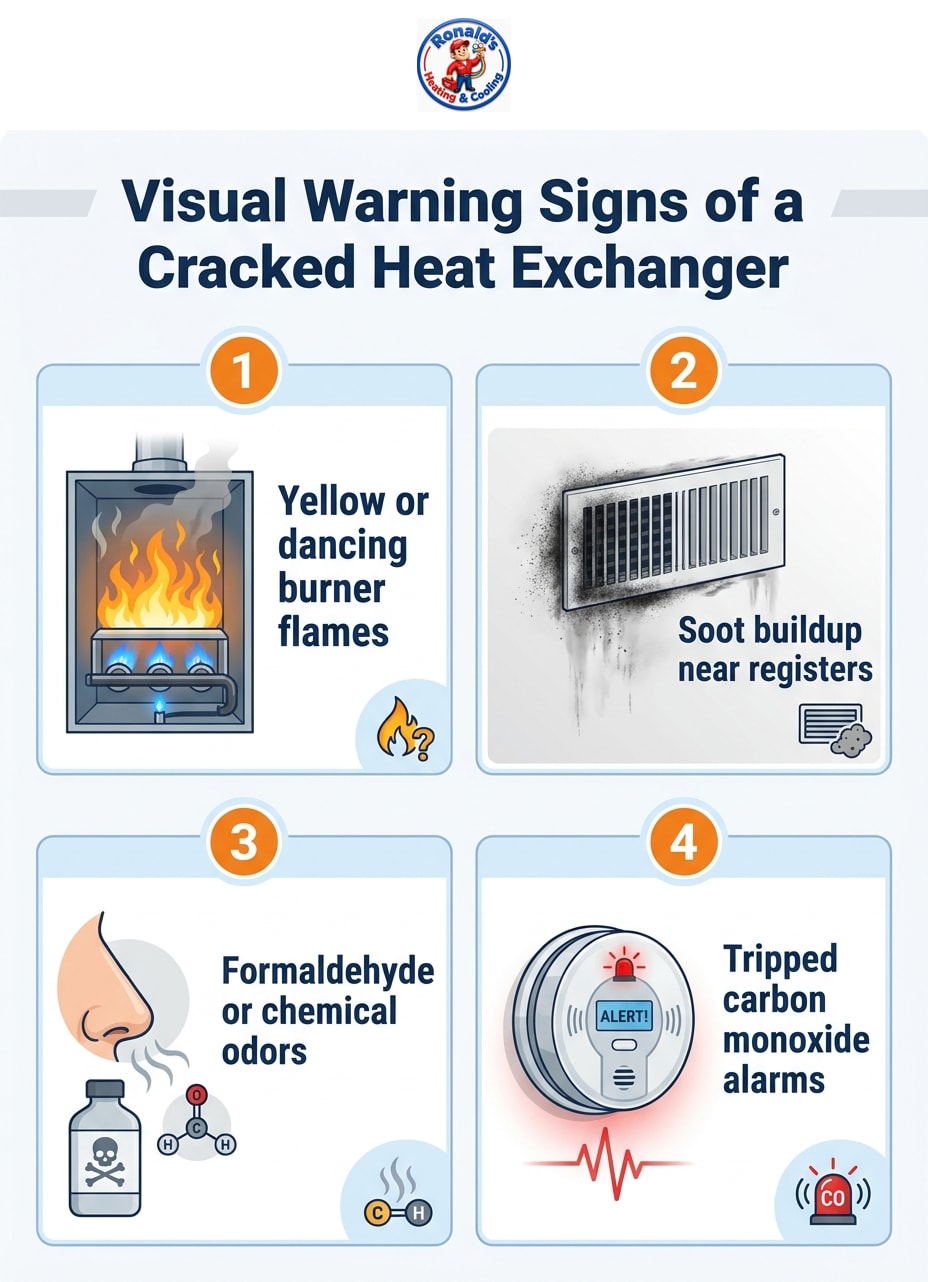
• Burner Flames — Normal, Safe Operation: Steady, crisp, and predominantly blue. — Warning Sign of a Breach: Dancing, flickering, or burning yellow/orange.
• Furnace Cabinet — Normal, Safe Operation: Clean metal with no dark residue. — Warning Sign of a Breach: Black soot buildup around panels or registers.
• System Sounds — Normal, Safe Operation: Smooth hum of the blower and burners. — Warning Sign of a Breach: Rattling, scraping, or hollow popping noises.
The burner flame test: A healthy gas furnace should always produce a steady blue flame. If the heat exchanger is cracked, the air from the blower motor can push through the breach and disrupt the flames, causing them to dance, flicker, or turn yellow. A yellow flame indicates incomplete combustion, which drastically increases the production of carbon monoxide.
Soot accumulation: Keep an eye out for fine black powder around your furnace cabinet, near the burners, or even dusting the supply registers in your home. Soot is a byproduct of incomplete combustion and is a major red flag that our technicians look for when a system is not venting properly.
Unusual noises: While all furnaces make some noise, listen for sharp rattling, scraping, or loud popping sounds specifically when the system heats up or cools down. This can indicate that a cracked piece of metal is shifting or that the structural integrity of the heat exchanger has been compromised.
Why Strange Odors Demand Immediate Attention
Your sense of smell is often the first line of defense when it comes to detecting HVAC safety hazards. However, it is crucial to differentiate between harmless seasonal odors and the toxic warning signs of a failing system.
The Difference Between Dust and Danger
As mentioned earlier, a brief smell of burning dust is standard during a November first furnace startup. This odor is simply the result of particles that have settled on the dormant heat exchanger being incinerated when the burners ignite for the first time in months. It should clear out quickly.
Conversely, a cracked heat exchanger allows combustion exhaust to mix with your breathing air. While carbon monoxide itself is completely odorless, tasteless, and invisible, it is rarely the only gas produced during combustion. The accompanying exhaust gases often carry a very distinct, noxious smell.
The chemical warning: When responding to emergency calls, our team frequently hears homeowners describe a sharp, pungent odor that smells strongly of formaldehyde or a harsh chemical burn. This is not a dusty smell; it is an acrid, eye-watering scent that lingers as long as the heating cycle runs. If you detect this chemical odor, it means exhaust fumes are actively circulating through your ductwork. Do not wait to see if the smell goes away. Turn off the thermostat, ventilate the house if necessary, and contact a professional immediately.
The Invisible Threat: Carbon Monoxide and Your Safety
The most severe consequence of a breached heat exchanger is the potential for carbon monoxide (CO) poisoning. Because this gas is entirely undetectable by human senses, it relies on physical symptoms and electronic monitors to make its presence known.
According to the CDC, carbon monoxide is responsible for over 400 accidental deaths in the United States every year, with many of these incidents tracing back to faulty or unmaintained heating equipment. When the metal barrier in your furnace cracks, this toxic gas escapes the designated exhaust flue and is instead pushed directly into your home's living spaces.
Physical Symptoms of CO Exposure
Low-level carbon monoxide exposure can easily be mistaken for the winter flu. If multiple family members begin experiencing these symptoms simultaneously—especially when the heat is running—it is a critical emergency:
• Dull, persistent headaches that do not respond to normal medication.
• Dizziness, weakness, or unexplained fatigue while indoors.
• Nausea or vomiting without other signs of illness.
• Shortness of breath or confusion.
Because the gas is invisible, functional carbon monoxide detectors are a non-negotiable safety requirement for any home with a gas furnace. A tripped carbon monoxide detector should never be ignored, unplugged, or assumed to be a false alarm. If you want to understand the mechanics behind these alerts, it helps to learn why your carbon monoxide detector beeps when the heat kicks on. Treat every alarm as a life-safety event: evacuate the home, call emergency services if anyone feels ill, and have the HVAC system locked out until it can be professionally evaluated.
How Coastal Air Accelerates Hidden Furnace Wear
While metal fatigue is a universal reality for all gas furnaces, the specific climate you live in plays a massive role in how quickly that wear and tear occurs. Standard lifespan estimates for heating equipment often fail to account for unique regional environmental stressors.
From what we see daily in Virginia Beach coastal homes, the combination of high average humidity and airborne salinity creates a highly corrosive environment for metal HVAC components. Even though your furnace is located indoors, the combustion air it draws in carries microscopic salt particles and moisture from the coastal atmosphere.
Over time, this salty, humid air accelerates oxidation on the internal metal surfaces of the furnace. The heat exchanger, which is already subjected to extreme thermal stress, becomes highly susceptible to premature rust and corrosion. As the metal oxidizes, it thins out and loses its structural integrity, making it far more likely to crack under the pressure of daily heating cycles.
Our technicians frequently find this coastal corrosion hidden completely out of sight, deep inside the furnace cabinet. A homeowner performing a basic visual check will likely miss the early signs of rust. Seeing this accelerated wear firsthand is exactly why we insist that annual professional inspections are so critical for maintaining safe heating services in Virginia Beach. Specialized local knowledge is required to accurately evaluate equipment lifespan and catch coastal corrosion before it results in a dangerous exhaust leak.
Why We Insist on Professional, Zero-Compromise Diagnostics
When it comes to the safety of your family, guesswork is never acceptable. Verifying a cracked heat exchanger is not a DIY project. It requires specialized diagnostic tools, extensive training, and a strict adherence to safety protocols. Working with combustion appliances always requires a licensed professional.
At Ronald's Heating & Cooling, we believe in an honest, meticulous diagnostic process. We know that a cracked heat exchanger diagnosis can be stressful, which is why we never use it as a high-pressure scare tactic. Instead, we rely on undeniable, evidence-based testing to show you exactly what is happening inside your system.
Our technicians use digital combustion analyzers to measure the exact parts-per-million of gases in your airstream, detecting even the smallest traces of carbon monoxide that shouldn't be there. We also utilize specialized infrared inspection cameras, snaking them deep into the heat exchanger cells to visually identify hairline fractures, rust spots, or structural failures that are invisible to the naked eye.
If a tripped carbon monoxide detector or strange odor prompts a visit, we will not leave you in the dark. We provide definitive answers and safe pathways forward. If the heat exchanger is indeed compromised, we will walk you through your options clearly and transparently, whether that involves a complex warranty repair or planning for a safe furnace replacement. Our priority is ensuring your home is safe, period.
Common Questions About Heat Exchanger Safety
What happens if a heat exchanger cracks?
When a heat exchanger cracks, combustion gases—including carbon monoxide—can leak directly into the home's breathing air. The furnace loses its safe operational boundary, transforming from a reliable heat source into a severe health hazard. The system must be shut down immediately to prevent toxic exposure.
Can you smell a cracked heat exchanger?
While carbon monoxide is completely odorless, the other exhaust gases leaking alongside it often produce a distinct, sharp smell. Many homeowners describe this odor as smelling like formaldehyde or a strong chemical burn. Any persistent, acrid chemical odor when the heat runs is a major warning sign that requires professional attention.
Why is a cracked heat exchanger dangerous?
It is dangerous because it removes the only physical barrier between toxic exhaust fumes and the clean air circulated through your home's vents. Prolonged exposure to these leaked gases can lead to severe illness, physical symptoms like nausea and headaches, or fatal carbon monoxide poisoning.
How do you test for a cracked heat exchanger?
Professionals test for cracks using digital combustion analyzers to measure precise gas levels in the supply airstream. Additionally, technicians use specialized infrared inspection cameras to visually inspect the internal metal cells for hairline fractures, rust, and structural fatigue that cannot be seen from the outside.
Does coastal air affect my heat exchanger's lifespan?
Yes, the high humidity and airborne salt prevalent in coastal environments can significantly accelerate metal corrosion. From our experience serving Virginia Beach coastal homes, this salty air increases the rate of oxidation inside the furnace, making annual professional inspections essential to catch premature wear before the metal cracks.
Protect Your Home Before the Deep Freeze Sets In
True peace of mind during the winter months comes from knowing your heating system is operating safely, efficiently, and without leaking dangerous exhaust into your living spaces. The transition into the cold season should be comfortable, not stressful. If your November first furnace startup brought unusual smells, rattling noises, or a yellow burner flame, do not wait to see if the problem resolves itself.
We always tell our Virginia Beach customers that taking proactive steps now ensures reliable, safe warmth for your family all winter long. If you have any doubts about the integrity of your equipment, schedule a thorough, uncompromising professional inspection with our team today to protect your home before the deep freeze sets in.
