





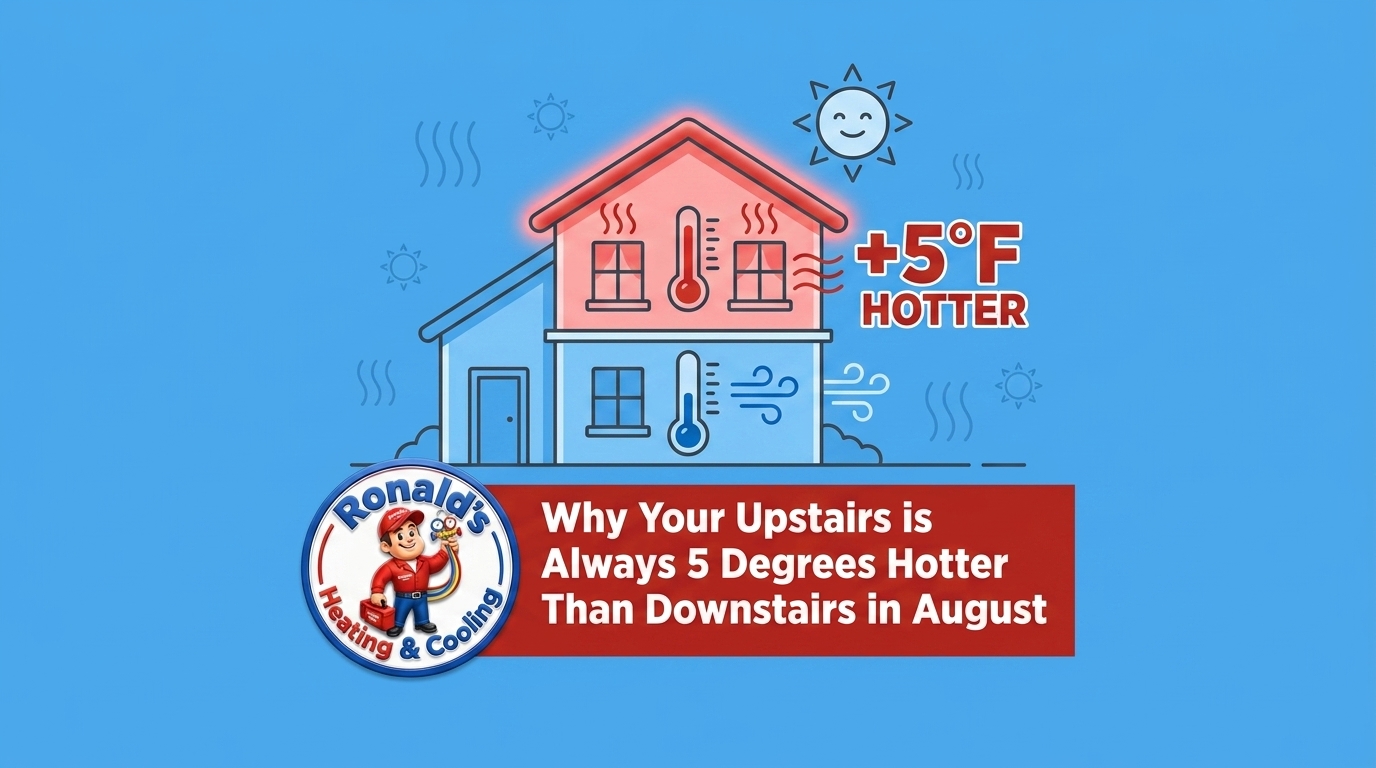
Tired of Sweating Upstairs? Understanding the Second-Floor Heat Trap
Are you trying to figure out exactly why your upstairs is always 5 degrees hotter than downstairs in August? You are certainly not alone. Here at Ronald's Heating & Cooling, our team typically sees this exact scenario play out as late August in Virginia Beach brings peak temperatures that push cooling systems to their absolute limits. Many homeowners find themselves tossing and turning because their second-floor bedrooms feel like a sauna. The natural reaction is to walk downstairs and push the thermostat even lower. However, this usually just turns the first-floor living room into an icebox while barely making a dent in the upstairs heat.
It is incredibly frustrating to pay high energy bills only to wake up sweating. Standard two-story homes face unique airflow challenges that require more than just a quick thermostat adjustment. If you are constantly battling the temperature difference, relying on your standard air conditioning systems to muscle through the problem will only lead to higher utility costs and premature wear and tear.
Diagnosing the root cause is the very first step toward permanent comfort. The issue is rarely that your AC is completely broken. Instead, it is usually a combination of physics, ductwork design, and thermostat placement working against you. By understanding how these elements interact, you can stop wasting energy and start finding a real solution that keeps your entire home comfortable, even during the hottest days of the late-summer season.
The Physics of Thermal Buoyancy: Why Heat Always Rises
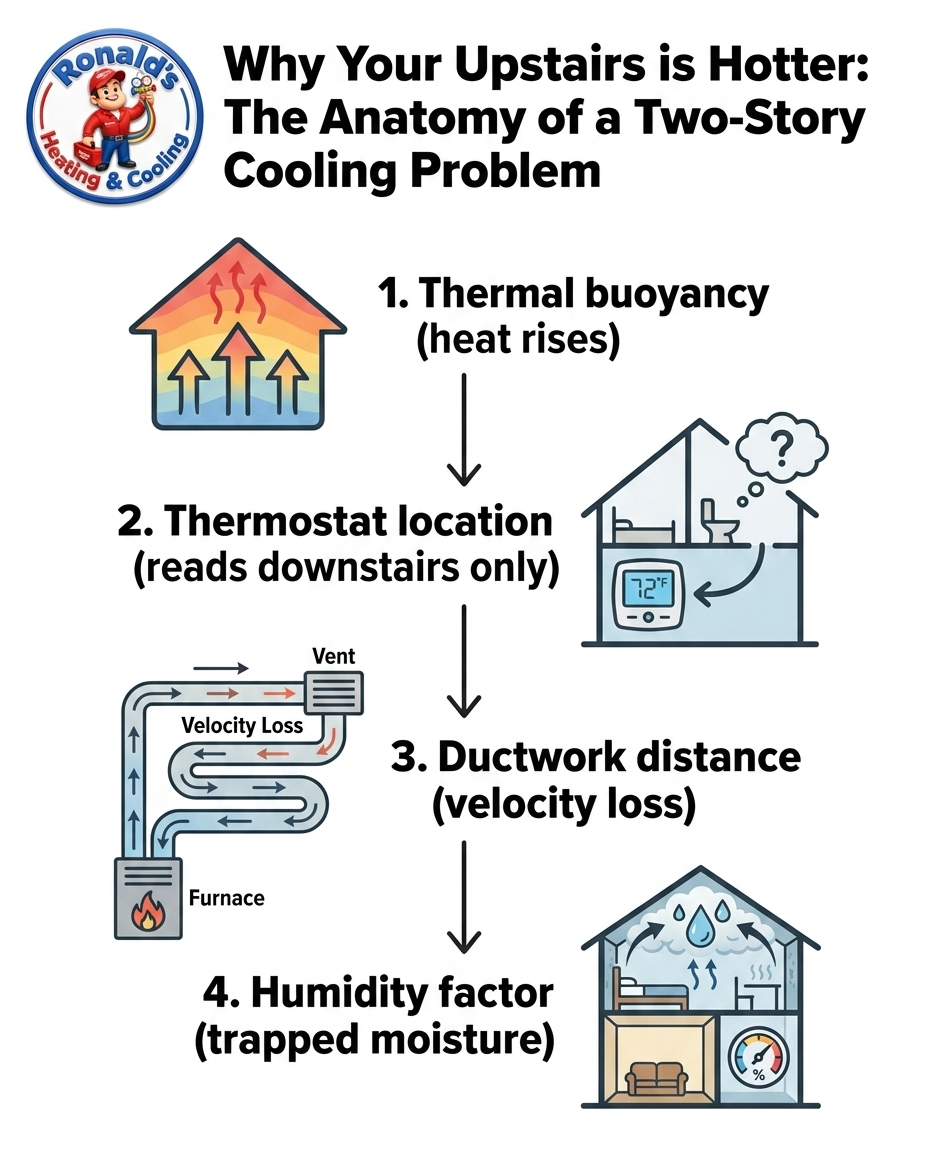
To truly fix a hot second floor, we have to look at the fundamental thermodynamics happening inside your home. The underlying culprit is thermal buoyancy. Warm air is less dense than cold air, which naturally causes it to rise to the highest point in the house. As the summer sun beats down on your roof, the physics of heat transfer go into overdrive.
At Ronald's Heating & Cooling, we believe in diagnostic transparency—explaining the "why" behind the physics before ever suggesting a repair or replacement. During a recent summer heat wave, a customer called us about a struggling AC system. Our technician Mark performed an outstanding job diagnosing the root cause and thoroughly explaining the airflow dynamics before addressing the problem. This transparency is key to finding the right fix.
Here is exactly how thermal buoyancy traps heat in your second-floor bedrooms during the August back-to-school transition:
1. Radiant heat transfer: The intense summer sun continuously bakes your roof throughout the day.
2. Attic superheating: Because most attics are not perfectly insulated, the temperature inside the attic space can easily exceed 130 degrees.
3. Ceiling saturation: This massive pocket of attic heat radiates downward, pressing directly into your second-floor bedroom ceilings.
4. Gravity resistance: Your central air system must actively fight gravity to push heavy, dense, cold air up through the ductwork to the second floor.
Because of these physical realities, a 5-degree difference is actually a common physical reality in two-story homes without specialized airflow management. Your AC is essentially fighting a losing battle against the sun, the attic, and gravity all at once.
How Coastal Humidity Amplifies the Second-Floor Heat Index
The temperature reading on your thermostat only tells half the story. There is a massive difference between the actual temperature and the perceived temperature, commonly known as the heat index. Virginia Beach's intense coastal humidity in late summer drastically increases this indoor heat index, making a standard 5-degree difference feel physically unbearable.
A pattern we see often on our late-summer service calls is that moisture naturally becomes trapped in the upper levels of a home. When coastal weather patterns bring high humidity, that moisture infiltrates your house. Because warm air holds more moisture than cold air, the rising heat carries humidity right into your upstairs bedrooms. If your AC system is struggling to push enough conditioned air upstairs, it is also failing to remove that excess moisture from the air.
The sweat evaporation problem: Your body cools itself by sweating, and that sweat needs to evaporate into the surrounding air to provide relief. High indoor humidity prevents sweat from evaporating. As a result, a 75-degree upstairs room can feel like a sticky, suffocating 82 degrees. This is particularly disruptive during the August back-to-school transition, right as families desperately need restful sleep to adjust to new early-morning schedules.
In our experience working on Virginia Beach homes, managing this moisture is critical. By focusing on achieving perfect home humidity control, you can dramatically improve second-floor comfort without necessarily dropping the temperature setting on your thermostat.
The Single-Zone Thermostat Flaw in Two-Story Homes
A major reason you are constantly asking why your upstairs is always 5 degrees hotter is a fundamental design flaw our technicians frequently encounter in local two-story homes: the single-zone thermostat setup. Standard HVAC setups often fail to properly cool the second floor simply because of where the thermostat is mounted.
The Problem: Blind Spots in Temperature Reading
Most two-story homes only have one thermostat, typically located in a first-floor hallway or living room. A thermostat is essentially a localized sensor. It only measures the ambient air immediately surrounding it. It has absolutely no way of knowing that the upstairs bedrooms are sweltering.
The Cause: Short Cycling on the First Floor
Because cold air naturally sinks and warm air rises, the downstairs living areas cool off much faster than the rest of the house. The cycle looks like this: the AC turns on, cold air floods the first floor, and the downstairs thermostat quickly reads the target temperature (say, 72 degrees). Satisfied, the thermostat shuts the entire AC system off. Meanwhile, the upstairs bedrooms never received enough airflow to cool down, leaving them stuck at 77 degrees.
The Solution: Recognizing the Design Limitation
It is important to emphasize that this is a design limitation of single-zone systems, not necessarily a broken AC unit. The equipment is doing exactly what the thermostat tells it to do.
• First Floor — Airflow Dynamics: Cold air sinks and pools quickly — Thermostat Action: Reaches target temp and shuts system off
• Second Floor — Airflow Dynamics: Warm air rises and gets trapped — Thermostat Action: Ignored by the system; remains uncomfortably warm
Busting the Myth: Why Closing Downstairs Vents Damages Your System
If you are searching for reasons why your upstairs is always 5 degrees hotter, you have likely come across a very common piece of DIY advice that our team constantly has to warn homeowners about: just close the downstairs vents to force the cold air upstairs. While this seems perfectly logical on the surface, it is actually a dangerous myth that can cause severe damage to your HVAC equipment.
Myth vs. Reality: The Static Pressure Problem
The Myth: Closing vents redirects air exactly where you want it, saving energy and balancing the home's temperature.
The Reality: HVAC systems are precisely balanced to push a specific volume of air through the ductwork. Closing vents restricts this necessary airflow, creating a condition known as high static pressure.
Think of your ductwork like a human circulatory system. If you pinch off a major artery, the heart has to work significantly harder to pump the same amount of blood. In your HVAC system, the blower motor acts as the heart. High static pressure strains the blower motor, increasing energy consumption and accelerating wear and tear. Furthermore, restricting airflow means less warm air is passing over the indoor evaporator coil. Without enough heat exchange, the condensation on the coil can literally freeze into a block of ice, shutting down your entire cooling system.
Instead of restricting airflow and risking a breakdown, checking the system's baseline health is a far better approach. Scheduling routine HVAC maintenance ensures your blower motor is operating at peak capacity and your ductwork is free of hidden obstructions.
Ductwork Limitations: Velocity Loss and Hidden Leaks
Even if your AC is perfectly sized and your blower motor is running strong, the cold air still has to physically travel to the second floor. This journey through the ductwork is where many cooling problems originate.
Velocity loss is a major factor. The cold air loses speed and pressure the further it has to travel from the indoor air handler unit. By the time the air reaches the furthest upstairs bedroom vents, it often lacks the force needed to properly mix with the warm air in the room. Instead of a strong, cooling breeze, you get a weak trickle of air that barely makes a difference.
Additionally, the environment surrounding the ductwork plays a massive role. If your ducts run through unconditioned spaces, like a hot attic or a stuffy crawlspace, the ambient heat can warm the cooled air inside the ducts before it ever reaches the vents.
Hidden leaks are another silent comfort killer. Over time, the seams in sheet metal ductwork can separate, and flexible ducts can tear. Leaky ductwork can spill up to 30% of your conditioned air directly into the walls, attic, or basement. If you suspect your airflow is weaker than it used to be during the August back-to-school transition, our team highly recommends professional diagnostics. We frequently utilize professional duct air leakage testing to measure precise airflow volume and pinpoint hidden leaks that are stealing your comfort.
Professional Solutions: From Dampers to Ductless Systems
Bridging the gap between understanding the diagnostics and taking action is how you finally reclaim your second floor. Once you know why the heat is trapped, you can implement professional solutions that directly address the airflow limitations.
HVAC Zoning Systems
In our experience upgrading local HVAC setups, one of the most effective ways to correct a single-zone flaw is to upgrade to an HVAC zoning system. This involves installing motorized dampers directly inside the ductwork and adding a second thermostat upstairs. The dampers act like traffic lights for your airflow. When the upstairs thermostat calls for cooling, the dampers close off the downstairs ductwork, forcing all the cold air up to the second floor until the target temperature is reached.
Ductless Mini-Split Systems
If your existing ductwork is too undersized or inaccessible to modify, bypassing the ducts entirely is often the best route. For targeted bedroom cooling, ductless mini-split zoning solutions are incredibly efficient. These systems feature an outdoor compressor connected directly to a sleek, wall-mounted indoor unit in the bedroom. They provide independent, pinpoint temperature control without requiring any modifications to your existing central ductwork. Plus, federal tax credits and local utility incentive programs may apply to qualifying high-efficiency heat pump installations, making this a great time to verify available rebates with your tax professional or utility provider.
Sometimes, addressing aging systems on both floors is the most comprehensive way to restore whole-home comfort. A thorough diagnostic is always the first step. For example, our team recently helped a homeowner who was told by a previous provider that their outdated equipment needed full replacement. Our technician found a missing, unhooked part, ordered it, and fixed the system—avoiding unnecessary replacement entirely. We bring that same diagnostic rigor to summer cooling issues. A professional load calculation is always required to choose the right solution for your specific home.
Frequently Asked Questions About Upstairs Cooling Challenges
Is a 5-degree difference between floors normal?
Yes, without specialized zoning, a 5 to 8-degree difference is physically normal due to heat naturally rising. Thermal buoyancy causes the warmest air to gather at the ceiling of the highest floor. However, just because a 5-degree difference is normal physics does not mean it is comfortable. It can certainly be corrected with proper HVAC modifications and airflow management.
How do I fix the temperature difference between floors?
The most effective fixes we recommend are installing a zoned HVAC system, adding a ductless mini-split upstairs, or sealing leaky ductwork. These professional solutions directly address the root causes of poor airflow. Additionally, running your indoor thermostat fan setting from 'Auto' to 'On' can help circulate air continuously, providing a temporary improvement in temperature balance.
Should I close downstairs vents to cool upstairs?
No. Closing vents increases static pressure, which can severely damage the blower motor and cause the AC evaporator coil to freeze solid. Modern HVAC systems are balanced for a specific volume of airflow. Furthermore, closing a few vents downstairs rarely pushes enough air up to the second floor to make any noticeable difference in comfort.
Why is my AC not cooling the upstairs?
It is likely due to the single downstairs thermostat shutting off the system too early, ductwork distance causing velocity loss, or an undersized AC unit. Because the first floor cools faster, the system shuts down before the upstairs receives enough conditioned air. A professional diagnostic is needed to pinpoint the exact mechanical or design cause.
Will an attic fan help cool my upstairs bedrooms?
Attic fans can reduce the radiant heat pressing down on your ceilings, which helps slightly by lowering the attic's extreme temperatures. By exhausting superheated air, the heat transfer into your bedrooms is reduced. However, attic fans do not solve underlying ductwork issues, velocity loss, or HVAC sizing problems.
Can high humidity make my upstairs feel hotter than the thermostat says?
Absolutely. High indoor humidity traps heat against your skin and prevents sweat from evaporating, significantly increasing the perceived temperature. A room that reads 75 degrees can feel miserable if the relative humidity is high. Proper AC operation naturally dehumidifies the air, but struggling upstairs systems often fail to remove this trapped moisture.
Stop Battling the Thermostat and Restore Your Home's Comfort
An uncomfortable upstairs is a solvable problem, not a life sentence you have to endure every summer. Understanding why your upstairs is always 5 degrees hotter than downstairs in August is the first step, but taking action is what actually restores your rest during the busy back-to-school transition. Stop relying on band-aid fixes like closing vents or freezing out your first floor.
Getting a proper diagnostic is essential to identifying whether you need duct sealing, zoning, or a targeted ductless solution. Don't let another humid night disrupt your sleep. Schedule an inspection for professional AC repair in Virginia Beach with the team at Ronald's Heating & Cooling. We truly understand two-story airflow challenges and can provide a permanent, comfortable solution.
