





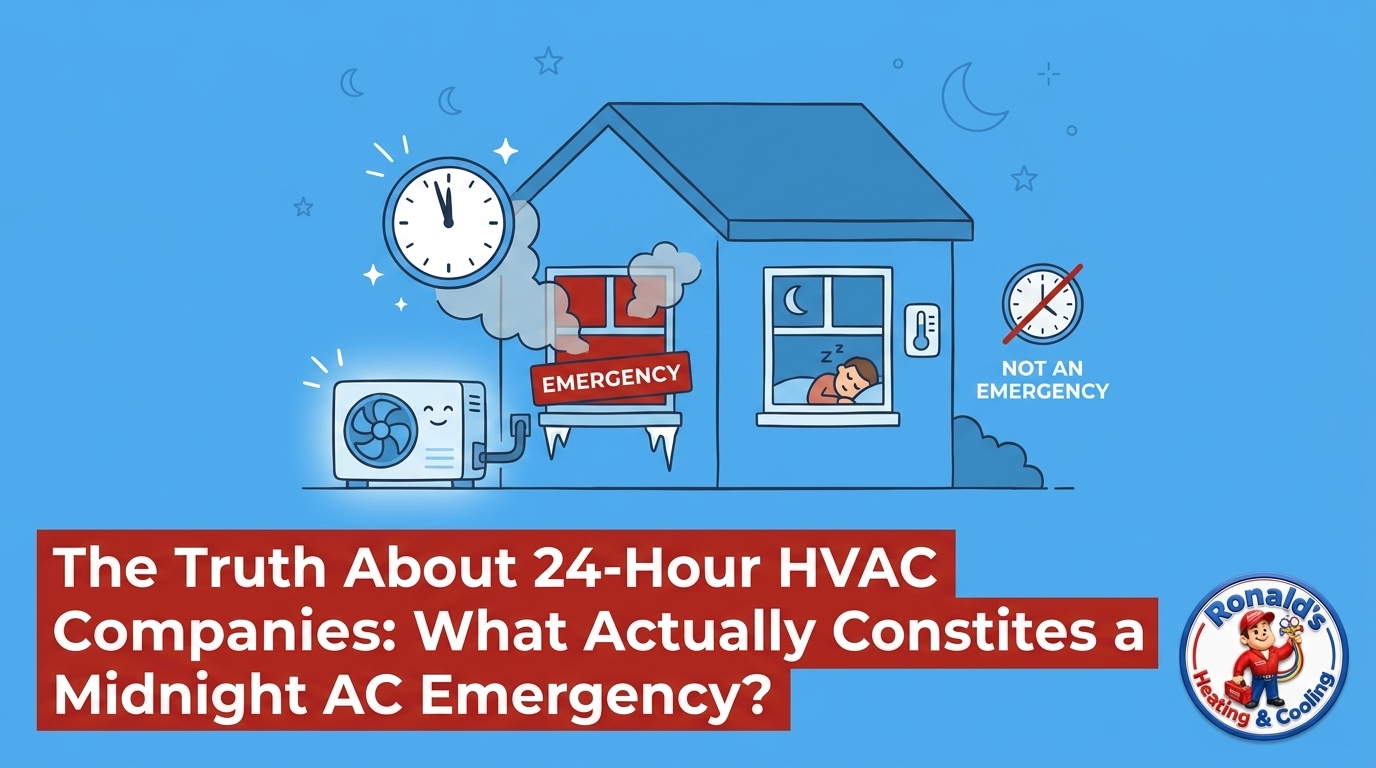
Is Your Midnight AC Failure a True Emergency or Just a Panic?
Is your AC actually broken in a way that demands immediate attention, or are you just feeling the panic of a hot, stagnant house at midnight? The truth about 24-hour HVAC companies: what actually constitutes a midnight AC emergency is often vastly different from what it feels like in the moment. When you wake up during a July peak summer heatwave and realize the vents have stopped blowing cold air, the immediate instinct is to grab your phone and call the first company that promises a technician right now. You are suddenly faced with a stressful decision: request an immediate dispatch and accept the premium after-hours fees, or safely shut down the system, set up some fans, and wait for standard morning hours.
Before you make that call, it is essential to step back and evaluate the situation objectively. Not every cooling breakdown requires a technician at 2 AM. The reality of the heating and cooling industry is that many late-night service calls result in a temporary diagnosis, followed by a recommendation to wait until morning when supply houses open. At Ronald's Heating & Cooling, we have spent years providing reliable air conditioning services, and the most honest advice our team can give is to evaluate the real threat level first. Radical transparency means acknowledging that sometimes, the smartest financial and practical decision you can make is to leave the system off and go back to sleep.
Discomfort vs. Danger: Assessing the Situation
Coastal humidity drastically changes how the temperature inside your house actually feels. In our years serving the Virginia Beach coastal region, our technicians see firsthand how the outside air holds a tremendous amount of moisture, especially in the middle of summer. When your cooling system fails, it stops performing two critical jobs: lowering the ambient temperature and dehumidifying the indoor air. This sudden loss of dehumidification leads to rapid, sticky discomfort that can easily trigger panic.
However, there is a significant difference between a highly uncomfortable house and a medically dangerous environment. When the indoor temperature is climbing past 80 degrees, your body's natural cooling mechanism—evaporating sweat from your skin—becomes much less effective due to the high indoor humidity. This makes the heat index feel significantly worse than what the thermostat actually reads.
When the Heat Index Triggers Panic
Nighttime temperatures in peak summer offer very little natural relief. Because the outside air remains warm and humid long after the sun goes down, opening your windows often brings more moisture into the house, increasing the latent heat load and making you feel even more miserable. It is entirely normal to feel anxious when your home is hot and you are trying to sleep. But for standard, healthy adults, an 82-degree house is a matter of severe discomfort, not an immediate medical crisis.
Assessing the actual danger level is the very first step before picking up the phone. Staying calm allows you to make a financially sound decision rather than a fear-based one. To help you evaluate your current environment, consider the differences between simple discomfort and actual danger that we typically share with our customers:
• Indoor Temperature — Discomfort (Safe to Wait): 78°F to 85°F for healthy adults — Danger (Requires Action): Approaching 90°F+ or affecting vulnerable people
• System Sounds — Discomfort (Safe to Wait): Silence, or the fan blowing warm air — Danger (Requires Action): Loud grinding, screeching, or popping noises
• Odors — Discomfort (Safe to Wait): Musty or stale stagnant air — Danger (Requires Action): Burning plastic, ozone, or electrical smoke
• Moisture — Discomfort (Safe to Wait): High humidity feeling sticky — Danger (Requires Action): Active water pouring through ceilings or floors
Checklist: What Actually Constitutes an HVAC Emergency
While many situations can safely wait for the sun to come up, there are absolute exceptions. Some scenarios require immediate, after-hours professional intervention to protect your property or your family's health. If you are experiencing any of the following critical issues, our team urges you to seek emergency AC repair in Virginia Beach without delay.
Electrical and Fire Hazards
An electrical failure inside your air conditioning unit is a non-negotiable emergency. If you notice an acrid, ozone-like smell, or the distinct odor of burning plastic coming from your vents or the equipment itself, you must act immediately.
• Identify the source: Check if the smell is localized to the indoor air handler or the outdoor compressor.
• Shut off the power: Do not just turn off the thermostat. Go to your main electrical panel and flip the breaker for the HVAC system to the "OFF" position.
• Look for smoke or sparks: If you see visible smoke or sparks, evacuate the immediate area and consider calling emergency services before calling an HVAC technician.
Continuing to run a system with a compromised electrical component can lead to a catastrophic fire. This is a situation where an immediate midnight dispatch is entirely justified.
Vulnerable Family Members
The rules change entirely when highly vulnerable household members are involved. While a healthy adult can sweat out a warm night, rapid temperature increases severely affect the elderly, infants, and individuals with specific medical conditions. When the indoor temperature is climbing past 80 degrees, those who cannot regulate their own body temperature are at risk of heat exhaustion or worse. If your household includes someone who is medically compromised, a broken AC crosses the line from uncomfortable to unsafe, and an emergency call is necessary.
Severe Water Leaks
Air conditioners produce condensation, which normally drains safely outside. However, if the primary and secondary drain lines clog, or the drain pan cracks, gallons of water can overflow. In our experience, if your indoor unit is located in an attic or a second-floor closet, a severe leak threatens immediate structural damage to your ceilings, drywall, and floors. If you cannot stop the flow of water by turning the system off, you need professional help immediately to prevent massive water damage.

Scenarios Where Waiting Until Morning is the Smarter Choice
If you have ruled out electrical fires, severe water damage, and medical vulnerabilities, you are likely dealing with a standard mechanical failure. In these situations, actively choosing to wait until morning is almost always the smarter choice. A trustworthy company like Ronald's Heating & Cooling would rather save you an unnecessary after-hours fee than dispatch a technician who cannot complete the repair in the dark anyway.
The Reality of Replacement Parts
Many homeowners assume that a 24-hour service van carries every conceivable part required to fix any air conditioner. This is physically impossible. While technicians carry universal parts—like standard capacitors, contactors, and common fuses—they do not carry proprietary OEM (Original Equipment Manufacturer) parts for every brand, age, and model of equipment.
If your system has suffered a failed blower motor, a burnt-out proprietary control board, or a specialized variable-speed compressor issue, the replacement part must be acquired from a local HVAC supply house. Those supply houses are completely closed overnight. They typically open their doors at 7 AM or 8 AM.
Paying a premium dispatch fee for a technician to arrive at 2 AM, inspect the unit with a flashlight, and say, "Your control board is fried, I have to go to the supply house when they open at 8 AM," is a frustrating waste of your money. You will still be sleeping in a hot house, but you will have paid extra for the privilege of knowing exactly why.
Accurate diagnostics also require time and proper lighting. Our technicians recently helped a local homeowner who experienced a complete system malfunction where the unit simply would not run. When our team arrived during standard hours, we found and installed a small, missing part that another company had completely overlooked during a previous, rushed visit. The system was repaired and returned to perfect working order. If that had been a panicked midnight call, the nuanced problem might have been missed entirely in the dark. Whether you need an inspection or comprehensive AC repair in Portsmouth, scheduling during daylight hours ensures a thorough, accurate diagnosis.
The Frozen Coil Dilemma: Why a 2 AM Call Won't Help
During a July peak summer heatwave, one of the most common reasons our dispatchers get frantic late-night calls is a frozen evaporator coil. When this happens, calling a technician in the middle of the night will not speed up the repair process. It is a problem bound by the laws of physics.
Signs of a frozen evaporator coil include:
• The system runs constantly, but the air coming from the vents feels warm or weak.
• Visible ice or heavy frost accumulating on the copper refrigerant lines outside near the compressor.
• Water pooling excessively around the indoor air handler as ice slowly begins to melt.
• The system makes a strange hissing or bubbling sound.
A frozen coil occurs when the system cannot absorb enough heat, usually due to severe airflow restriction (like a completely blocked air filter) or a low refrigerant charge caused by a leak. The moisture in the air freezes directly onto the indoor coil, eventually encasing it in a solid block of ice.
The science is simple: a solid block of ice takes 12 to 24 hours to completely thaw at room temperature. A technician cannot accurately diagnose the root cause of the freezing while the coil is encased in ice. They cannot measure refrigerant pressures accurately, and they cannot test the airflow. Furthermore, they cannot simply "chip the ice away" because doing so will puncture the delicate copper tubing, destroying the coil entirely.
If you suspect a frozen coil, an emergency dispatch is useless. The only immediate action required is to turn the system completely OFF at the thermostat. You can switch the fan setting from "AUTO" to "ON" to blow warm room air over the ice and speed up the thawing process, but the cooling cycle must be disabled. By morning, the ice will have melted enough for a professional to diagnose the actual problem. If you are also dealing with electrical anomalies, you might want to understand why your AC circuit breaker keeps tripping before resetting anything.
How to Safely Manage Indoor Heat Until Business Hours
If you have determined that your situation is a high-discomfort scenario rather than a true emergency, your goal is to manage the indoor environment safely until standard business hours. As we always remind our customers, do not attempt DIY repairs or open electrical panels yourself. Instead, focus on mitigating the heat.
• Keep the AC system turned OFF: Leaving a malfunctioning system running will not cool the house, but it will continuously strain the compressor, potentially turning a minor repair into a catastrophic system failure. Turn it off at the thermostat immediately.
• Utilize ceiling and portable fans: Fans do not lower the temperature of the room; they cool the people in it. The wind-chill effect created by moving air helps evaporate sweat from your skin, making you feel cooler even if the indoor temperature is climbing past 80 degrees. Ensure ceiling fans are rotating counter-clockwise to push air straight down.
• Keep windows and doors closed: It is tempting to open windows at night, but in the Virginia Beach coastal region, the nighttime air is incredibly humid. Opening windows introduces a massive latent heat load (humidity) into your home, which will make the house feel much worse the next morning. Keep the house sealed.
• Relocate to the lowest level: Heat naturally rises. The second floor of a home will always be significantly hotter than the ground floor or a finished basement. Move your family and your mattresses to the lowest possible level of the house for the night.
• Stay hydrated: Drink plenty of ice water to help regulate your core body temperature from the inside out.
Frequently Asked Questions About AC Emergencies
Is a broken AC considered an emergency?
A broken AC is only considered a true emergency if it presents a direct threat to life or property. This includes active electrical fire hazards like sparking or burning smells, severe water leaks threatening structural damage, or the presence of highly vulnerable individuals like infants or the elderly in a rapidly heating house. In most other cases, a broken AC is an urgent priority that can safely wait for standard business hours, saving you from premium after-hours dispatch fees.
What should I do if my AC stops working at night?
The very first step is to turn the system completely off at the thermostat to prevent further mechanical damage. Next, check your main electrical panel to see if a breaker has tripped, but do not repeatedly reset it if it trips again. Finally, assess the danger level in your home to decide if you need to call a 24-hour dispatch line immediately or if you can safely use fans and wait until morning.
Should I turn off my AC if it's not cooling?
Yes, you should absolutely turn off your AC if it is running but not producing cold air. Leaving a malfunctioning system running puts immense strain on the compressor and the blower motor. It wastes electricity without providing any comfort, and it can turn a relatively simple repair into a complete system replacement if the compressor burns out from overwork.
Will a frozen AC coil thaw overnight?
A frozen AC coil can begin thawing overnight, but it typically takes a full 12 to 24 hours to melt completely. The system must be turned completely off at the thermostat for this process to happen. A technician cannot properly diagnose or repair a system while the coil is encased in ice, which is why calling for emergency service on a frozen unit in the middle of the night is generally unproductive.
Can a tripped breaker cause my AC to stop blowing cold?
Yes, a tripped breaker can cause your system to stop blowing cold air. Air conditioning systems generally use two separate breakers: one for the indoor air handler and one for the outdoor compressor. If the outdoor unit's breaker trips, the indoor fan will continue to blow air through your vents, but because the compressor is off, that air will be warm. Always check your electrical panel before assuming the entire system has failed.
Make the Smart Call for Your AC Repair
Navigating a midnight AC breakdown requires a clear head and a bit of practical knowledge. At Ronald's Heating & Cooling, we believe the truth about 24-hour HVAC companies is that while they provide a vital service for true emergencies, a reputable team will always advise you on the most cost-effective and logical course of action. Whether you are dealing with a sparking electrical component that requires immediate intervention, or a frozen coil that simply needs time to thaw, expert help is available to get your home comfortable again.
When the sun is up and standard hours resume, having a professional thoroughly diagnose the root cause of the failure ensures the problem is fixed right the first time. If your system has left you sweating through the night, do not wait for the heat to get worse tomorrow. Schedule a comprehensive inspection with our trusted professionals today and restore your home's comfort.
