





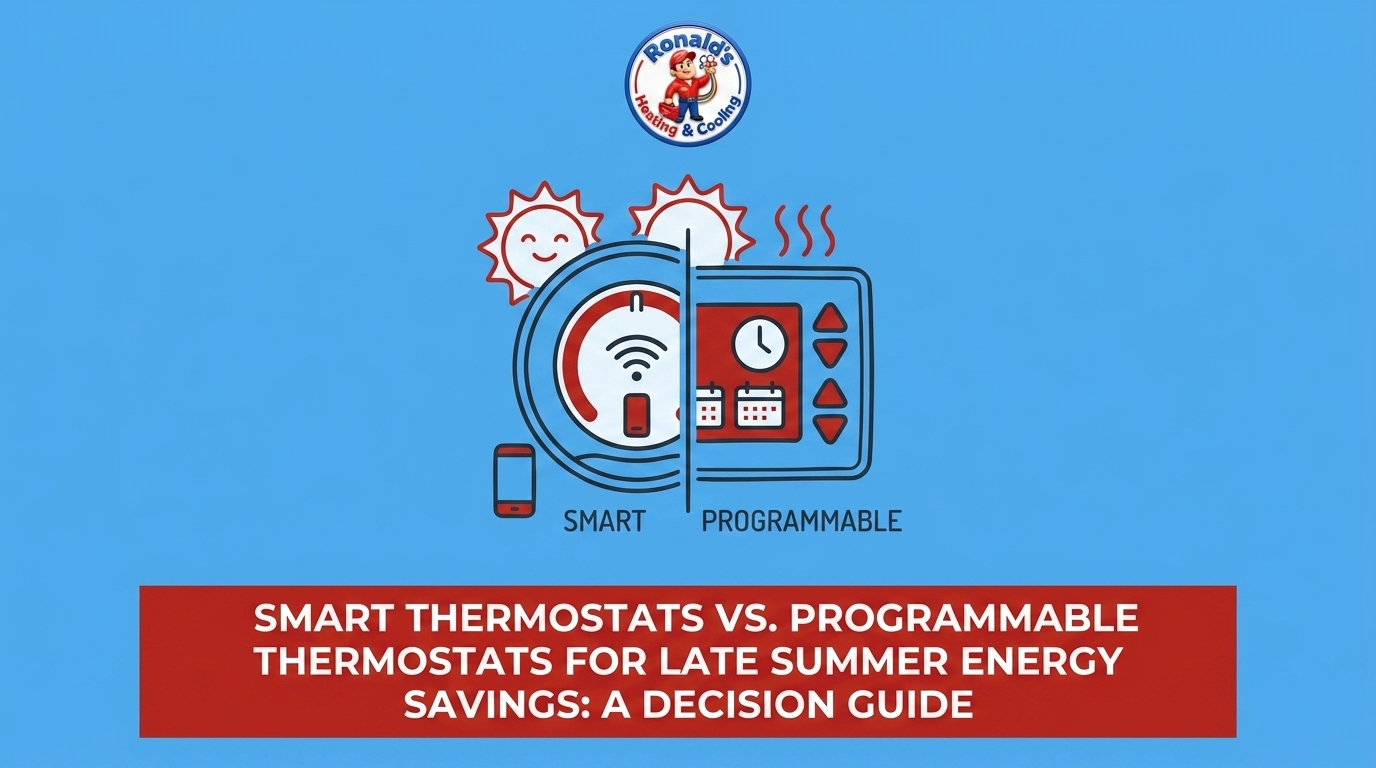
The Late Summer Climate Challenge: Why Basic Controls Fall Short
A digital screen does not automatically make a thermostat intelligent. When evaluating smart thermostats vs. programmable thermostats for late summer energy savings, the distinction goes far beyond having a touchscreen or a modern design on your wall. Most homeowners assume that if they can punch in a time and a temperature, they are operating at peak efficiency. However, a standard programmable unit is fundamentally just a digital clock attached to a temperature switch. It operates entirely blind to the actual conditions inside and outside your home, which becomes a glaring liability during the unpredictable weather shifts of late summer.
Here in our service area, our team at Ronald's Heating & Cooling knows firsthand that Virginia Beach's late summer climate presents a unique challenge. We frequently see the weather transition from blistering heat to damp, unpredictable early fall fronts, often bringing fluctuating temperatures while heavy mugginess persists. Basic controls struggle to maintain indoor comfort during this period because they cannot adapt to anything outside their rigid, pre-programmed schedule. If your air conditioning systems are running constantly but the house still feels sticky and uncomfortable, we often find the problem might not be the equipment itself, but rather the brain controlling it.
This specific seasonal shift, particularly around the August back-to-school transition, exposes the limitations of outdated technology. As household routines become chaotic and outdoor temperatures swing wildly, maintaining efficiency requires a decision framework based on actual climate needs. Choosing the right technology means understanding exactly how these different devices process information and command your heating and cooling equipment to respond to coastal weather.
Understanding the Core Differences: Static Scheduling vs. Dynamic Learning
To make an informed decision about upgrading your home's climate controls, you must first understand the foundational operational differences between a standard programmable unit and a Wi-Fi-enabled smart thermostat. They represent two completely different philosophies of energy management: static scheduling versus dynamic learning.
Standard programmable thermostats follow strict, user-inputted rules. You tell the device to drop to 72 degrees at 5:00 PM, and it will execute that command every single day, regardless of whether it is 95 degrees outside or a mild 75 degrees. Smart thermostats, conversely, utilize dynamic learning algorithms, geofencing technology, and continuous Wi-Fi connectivity to adjust your home's climate on the fly. In our experience, this adaptability is heavily considered during any modern HVAC installation in Virginia Beach, as the right control unit dictates the overall efficiency of the entire system.
The Limitations of Set-It-and-Forget-It
During our late summer service calls, we consistently see that the primary flaw in the traditional programmable model is its inability to detect reality. These models cannot detect if the house is empty, if the family went on vacation, or if everyone stayed home sick for the day. They require manual overrides to deviate from the schedule. Unfortunately, manual overrides are frequently forgotten. A homeowner might bump the temperature down for an afternoon gathering and forget to reset it, causing the system to run at maximum capacity for days. This rigid "set-it-and-forget-it" approach often wastes significant energy when the August back-to-school transition suddenly alters the daily rhythm of the household.
The Advantage of Algorithmic Learning
Smart models take a proactive rather than reactive approach. Through algorithmic learning, these devices monitor how long it takes your specific home to cool down or heat up. If you want the house at 72 degrees by 5:00 PM, a smart thermostat learns your home's thermal profile. On a moderately warm day, it might start cooling at 4:30 PM. On a sweltering day, it might start at 3:45 PM. By adjusting cycles proactively, these systems reduce the intense wear and tear that occurs when an HVAC system is forced to cool a hot house too quickly, which our technicians note ultimately extends the lifespan of your equipment.
Adapting to the August Back-to-School Schedule Shift
The end of summer brings a massive shift in household occupancy. The lazy, predictable days of mid-summer are suddenly replaced by erratic schedules involving early morning bus routes, after-school sports practices, varying office hours, and unpredictable weekend activities. This August back-to-school transition is where the technological gap between smart and programmable thermostats becomes highly visible to our installation teams.
Here is how the two technologies handle the reality of a chaotic fall schedule:
1. The Morning Departure: With a programmable thermostat, you must guess exactly when the last person will leave the house and set a rigid setback temperature. If someone leaves an hour late, they suffer in a hot house. A smart thermostat uses geofencing—tracking the location of household smartphones—to detect when the house is actually empty. It only enters energy-saving mode once the perimeter is cleared.
2. The Empty Afternoon: During a late August afternoon, a programmable thermostat might begin cooling the house at 3:00 PM because that is what the schedule dictates, even if soccer practice was extended and the family won't return until 6:00 PM. A smart thermostat recognizes the house is still empty and delays the cooling cycle, preventing hours of wasted energy during the hottest part of the day.
3. The Early Arrival: If a family member comes home early due to a canceled event, a programmable thermostat requires them to walk into a warm house and manually force the system to run. A smart thermostat detects the smartphone crossing the geofence radius on the drive home and begins preemptively cooling the space, ensuring the house is comfortable the moment the front door opens.
This level of adaptability eliminates the tedious need for constant reprogramming. Instead of forcing your family to live around the HVAC schedule, the HVAC system learns to live around your family's actual behavior.
Mastering Indoor Relative Humidity Percentages in Coastal Environments
True indoor comfort is not merely a measurement of sensible heat. In coastal environments like ours, high moisture levels make a home feel significantly warmer and far more oppressive than the number on the thermostat indicates. Managing indoor relative humidity percentages is a critical gap that basic programmable units completely miss, as they are only capable of reading the ambient dry-bulb temperature.
The Environmental Protection Agency (EPA) recommends maintaining optimal indoor moisture levels between 30 and 50 percent to ensure both physical comfort and healthy indoor air quality. When humidity climbs above that threshold during the muggy late summers in Coastal Virginia, sweat cannot evaporate from your skin, making 74 degrees feel like 80 degrees. A standard programmable thermostat sees that the room is 74 degrees, decides its job is done, and shuts off the air conditioner, leaving the air feeling thick and stagnant.
Advanced smart thermostats take a holistic approach to climate control. High-end models feature built-in hygrometers that constantly monitor indoor relative humidity percentages. When integrated properly with a modern HVAC system, these smart units can execute specific dehumidification strategies. If the humidity spikes, the smart thermostat can command the air conditioner to run a low-speed overcooling cycle—dropping the temperature a degree or two below the setpoint specifically to extract more moisture from the air. For homeowners looking to achieve perfect home humidity control, our team often recommends this intelligent integration as the difference between a house that feels cold and clammy versus one that feels crisp and refreshing.
Proactive Weather Adaptation: Handling Unpredictable Fall Fronts
Another major differentiator between the two technologies is their awareness of the outside world. Programmable thermostats are entirely confined to the four walls of your hallway. They do not know if it is raining, snowing, or experiencing a sudden heatwave. They only react once the indoor temperature has already become uncomfortable, forcing your equipment to play catch-up.
Smart thermostats break down this barrier by pulling real-time local weather station data via their Wi-Fi connection. This external awareness allows the system to engage in proactive weather adaptation. For example, if the forecast predicts a sudden, unseasonable cold front moving in during an early September evening, a smart unit knows that the demand on your home's heating capabilities will spike. It can gently pre-heat the home before the extreme temperature drop hits the exterior walls.
This proactive approach significantly reduces the sudden, intense strain on your HVAC system. By making incremental adjustments based on incoming weather data, the system avoids the harsh, high-capacity cycling that leads to mechanical fatigue. Whether you are relying on your cooling system to fight off a late-summer heatwave or depending on your heating services to manage an unexpected freeze, a smart thermostat ensures your equipment operates smoothly and efficiently, all while keeping indoor relative humidity percentages balanced despite the chaos outside.
Feature-by-Feature Comparison for Your HVAC System
To provide a clear decision framework, we find it helps to look at exactly how these devices stack up against each other across key operational categories. While both will turn your system on and off, the depth of their capabilities dictates your overall energy savings and comfort level, especially during the volatile August back-to-school transition.
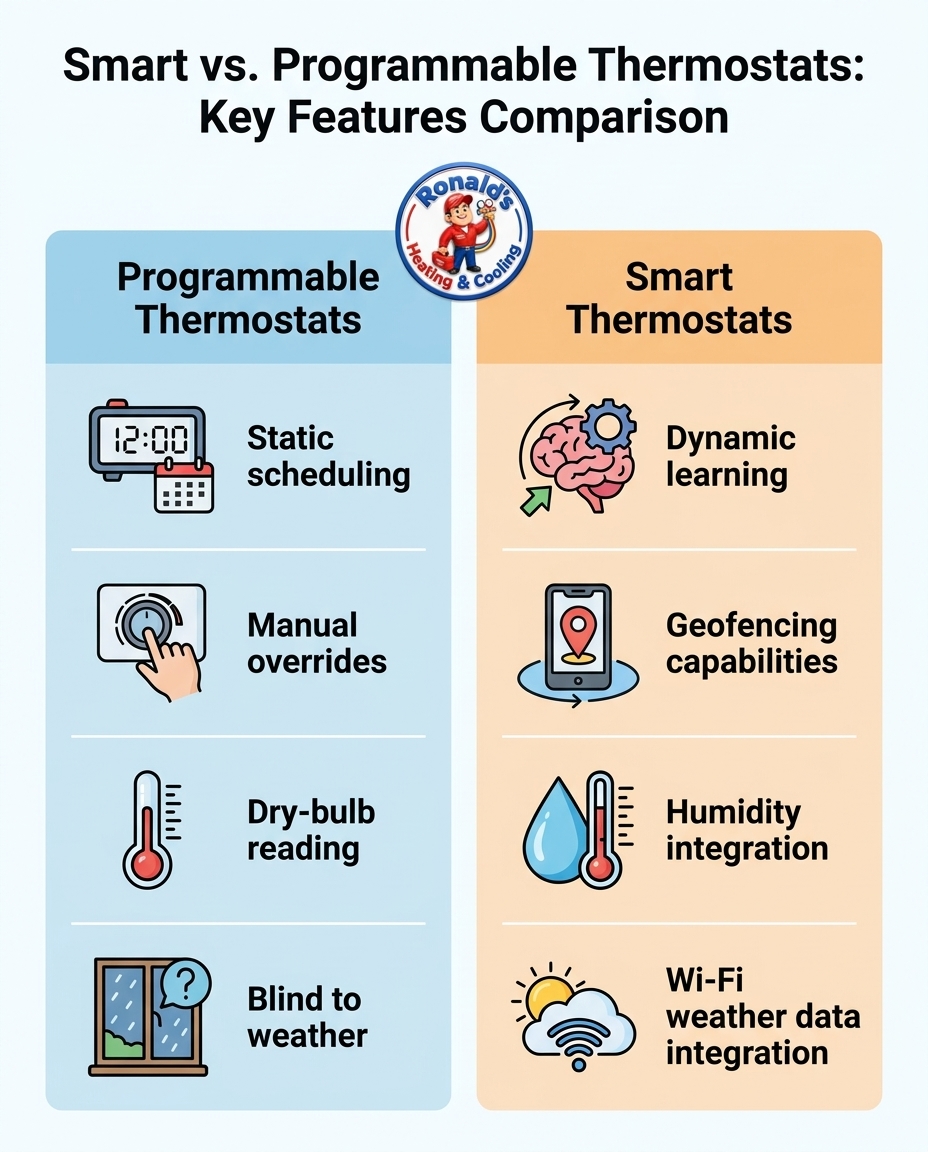
• Scheduling Mechanism — Standard Programmable Thermostat: Rigid, manual time blocks that require physical reprogramming when routines change. — Smart Wi-Fi Thermostat: Dynamic algorithms that learn your habits and adjust automatically via geofencing.
• Weather Adaptation — Standard Programmable Thermostat: Blind to outdoor conditions; only reacts once indoor temperatures drift past the setpoint. — Smart Wi-Fi Thermostat: Pulls local Wi-Fi weather data to proactively adjust cycles before a front arrives.
• Moisture Management — Standard Programmable Thermostat: Reads dry-bulb temperature only; cannot detect or respond to muggy conditions. — Smart Wi-Fi Thermostat: Monitors indoor relative humidity percentages and can trigger dehumidification cycles.
• Energy Reporting — Standard Programmable Thermostat: No data tracking; energy usage is only visible when the monthly utility bill arrives. — Smart Wi-Fi Thermostat: Provides detailed digital reports on runtime, energy savings, and efficiency patterns.
• System Compatibility — Standard Programmable Thermostat: Works well with basic, single-stage equipment but limits advanced features. — Smart Wi-Fi Thermostat: Optimizes complex, multi-stage equipment for maximum efficiency and staging control.
• Remote Accessibility — Standard Programmable Thermostat: Requires physical interaction at the wall unit to make any schedule or temperature changes. — Smart Wi-Fi Thermostat: Full control from anywhere in the world via smartphone application.
Beyond these operational features, upgrading to advanced technology often opens the door to financial benefits. ENERGY STAR certified smart models frequently qualify for generic utility incentive programs and energy rebates, as local power grids benefit from the reduced peak-load strain these devices provide. While specific program details vary, these generic incentives often help offset the initial cost of the upgrade. Furthermore, integrating a smart control unit is something we highly recommend when establishing an ongoing HVAC maintenance plan, as the diagnostic alerts provided by the thermostat can warn technicians of impending system failures before they cause total breakdowns.
When is a Standard Programmable Thermostat Sufficient?
Despite the impressive capabilities of smart technology, we always tell our customers that advanced thermostats are not strictly necessary for every single household. There are specific scenarios where a standard programmable unit is perfectly sufficient, and pushing for a high-tech upgrade might yield diminishing returns.
If your household operates on a highly rigid, predictable daily schedule with someone almost always home at the same times, the dynamic learning features of a smart unit may not provide significant additional energy savings. Retirees or individuals who work from home permanently often find that a basic programmable schedule meets all their needs. Furthermore, if your home operates on older, simpler single-stage HVAC equipment, the system itself may not be capable of utilizing the advanced staging and dehumidification features that a smart thermostat commands.
The key is matching the technology to both your lifestyle and your equipment. At Ronald's Heating & Cooling, our technicians provide expert, transparent guidance to ensure homeowners get the right climate control upgrades without hidden fees or being pushed into unnecessary tech. A professional assessment of your current system is the best way to determine if managing your indoor relative humidity percentages and schedule shifts requires a smart upgrade, or if a reliable programmable unit will do the job effectively.
Frequently Asked Questions About Thermostat Upgrades
Can a smart thermostat control indoor humidity?
Yes, advanced models can communicate with whole-home dehumidifiers or use overcooling cycles to reduce moisture. By monitoring indoor relative humidity percentages rather than just temperature, these thermostats can force the air conditioner to run slightly longer, extracting excess dampness from the air. We see this as particularly beneficial in coastal regions where high humidity makes the air feel warmer than the actual temperature.
Is a smart thermostat better than a programmable one for changing weather?
Yes, because it uses real-time local weather data to adjust settings proactively, whereas programmable units only react to indoor temperatures. If a sudden fall cold front is approaching, a smart thermostat will sense the impending drop via Wi-Fi and preemptively adjust the heating cycle. This prevents the indoor climate from dropping uncomfortably low before the system finally kicks on.
How do smart thermostats adapt to changing schedules?
They use geofencing to detect when smartphones leave or enter the home, and learning algorithms to identify new routine patterns automatically. If your schedule changes daily, the thermostat recognizes when the house is empty and switches to an energy-saving mode. As you cross an invisible geographic boundary on your way home, it resumes your preferred comfort settings automatically.
Do smart thermostats actually save energy during the fall transition?
Yes, ENERGY STAR certified models provide measurable percentage savings by eliminating the waste of heating or cooling an empty home during unpredictable weather shifts. Because they learn exactly how long your home takes to reach a target temperature, they run the equipment only as long as necessary. This optimized runtime directly translates to reduced energy consumption over the course of the season.
Will a new thermostat work with my existing HVAC setup?
Most modern thermostats are compatible with standard systems, but our technicians always recommend professional verification for multi-stage systems, heat pumps, or setups lacking a common wire (C-wire). Attempting to wire a complex thermostat without the proper connections can blow low-voltage fuses or void equipment warranties. A licensed technician from Ronald's Heating & Cooling can ensure the new control unit properly communicates with all components of your existing HVAC equipment.
Make the Right Choice for Your Home's Comfort
Choosing the right climate control technology ultimately depends on the flexibility of your daily schedule and your need for precise moisture control. Navigating the erratic weather and the August back-to-school transition is significantly easier when your HVAC system can adapt to your life automatically. If you are tired of constantly adjusting the dial to fight off coastal humidity or wasting energy on an empty house, a smart upgrade offers a clear advantage. Consult with our local professionals at Ronald's Heating & Cooling to evaluate your current equipment and implement a decision framework that ensures your home remains perfectly balanced, no matter what the late summer weather brings.
