





Facing an August AC Breakdown: The R-22 Dilemma
Are you staring at a thermostat that refuses to budge, caught in the frustrating debate of repairing vs. replacing an R-22 AC unit that springs a leak in late summer? Right as back-to-school season ramps up, a sudden air conditioning failure is the last thing you need. The situation gets even more complicated when you discover your older system relies on phased-out R-22 refrigerant. You are immediately faced with a tough choice: apply a short-term patch to finish out the cooling season, or invest in a modern replacement right now.
Before you make a panicked decision, it helps to rely on an objective framework for weighing short-term relief against long-term value. If you are exploring your options for your Air Conditioning, we can help you navigate this transition smoothly.
The heavy, August late-summer humidity in Virginia Beach makes a working air conditioner non-negotiable. When an obsolete R-22 refrigerant system goes down in this weather, the discomfort is immediate. Let us break down exactly what you need to know to make the smartest financial decision for your home.
Understanding the Scarcity of Obsolete Refrigerant
To make an informed decision about your system, you first need to understand why R-22 has become such a massive hurdle for homeowners. On January 1, 2020, the Environmental Protection Agency (EPA) officially banned the production and import of R-22, commonly known as Freon. This phase-out was enacted because R-22 is an ozone-depleting substance.
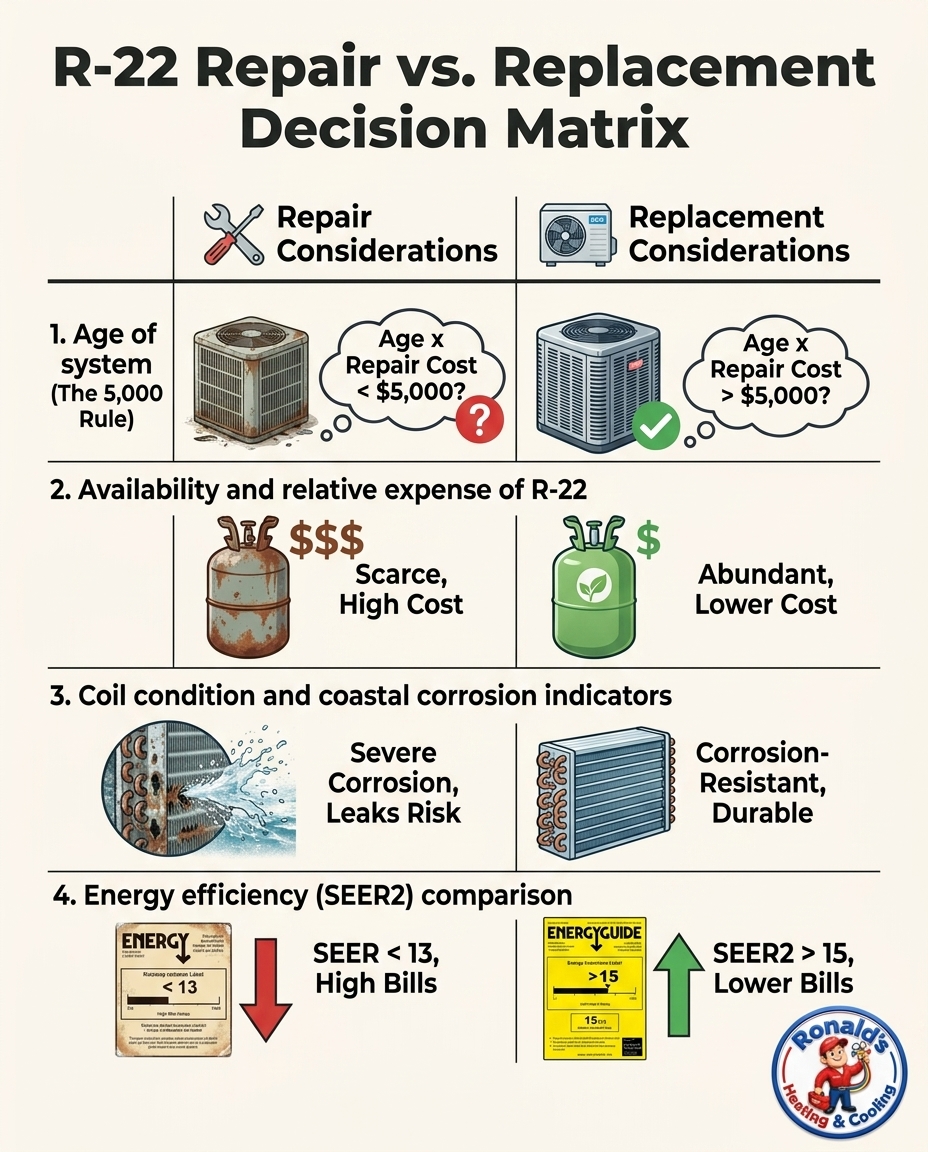
Because no new R-22 is being manufactured or brought into the country, the only supplies legally available on the market are recovered, recycled, or reclaimed from older systems that have been decommissioned. This extreme scarcity translates directly to an exorbitant relative expense when you need to top off a leaking system. You are essentially paying a premium for a product that is disappearing from the industry entirely.
Many homeowners wonder if they can simply substitute a newer, cheaper refrigerant into their older unit to save on costs. Unfortunately, older systems cannot simply be filled with modern refrigerants without causing catastrophic damage. The compressors and components in obsolete R-22 refrigerant systems were engineered for specific operating pressures and specialized oils. Introducing a modern refrigerant like R-410A into an R-22 system will quickly destroy the compressor, leaving you with a completely ruined unit.
This is why a simple leak suddenly turns into a major financial decision. If you are weighing the costs and leaning toward an upgrade, looking into AC Replacement in Virginia Beach is often the most financially sound path forward.
Why Coastal Climates Accelerate Coil Corrosion and Leaks
The root cause of most refrigerant leaks isn't just bad luck; it is often directly tied to the environment around your home. In Virginia Beach, coastal salt air significantly accelerates coil corrosion, meaning a patched leak is often just the first of many to come.
The mechanics of galvanic corrosion: Your outdoor condenser coil is exposed to the elements around the clock. When salty, humid air interacts with the dissimilar metals (like copper and aluminum) in your AC unit, it triggers a process called galvanic corrosion. This process literally eats away at the metal over time, creating microscopic pinhole leaks where refrigerant escapes.
The reality of patching a leak: Applying a temporary patch to a single pinhole does not reverse the underlying degradation of the entire coil. If the salty August late-summer humidity in Virginia Beach has caused one weak spot to rupture, the rest of the coil is likely in a similar state of decay.
The high probability of future failures: Because the metal is fundamentally compromised, there is a very high probability that a patched system will develop new leaks shortly after the repair is completed. You might fix one hole today, only to have another one open up next week as the metal continues to thin out.
Recognizing the early warning signs: Before a complete breakdown occurs, you might notice your system running longer cycles, blowing lukewarm air, or developing ice on the indoor evaporator coil. Knowing how to detect refrigerant leaks in your AC early can help you avoid a total system failure on the hottest day of the year.
The Sunk-Cost Fallacy of the Late-Summer Band-Aid Fix
The Problem: When your AC fails in late August, the psychological temptation to just "limp through" the rest of the cooling season is incredibly strong. You might think that paying for a quick recharge will buy you enough time to get to the cooler fall months, allowing you to delay a major purchase.
The Cause: This mindset leads to the false economy of paying a premium for obsolete refrigerant just for a few more weeks of cooling. Because R-22 is so scarce and expensive, you end up sinking a significant amount of funds into a temporary fix. The danger here is the sunk-cost fallacy—the belief that because you have already invested money into patching the old unit, you must keep repairing it. However, the system is still degrading. There is a massive risk that you will face the exact same breakdown and an empty refrigerant line when you turn the system back on next spring.
The Solution: Evaluating when a minor fix is actually viable versus when it is throwing good money after bad is critical. Sunk costs in temporary repairs drain funds that could have been used as a down payment for a permanent, reliable solution. While professional AC Repair is sometimes the right answer for minor electrical issues or worn capacitors, pouring expensive R-22 into a corroding coil is rarely a wise investment. Homeowners must objectively assess whether a band-aid fix is truly saving them money, or just delaying an inevitable and increasingly expensive replacement.
Honest Cost-Benefit Assessments: When to Repair vs. Replace
Navigating an AC breakdown requires a transparent framework. We pride ourselves on a commitment to honest cost-benefit assessments, ensuring customers only replace their equipment when it is truly the best financial move. A typical pattern we see is homeowners being told by other providers that their outdated system requires an immediate, total replacement, only for an honest technician to evaluate the unit and find a small, unhooked part or a minor electrical fault. We believe in providing objective second opinions to ensure a replacement is actually necessary.
To help you weigh your options, industry professionals often use the "5,000 rule." You multiply the age of your system by the relative repair cost. If the resulting number exceeds 5,000, replacement is generally the smarter financial choice. You must also factor in the overall condition of the system, including ductwork integrity and airflow quality, comparing the questionable reliability of a patched system against the peace of mind of a brand-new warranty.
• Refrigerant Cost — Repairing the R-22 System: Extremely high due to scarcity of R-22 — Replacing the System: Uses modern, readily available refrigerants
• Future Reliability — Repairing the R-22 System: Low; patched coils often develop new leaks — Replacing the System: High; protected by comprehensive manufacturer warranties
• Energy Efficiency — Repairing the R-22 System: Poor; older systems consume more electricity — Replacing the System: Excellent; meets higher modern SEER2 standards
• Overall Value — Repairing the R-22 System: Sunk cost into a degrading asset — Replacing the System: Long-term investment in home comfort
Signs a Repair Still Makes Sense
Not every breakdown means the end of the line for your air conditioner. If the issue is completely unrelated to the refrigerant circuit—such as a failed capacitor, a burnt-out contactor, or a faulty blower motor—a targeted repair is usually the best route. Additionally, if the system is relatively young, has been meticulously maintained, and is in otherwise excellent condition, repairing a minor non-refrigerant issue makes perfect sense.
When Replacement is the Clear Choice
Conversely, there are scenarios where investing more into an old unit is a mistake. When multiple leaks are present due to severe coastal coil corrosion, the structural integrity of the system is compromised. Furthermore, if the system requires a massive recharge of obsolete R-22, the relative expense of that rare refrigerant often approaches what you would put down as a down payment on a brand-new, highly efficient unit. In these cases, replacement is the undeniable choice.
Long-Term Value: Efficiency Upgrades and Generic Tax Credits
Choosing to replace obsolete R-22 refrigerant systems isn't just about avoiding the high cost of rare Freon; it is an investment in modern technology that pays dividends over time. Today's air conditioning systems are built to meet strict, higher SEER2 (Seasonal Energy Efficiency Ratio) standards. A higher SEER2 rating means the system uses significantly less electricity to produce the same amount of cooling, which translates to lower long-term operating costs for your household.
Upgrading your system provides several distinct long-term benefits:
• Superior performance: Modern systems utilize advanced, readily available refrigerants that transfer heat more effectively, cooling your home faster and maintaining a more consistent temperature.
• Environmental impact: Newer refrigerants have a vastly lower environmental footprint compared to ozone-depleting R-22.
• Enhanced comfort: A new system does more than just blow cold air; it provides better humidity control, which is essential during the August late-summer humidity in Virginia Beach, and significantly improves indoor air quality.
Upgrading to a high-efficiency system can also open the door to valuable financial incentives. Depending on the specific equipment you choose, you may be eligible for generic federal tax credits and local utility incentive programs designed to encourage energy-efficient home improvements. We always recommend consulting with your utility provider or a tax professional to verify current programs and maximize your savings.
Using Flexible Financing to Ease Unexpected Replacements
We understand that a sudden AC failure in late August is rarely a planned expense. The immediate panic of an unexpected replacement can lead homeowners to choose a cheaper, temporary repair simply because they feel they cannot afford a new system out of pocket. To ease this burden, we emphasize the availability of flexible financing options to make high-efficiency systems accessible when you need them most.
By utilizing financing, you completely remove the stress of an unexpected August replacement. Instead of draining your savings to pay a premium for obsolete R-22, spreading the investment over time allows you to upgrade to a premium, high-efficiency system with manageable monthly terms. The straightforward process of exploring available financing terms typically involves:
1. Selecting your ideal system: Choosing the SEER2 rating and features that best match your home's cooling needs.
2. Reviewing terms: Looking at different monthly payment options to find a plan that fits comfortably within your household budget.
3. Quick approval: Completing a simple application process to secure funding without unnecessary delays.
This approach lets you invest in long-term home value rather than pouring money into temporary, sunk repair costs that will evaporate as soon as the next leak occurs. If you are ready to explore your options, looking into HVAC Financing can bridge the gap between an unexpected breakdown and a permanent, reliable home comfort solution.
Frequently Asked Questions About R-22 Systems
Is it worth fixing an R22 AC unit?
Generally, no, due to the exorbitant cost of obsolete refrigerant and the likelihood of future leaks. Because R-22 is no longer manufactured, the limited supply makes recharging an older system incredibly expensive. Furthermore, if a leak has developed, the internal coils are likely corroding, meaning new leaks will almost certainly appear soon. Investing that money into a modern, energy-efficient replacement offers far better long-term value.
Can you still get R-22 refrigerant?
Yes, but only from recovered and recycled supplies, making it extremely scarce and expensive. The EPA completely banned the production and import of new R-22 on January 1, 2020. HVAC technicians must rely on specialized reclamation facilities to source clean, recycled R-22 for repairs. This dwindling supply is why the relative expense of topping off an older system continues to climb every year.
Can I put R410a in an R22 system?
No, the systems operate at completely different pressures, and mixing them will cause catastrophic compressor failure. R-410A runs at a significantly higher pressure than R-22, and older compressors simply were not built to handle that stress. Additionally, the two refrigerants use incompatible oils that will sludge up and destroy the internal components if mixed. Upgrading to a newer refrigerant requires completely replacing the indoor coil and outdoor condenser.
What happens if my AC leaks R-22?
The system loses its ability to cool, the indoor coil may freeze over, and the compressor risks overheating. As the refrigerant level drops, the pressure inside the evaporator coil falls, causing the condensation on the coil to freeze into a block of solid ice. If left running in this state, the compressor in the outdoor unit will overheat and eventually burn out, turning a simple leak into a total system failure.
How long do AC coils last in coastal air?
Without protective coatings, airborne salinity can significantly reduce coil lifespan compared to inland environments. In areas exposed to coastal salt air, the galvanic corrosion process is drastically accelerated, eating away at the copper and aluminum components. While inland coils might last 12 to 15 years, unprotected coils in coastal regions can begin developing severe pinhole leaks in as little as 5 to 7 years if not properly maintained.
Make an Informed Decision for Your Home's Comfort
Facing an air conditioning failure is stressful, but it doesn't have to result in panicked spending. By relying on an objective framework for weighing short-term relief against long-term value, you can confidently navigate the repair versus replacement dilemma. Remember that pouring expensive, obsolete refrigerant into a deteriorating system is often a temporary band-aid that leaves you vulnerable to future breakdowns. A late-summer breakdown is an opportunity to upgrade your home's efficiency and comfort before the seasons change.
We encourage you to reach out for a professional, transparent assessment of your system's condition. Our team is here to provide the honest guidance you need to make the best financial choice for your household. Contact us today to schedule a comprehensive evaluation and restore reliable, efficient cooling to your home.
