





The Erratic Cycling Problem During the Fall Transition
Your air conditioner kicks on, runs for five minutes, and abruptly shuts down—leaving you to wonder exactly how shifting fall temperatures confuse your HVAC system's sensors so badly. Just ten minutes later, you hear the familiar click of the thermostat, and the system fires right back up again. This constant on-and-off behavior is known as short-cycling, and it is one of the most frustrating issues homeowners face as the seasons change. The house never quite feels comfortable, your energy bills creep up, and the constant noise becomes a daily nuisance.
During the September early fall transition, our team at Ronald's Heating & Cooling frequently fields calls from homeowners dealing with this exact dilemma. You are left wondering if your system's control board is genuinely failing, or if the equipment is simply struggling to adapt to the unpredictable weather outside. Before you panic and assume you need a massive repair, it helps to understand how extreme daily temperature shifts affect your equipment. Often, we find the root cause isn't a broken machine, but rather a confused one. If you want to ensure your equipment is ready for the colder months, securing professional heating services is always a smart move, but educating yourself on system behavior is the first step.
Common signs of erratic autumn cycling include:
• Brief run times: The system runs for less than ten minutes before shutting off.
• Uneven temperatures: One room feels freezing while the hallway remains stuffy.
• Frequent clicking: The thermostat audibly clicks on and off multiple times an hour.
• Unexpected mode switching: Systems set to "Auto" battle themselves, switching between heating and cooling all afternoon.
Understanding the "why" behind this behavior requires looking at the environment surrounding your home, the physics of heat transfer, and the specific way your thermostat reads the air.
The Mechanics of 30-Degree Daily Temperature Swings
To understand why your system gets so confused, you have to look at the severe weather shifts happening just outside your front door. When you experience 80°F days dropping to 50°F nights, your home is subjected to two completely different thermal extremes within a single 12-hour window. During the peak of the afternoon, the sun beats down on your roof, solar heat gain pours through your windows, and your air conditioner has to work hard to remove that heat. But as soon as the sun sets, the temperature plummets rapidly.
This rapid shift creates contradictory thermal loads. The system is forced to switch from handling a heavy cooling load to potentially needing to provide a heating load, all while the physical structure of your house is still trying to catch up to the outside air. In our years of servicing Virginia Beach homes, we've seen firsthand how the ocean's influence creates these volatile 24-hour thermal cycles. The sea breeze can drop the ambient outdoor temperature by ten to fifteen degrees in a matter of minutes, throwing a massive curveball at your climate control system. This puts an incredible amount of strain on the equipment's starting components, which are designed to run in longer, steadier cycles rather than short, frantic bursts. To protect these components from premature failure, our technicians highly recommend enrolling in a comprehensive HVAC maintenance plan.
Why the Ambient Air Sensor Gets Confused
Your thermostat does not know what the weather is like outside; it only knows the temperature of the air immediately surrounding its internal sensor. This ambient air sensor is highly sensitive to rapid changes in its immediate vicinity. When the outdoor temperature drops suddenly, the structural elements of your home react at different speeds.
Factors that trick the ambient sensor:
• Drafty windows: A sudden nighttime breeze pulling cold air through a poorly insulated window can blow directly across a hallway thermostat, tricking the sensor into thinking the entire house is 65°F.
• Door traffic: Opening the front door to a blast of 50-degree evening air sends a wave of cold directly to centrally located sensors.
• Vent placement: If a supply register is blowing conditioned air too close to the thermostat, the sensor reads that cold stream rather than the actual room temperature, shutting the system off prematurely.
Once the draft stops or the conditioned air dissipates, the sensor realizes the room is actually still warm, forcing the system to turn right back on. We routinely see this create a loop of rapid cycling that has nothing to do with a broken part, and everything to do with a confused sensor.
How Thermal Mass and Humidity Complicate Sensor Readings
The science of thermal mass plays a massive role in why your thermostat struggles during the fall. Thermal mass refers to the dense materials inside your home—your brick walls, tile flooring, drywall, and large wooden furniture. Throughout an 80-degree afternoon, these materials absorb and store thermal energy like a giant battery. They hold onto that daytime heat long after the sun goes down.
Here is where the conflict arises: As the evening air cools down outside, your air conditioner turns on to cool the indoor air. The AC successfully cools the air in the room, and the thermostat sensor (reading that cool air) shuts the system off. However, the thermal mass inside your home is still packed with stored daytime heat. The moment the AC shuts down, your walls, floors, and furniture immediately begin radiating that stored heat back into the room. The air temperature spikes rapidly, triggering the sensor to turn the AC right back on. The system is fighting the house itself, not just the outside air.
Our team knows that living in the Virginia Beach coastal climate adds another layer of complexity to this process: moisture. Coastal humidity makes the air heavy and dense, which means it holds onto heat much longer than dry air. This moisture exacerbates the daytime heat retention, making the "thermal battery" effect even stronger. As the crisp night air cools the exterior of the house, the humid, heat-soaked interior continues to fight the thermostat. We often tell our customers that controlling this moisture is critical, and taking steps to achieve perfect home humidity control in Virginia can significantly reduce the strain on your cooling equipment during these transition months.
Weather-Induced Short-Cycling vs. Genuine Sensor Failure
Because the symptoms of a confused sensor and a broken sensor look nearly identical, it is incredibly easy to misdiagnose the problem. Guessing at the solution can lead to wasted money and lingering frustration. Replacing a perfectly good sensor will not fix a thermal mass issue, and ignoring a failing control board will eventually leave you without climate control entirely.
You need clear indicators to differentiate between a system that is just struggling with the weather and a component that has actually failed.
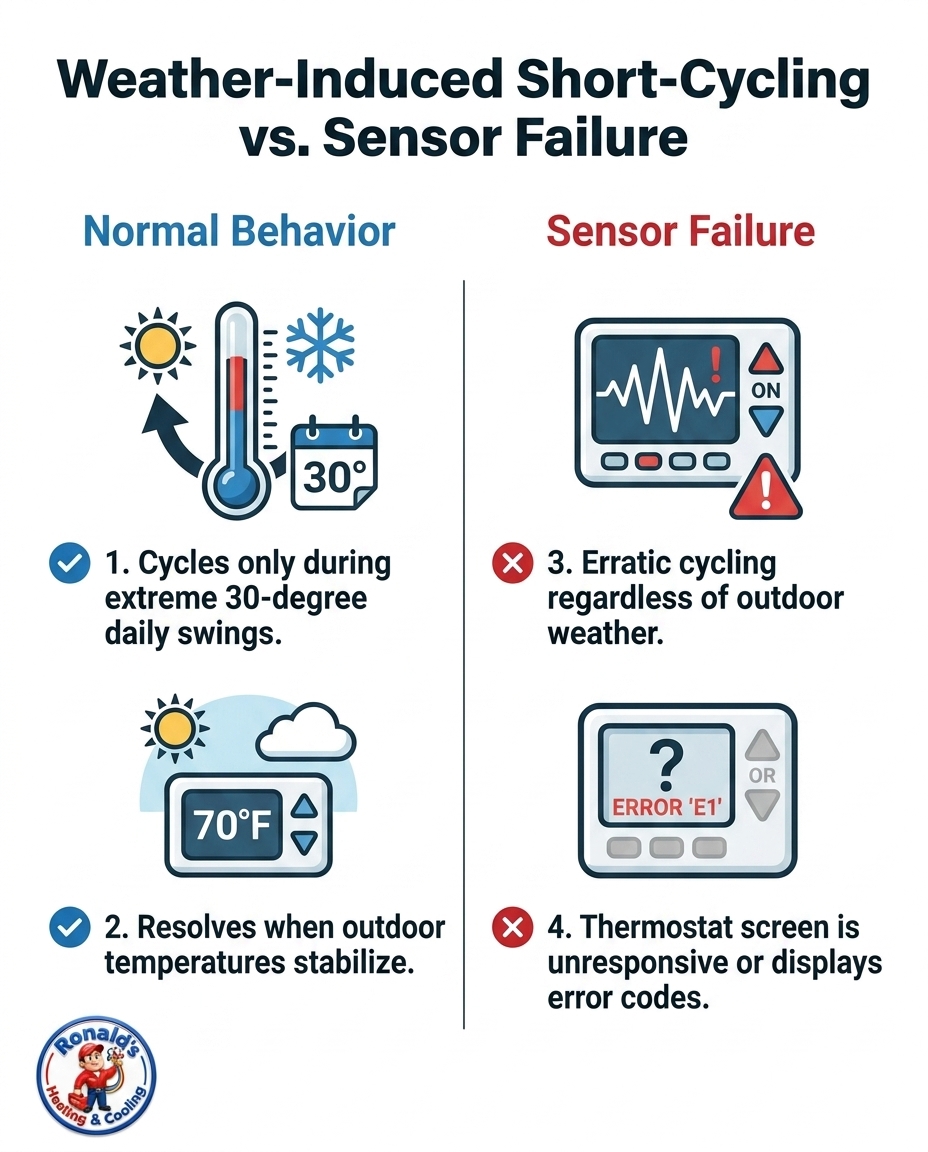
• Timing of Cycling — Weather-Induced Confusion: Only happens during extreme 30-degree daily swings. — Genuine Sensor Failure: Erratic cycling occurs regardless of outdoor temperatures.
• Resolution — Weather-Induced Confusion: Resolves naturally when outdoor temperatures stabilize for a few days. — Genuine Sensor Failure: Never resolves; the system continues to short-cycle constantly.
• Thermostat Screen — Weather-Induced Confusion: Screen responds normally, accurately displaying the target temp. — Genuine Sensor Failure: Screen is unresponsive, blank, or displays specific error codes.
• Temperature Reading — Weather-Induced Confusion: Reading fluctuates rapidly but logically based on drafts/heat. — Genuine Sensor Failure: Reading is wildly inaccurate (e.g., reads 40°F when it is 75°F inside).
This is where professional, precise diagnostics become vital. Just last fall, our team responded to a local homeowner experiencing severe erratic heating behavior during a cold snap. They had been told by another company that their entire system was completely outdated and required a full replacement. However, when our technicians at Ronald's Heating & Cooling arrived to run precise diagnostics, we discovered that the equipment wasn't dead at all—a single unhooked part was causing the erratic behavior. By taking the time to find the true root cause, we restored the system to perfect working order without an unnecessary, massive replacement. This commitment to accurate troubleshooting over guesswork is what protects our customers from paying for parts they don't need. If your system is acting up and you aren't sure why, scheduling professional HVAC repair in Virginia Beach is the safest way to get a definitive answer.
Smart Thermostat Strategies for the Fall Transition
While we advise that you should never attempt to open your thermostat casing to clean or replace sensors yourself, there are several actionable strategies we recommend to help your system navigate the September early fall transition. Adjusting how your system operates can drastically reduce weather-induced short-cycling and protect your equipment from unnecessary wear.
1. Avoid "Auto" mode during extreme swings: When days are hot and nights are cold, setting your thermostat to "Auto" forces the system to battle itself. It will run the AC at 4:00 PM and switch to the furnace by 10:00 PM. Instead, manually select "Cool" during the day and "Heat" (or simply turn the system off) at night.
2. Widen your deadband: The deadband is the temperature gap between your heating and cooling setpoints. If your deadband is too narrow (e.g., cooling at 72°F and heating at 70°F), the rapid fall temperature drop will trigger the heat immediately after the AC shuts off. Widen this gap to at least 5 to 7 degrees during the fall to give the house time to settle naturally.
3. Utilize ceiling fans for destratification: Heat rises and cold air sinks. Running your ceiling fans on a low setting helps blend the air in the room, breaking up cold pockets and hot spots. This provides the ambient sensor with a much more accurate, blended reading of the entire space, preventing drafts from triggering a false shut-off.
4. Keep interior doors open: Closed doors trap heat in isolated rooms. Keeping doors open allows the conditioned air to circulate freely back to the return vents, ensuring the thermostat gets an accurate picture of the whole home's temperature.
By implementing these non-DIY-repair strategies, you can minimize the confusion your system experiences and keep your home much more comfortable during the volatile autumn months.
Why Preventative Diagnostics Protect Your Equipment
It is easy to dismiss short-cycling as a minor annoyance, but constant on-and-off operation is incredibly destructive to your equipment. The most stressful part of any HVAC cycle is the startup phase. When the system kicks on, it requires a massive surge of electricity—known as inrush current—to get the compressor and blower motor spinning.
This heavy electrical load places immense wear and tear on two critical starting components: the capacitor and the contactor. The capacitor acts like a battery to jumpstart the motor, and the contactor is the heavy-duty switch that lets the power flow. In our experience, when your system short-cycles dozens of times a day due to the Virginia Beach coastal climate swings, these components degrade rapidly. The contactor can become pitted and burned from constant electrical arcing, and the capacitor loses its ability to hold a charge.
A system that has been weakened by weeks of severe fall short-cycling is significantly more likely to fail completely during the first actual winter freeze, right when you need your heat the most. Our professional calibration and diagnostics ensure that your sensors are reading accurately, your starting components are strong, and your system isn't tearing itself apart. Having one of our technicians evaluate the system guarantees peace of mind before the heavy heating season begins. Scheduling a thorough AC tune-up is the best way to catch these weakened components before they leave you in the cold.
Frequently Asked Questions About Fall HVAC Issues
Why is my AC turning on and off every 5 minutes?
This rapid on-and-off behavior is called short-cycling, and in the fall, it is often caused by extreme 30-degree daily temperature swings confusing your thermostat. The system cools the air quickly, but the heat stored in your home's walls radiates back into the room, tricking the sensor into turning the unit right back on. If the weather is stable and it still happens, you may have a failing component that requires professional diagnostics.
At what temperature should I switch from AC to heat?
There is no universal temperature, but a good rule of thumb is to switch to heating when the indoor temperature consistently drops below your personal comfort level (usually around 68°F) and stays there. During the fall transition, it is best to manually control your modes rather than using "Auto," which can cause the system to fight itself. Wait until the 80°F days dropping to 50°F nights transition into consistently cooler weather before fully committing to heat.
Can weather affect my thermostat?
Yes, rapid changes in outdoor weather directly impact how your indoor thermostat behaves. Sudden temperature drops, high winds creating drafts through window frames, and shifts in humidity all change how the ambient air sensor reads the room. The thermostat only reads the air immediately around it, so a sudden chill near the device can shut the system down prematurely.
How do I stop my HVAC from short cycling in the fall?
Start by taking your thermostat out of "Auto" mode and widening the temperature gap between your heating and cooling setpoints. Run ceiling fans to mix the air in your home, which gives the thermostat a more accurate reading of the overall room temperature. If adjusting these settings does not stop the short-cycling, we strongly recommend calling a professional to check for a failing sensor or weakened capacitor.
What is thermal mass and how does it confuse my thermostat?
Thermal mass refers to dense materials in your home, like brick walls, tile floors, and heavy furniture, which absorb heat during the day and release it slowly at night. When the AC cools the air and shuts off, the thermal mass immediately radiates its stored heat back into the room. This sudden spike in air temperature tricks the thermostat into turning the AC back on almost immediately.
Does coastal humidity make fall temperature swings harder on my HVAC?
Yes, humid air retains heat much more efficiently than dry air. In coastal environments, this means your home stays hotter longer into the evening, forcing your cooling system to work against both the thermal mass of the house and the heavy, moisture-laden air. This increases the likelihood of short-cycling as the outdoor temperatures drop rapidly at night.
Gain Peace of Mind Before the Winter Chill
Understanding how your equipment reacts to the September early fall transition is the first crucial step in protecting your investment. When you know the difference between a system that is temporarily confused by a 30-degree temperature swing and one that is genuinely breaking down, you can make smarter decisions about your home comfort. You don't have to listen to your unit aggressively cycle on and off every ten minutes, wondering if today is the day it finally gives out. If you are unsure whether your system is just struggling with the weather or suffering from a failing part, reaching out to Ronald's Heating & Cooling for professional diagnostics is the safest path forward. A calibrated, thoroughly inspected system ensures you stay comfortable, efficient, and worry-free all winter long.
