





Why the August Germ Wave Hits Harder Indoors
The kids just walked through the door after their first week back in class, and you already hear that familiar cough. Understanding the hidden connection between back-to-school colds and your home's air quality is the first step toward keeping your family healthy this fall. That late-summer sniffle is not just a matter of bad luck. While classrooms are notorious breeding grounds for bacteria and viruses, your home environment plays a massive, often overlooked role in how quickly those pathogens spread to the rest of the household.
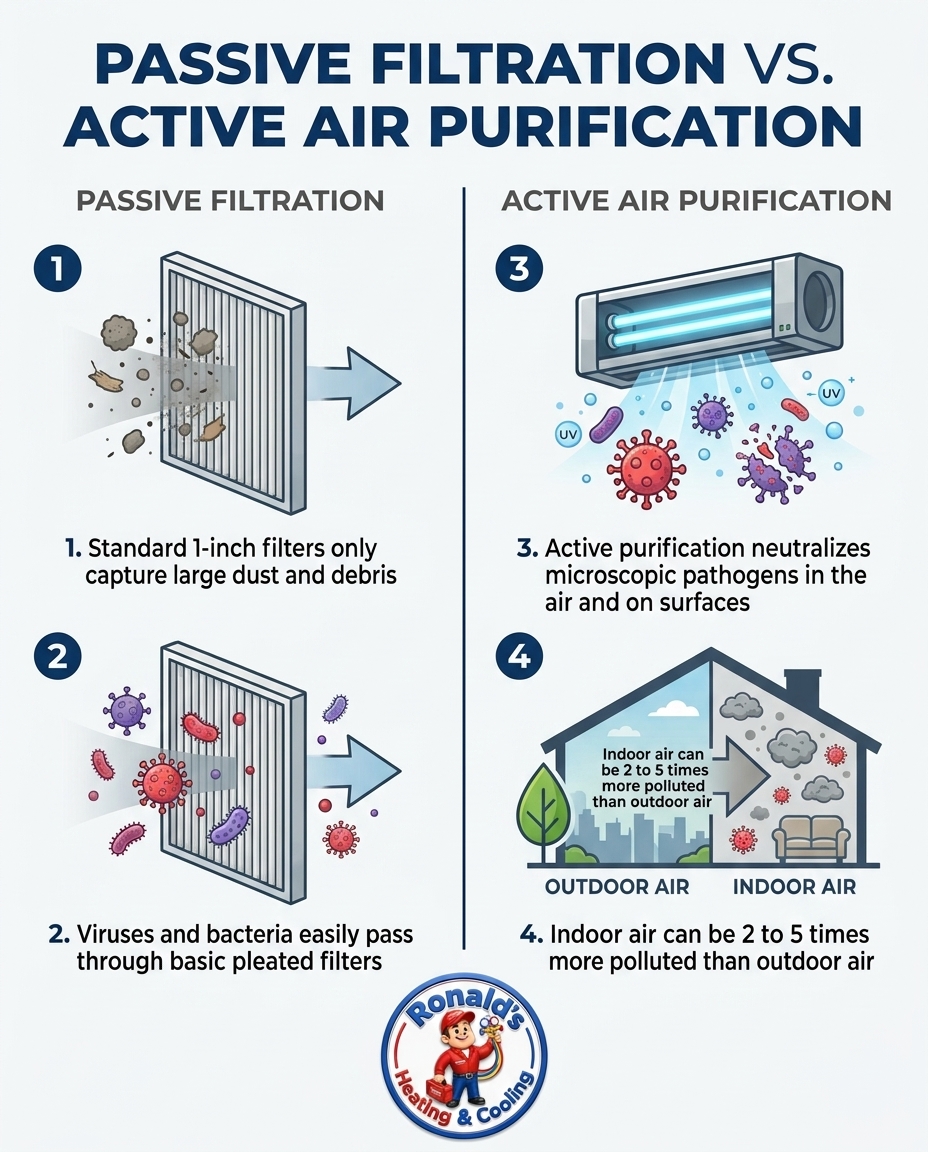
During the August back-to-school transition, families spend more time inside, gathering in shared living spaces. According to the Environmental Protection Agency, indoor air can routinely be two to five times more polluted than the air outside. Your central heating and cooling system is at the center of this dynamic. Right now, your HVAC system is either acting as a high-speed distribution network for classroom pathogens, or it is serving as your home's primary defense mechanism against them. To help your family breathe easier, we put together a comprehensive look at how your air conditioning interacts with airborne illnesses. For more information on protecting your home's environment, explore our complete guide to indoor air quality.
The Unintended Consequence of Escaping Coastal Humidity
The problem: Late summer weather on the coast is famously unforgiving. To stay comfortable, homeowners keep their windows firmly shut, relying heavily on their air conditioning to strip moisture and heat from the air. The cause: While a tightly sealed home efficiently blocks out the Virginia Beach coastal humidity, it also completely eliminates natural fresh air exchange. The solution: Recognizing how your closed-loop HVAC system traps airborne irritants is the necessary first step toward implementing a real purification strategy.
Modern homes are built to be incredibly airtight. This energy-efficient design is fantastic for keeping your utility bills under control during peak cooling season. However, this same insulation traps everything generated inside the house. Because the intense August heat demands continuous AC operation, your blower fan runs for hours at a time. This constant operation means the system is relentlessly pulling the same stale, potentially germ-filled indoor air into the return vents, cooling it, and pushing it right back into your living spaces.
How Recirculation Amplifies Sickness
To understand why this specific time of year creates a perfect storm for indoor transmission, you have to look at the path of a single viral particle. When a child sneezes in the living room, thousands of microscopic droplets enter the air. In a drafty, older home with open windows, many of these particles would eventually dilute and dissipate outdoors. In a sealed, air-conditioned environment, they follow the path of least resistance: straight into your HVAC return vent.
Once inside the ductwork, these tiny particles bypass basic filtration, travel through the blower motor, and are forcefully redistributed through the supply vents into every other room of the house—including the bedrooms where the rest of the family sleeps. The lack of dilution means the viral load inside your home remains highly concentrated. You are not just sharing a living space with a sick family member; you are continuously breathing the exact same recycled air.
The Truth About Your Standard HVAC Filter
One of the most common misconceptions we encounter is the belief that standard one-inch pleated filters are designed to protect human health. They are not. The basic fiberglass or pleated filter sitting in your return grille serves a single, mechanical purpose: protecting the HVAC blower motor and indoor coil from large debris like pet hair, heavy dust, and carpet fibers.
Microscopic viral particles and bacteria are incredibly small—often measuring less than 0.3 microns in diameter. To put that in perspective, a standard air filter is like a chain-link fence, and a cold virus is like a grain of sand blowing right through it. The pathogens easily pass through the filter media, circulate through the equipment, and re-enter your breathing air.
When homeowners realize this during the August back-to-school transition, many make a critical DIY mistake: they rush to the hardware store and buy the most restrictive, highest-MERV (Minimum Efficiency Reporting Value) filter on the shelf. This is a dangerous move for your equipment. Your HVAC system was engineered to operate with a specific volume of airflow. Slapping a dense, hospital-grade filter into a standard residential system acts like a piece of cardboard over a vacuum hose.
Signs your filter is too restrictive:
• Weak airflow: You barely feel air coming out of the supply registers.
• Strange noises: The blower motor whines or sounds like it is straining.
• Frozen coils: Ice forms on the indoor evaporator coil because the cold air cannot escape.
• Short cycling: The system turns on and off rapidly because it is overheating.
Overly restrictive filters choke the AC system, drive up your energy bills, and can cause catastrophic compressor failure, all while failing to effectively stop airborne viruses. Understanding how dirty air filters impact your AC is vital before attempting any DIY upgrades.
Passive Filtration vs. Active Air Purification
If standard filters cannot stop the spread of back-to-school colds, what is the alternative? The answer lies in understanding the fundamental difference between simply trapping particles and actively neutralizing them. To protect your family, you need to transition your thinking from passive filtration to active air purification.
• Primary Mechanism — Passive Air Filtration: Relies on air passing through a physical barrier (filter media) to catch debris. — Active Air Purification: Utilizes advanced technology to seek out and neutralize pollutants directly in the air.
• Target Contaminants — Passive Air Filtration: Large dust, pet dander, lint, and hair. — Active Air Purification: Microscopic viruses, bacteria, mold spores, and volatile organic compounds (VOCs).
• Method of Action — Passive Air Filtration: Waits for the air to circulate back to the return vent. — Active Air Purification: Releases purifying agents into the living space to treat air and surfaces simultaneously.
• Impact on HVAC System — Passive Air Filtration: Can restrict airflow if the filter is too dense or left unchanged too long. — Active Air Purification: Operates seamlessly within the ductwork without restricting essential airflow.
• Health Benefit — Passive Air Filtration: Keeps the mechanical equipment clean, indirectly supporting general air quality. — Active Air Purification: Fundamentally changes the HVAC system into a proactive health asset for the family.
Passive filtration is necessary for equipment maintenance, but it is entirely insufficient for dealing with the microscopic size of cold and flu viruses. Upgrading to an active system means you are no longer waiting for the germs to reach a filter; you are actively attacking them where they live, breathe, and land.
Advanced Technologies That Neutralize Airborne Pathogens
Turning your central air system into a health asset requires the right technology. These advanced indoor air quality solutions go far beyond basic hardware store filters, integrating seamlessly with your existing ductwork to work silently in the background.
The Role of UV Germicidal Lamps
Ultraviolet (UV) light has been used in hospitals and water treatment facilities for decades to maintain sterile environments. When installed directly inside your HVAC system, UV germicidal lamps provide a powerful defense against biological contaminants. The specific wavelength of UV-C light penetrates the cellular walls of viruses, bacteria, and mold spores, scrambling their DNA. Once their DNA is damaged, these pathogens are rendered sterile and completely harmless.
This technology is particularly effective against the biological growth fueled by Virginia Beach coastal humidity. Moisture inherently collects on your indoor evaporator coil during the cooling process. A UV lamp shining directly on this coil prevents mold and bacteria from colonizing in this dark, damp environment, ensuring the air blowing into your home is clean from the source. To see if this technology fits your home, learn more about UV light systems.
Whole-Home Air Scrubbers
While UV lights are fantastic for treating the air that passes through the ductwork, whole-home air scrubbers take purification a step further. These devices use specialized technology to create friendly, airborne scrubbers—often utilizing ambient moisture to generate safe, low-level oxidizers like vaporized hydrogen peroxide.
These purifying agents are actively distributed through your supply vents into every room of the house. Instead of waiting for a sneeze droplet to travel all the way back to the HVAC unit, the air scrubber neutralizes the pathogen right in the living room, reducing both airborne and surface-level school germs. It is an active, continuous cleaning process that protects your family 24 hours a day.
Steps to maximize these technologies:
1. Start with a clean slate: Have your ductwork professionally cleaned to remove years of accumulated dust and debris, ensuring your new purifiers aren't fighting a losing battle against pre-existing filth.
2. Install active purification: Choose a UV lamp or air scrubber based on your specific health concerns and system layout.
3. Maintain proper passive filtration: Continue using a standard, non-restrictive filter to keep large dust particles out of the mechanical components.
4. Schedule seasonal maintenance: Ensure the HVAC blower is operating at peak efficiency to properly distribute the purified air.
Preparing Your Home's Air for the School Year
Tackling the seasonal germ wave requires a tailored approach rather than a one-size-fits-all product. As a trusted local HVAC expert, Ronald's Heating & Cooling provides tailored indoor air quality solutions that actively protect families, rather than just selling generic filters that promise more than they can deliver. Here is how you can prepare your home right now:
• Assess your current filtration: Pull out your existing filter. If it looks like a thick, heavy block of tightly woven material and your AC seems to be struggling to keep up, you may be restricting your airflow. Swap it for a standard pleated filter and consult a professional about better purification methods.
• Evaluate your home's humidity: Balanced humidity supports respiratory health. Air that is too dry irritates the throat, while air that is too humid promotes mold growth. Ensure your AC is effectively managing the moisture load.
• Look into active scrubbing: If your household is particularly susceptible to the August back-to-school transition colds, investigate air scrubbers to actively reduce pathogens on doorknobs, countertops, and in the air.
• Consult a professional: Every home has a unique ductwork footprint and airflow dynamic. Have a technician evaluate your system to recommend the specific IAQ technology that will work safely and efficiently with your existing equipment.
Frequently Asked Questions About Indoor Air Quality and Colds
Can poor indoor air quality mimic cold symptoms?
Yes, poor indoor air quality frequently mimics common cold symptoms. High levels of dust, pet dander, mold spores, and volatile organic compounds (VOCs) can cause sneezing, coughing, congestion, and itchy eyes. If you notice that your symptoms improve significantly when you leave the house and return when you step back inside, your HVAC system is likely circulating environmental allergens rather than a viral infection.
How does an HVAC system spread or stop germs?
Your HVAC system spreads germs by pulling contaminated air into the return vents and forcefully redistributing it throughout the entire house. Because standard filters cannot catch microscopic viruses, the system acts as a circulation network. However, when equipped with active air purification technology like UV lights or scrubbers, the system stops germs by neutralizing them as they pass through the ductwork, effectively turning your AC into a whole-home filter.
Do HVAC UV lights really kill viruses?
Yes, HVAC UV lights are highly effective at neutralizing viruses when installed correctly. They use UV-C wavelength light to penetrate the cellular structure of airborne pathogens, scrambling their DNA so they cannot replicate or cause illness. To be effective, the light must be properly sized for your ductwork and positioned where the air or the evaporator coil receives adequate exposure time.
Does AC make a cold worse?
Air conditioning itself does not cause colds, but it can exacerbate symptoms in a few ways. First, AC inherently removes moisture from the air, and breathing dry air can irritate an already sore throat and dry out nasal passages. Second, if your home is tightly sealed against the Virginia Beach coastal humidity, the AC will continuously recirculate the viral particles you are shedding, increasing the viral load in your living space.
How do I purify the air in my home after being sick?
To purify your home after an illness, start by opening windows to allow for natural fresh air exchange if the weather permits. Next, replace your standard HVAC filter, as it may be harboring larger airborne debris that trapped moisture and bacteria. Finally, consider running a whole-home air scrubber or activating your UV germicidal light system to actively neutralize any lingering viral particles on surfaces and in the ductwork.
Breathe Easier This School Year
Surviving the seasonal germ wave requires more than just reminding the kids to wash their hands before dinner. When your home is tightly sealed against the late summer heat, your HVAC system is constantly recirculating the air you breathe. The hidden connection between back-to-school colds and your home's air quality is undeniable, but it is also entirely treatable. By upgrading from passive, equipment-protecting filters to active, virus-neutralizing technology, you can turn your ductwork into a powerful health asset. If you are ready to protect your family during the August back-to-school transition, the first step is ensuring your system is clean. Reach out today to schedule professional duct cleaning and explore the advanced purification options that fit your home.
