






Are You Paying for a True System Diagnostic or Just a Quick Look?
Your AC is running nonstop to fight off the heat, but when you hire a company to service it, the technician spends 15 minutes looking at the outdoor unit, changes a filter, and hands you an invoice. If you are wondering how to tell if your AC contractor is actually performing a thorough maintenance check, you are not alone. Many homeowners schedule an end-of-summer maintenance visit only to receive a superficial once-over that misses the hidden wear and tear accumulating inside the machine.
Before you settle for a basic visual inspection, it is critical to understand what a legitimate HVAC maintenance plan entails. There is a massive difference between a technician simply looking at your equipment and a professional taking the time to measure its actual performance. By the time we reach August late-summer high humidity, your cooling system has been working in overdrive for months. The components are stressed, the filters are loaded with dust, and the internal mechanisms have been subjected to thousands of hours of continuous vibration and moisture.
A quick "filter flip" simply cannot catch the subtle signs of impending failure. Late-summer wear requires specific, measurable diagnostic checks to prevent sudden breakdowns just when you need your cooling the most. If a technician leaves your driveway in under half an hour, they likely skipped the most critical steps of a true tune-up. Here is how you can spot the difference between a lazy inspection and a comprehensive diagnostic service.
Visual Inspections vs. True Diagnostic Measurements
When you hire a professional for AC maintenance in Virginia Beach, you are paying for their expertise and their tools, not just their eyesight. The Air Conditioning Contractors of America (ACCA) Standard 4 outlines specific diagnostic measurements that must be taken during a comprehensive maintenance visit. A visual inspection alone does not meet these standards. Looking at a copper pipe or listening to a fan motor tells a technician very little about the internal health of the cooling cycle.
The limits of a visual check: A lazy contractor might place their hand over the vent to feel if cold air is blowing, look at the outdoor unit to ensure the fan is spinning, and check the thermostat setting. They might even hook up a basic gauge, nod, and declare the system "fine." This is not a diagnostic check. Properly maintained air conditioners retain up to 95% of their original efficiency, but achieving that requires hard data.
Earlier this spring, one local homeowner experienced an issue with their AC system that required a professional repair. A service technician arrived, immediately hooked up digital diagnostic tools to measure the system's exact internal pressures, and professionally repaired the issue quickly and efficiently. That reliance on hard data over guesswork is exactly what you should expect during routine maintenance as well.
The Importance of Accurate Refrigerant Readings
One of the most misunderstood parts of an AC tune-up is checking the refrigerant. A thorough technician does not just check to see if there is "enough" freon in the system. They must take precise refrigerant superheat and subcooling measurements.
• Superheat: This measures how much heat the refrigerant vapor absorbs before it travels back to the compressor. If this number is off, your system is either starving for refrigerant or at risk of sending liquid directly into the compressor, which causes catastrophic failure.
• Subcooling: This measures how much the liquid refrigerant cools down after it leaves the condenser coil. It tells the technician if the outdoor unit is effectively rejecting the heat pulled from your home.
Taking these measurements requires digital manifolds, specialized temperature clamps, and a deep understanding of thermodynamics. An AC tune-up is completely incomplete without verifying these specific metrics. If your technician does not attach temperature clamps to the copper lines outside, they are not checking your refrigerant properly.
Combating Coastal Corrosion: The Deep Clean Requirement
Your geographic location plays a massive role in how your air conditioner ages. While an inland system might just deal with dust and pollen, coastal environments introduce a highly destructive element: salt air. The difference in wear and tear between Virginia Beach coastal and inland properties is staggering, and your maintenance routine must reflect that reality.
The Problem with Salt Air: The outdoor condenser unit is made primarily of aluminum fins and copper tubing. When salty ocean moisture blows inland, it settles on these metal surfaces. Over time, the salt acts as an electrolyte, accelerating a process called galvanic corrosion. The delicate aluminum fins begin to turn to white powder, crumbling away and destroying the system's ability to release heat.
The Superficial Fix: A rushed technician will take a broom or a shop vacuum, brush the loose leaves off the outside of the unit, and call it clean. This does absolutely nothing to stop coastal corrosion.
The Professional Solution: A thorough AC tune-up in Portsmouth or the surrounding coastal areas requires a deep chemical cleaning. A legitimate technician will remove the outer casing of the condenser and apply a specialized, foaming coil cleaner. This chemical reaction pushes dirt, salt, and grime out from deep within the fins.
• Condenser Coil Cleaning — Superficial Check: Brushing off leaves and cobwebs — Thorough Coastal Diagnostic: Chemical foaming wash to neutralize salt
• Fin Inspection — Superficial Check: Glancing at the exterior casing — Thorough Coastal Diagnostic: Using a fin comb to straighten bent aluminum fins
• Base Pan Clearing — Superficial Check: Ignoring the bottom of the unit — Thorough Coastal Diagnostic: Removing sludge and debris so water drains properly
If your technician does not use a hose and a specialized cleaning solution on your outdoor unit, they are leaving your system vulnerable to rapid, expensive decay.
Managing Condensate Drains During Heavy Late-Summer Humidity
While the outdoor unit battles salt and heat, the indoor unit is fighting a completely different war against moisture. Your air conditioner does not just cool the air; it dehumidifies it. During the peak of August late-summer high humidity, a standard residential AC system can pull gallons of water out of your indoor air every single day.
All of this moisture drips off the cold evaporator coil and falls into a drain pan, where it flows out through a white PVC pipe called the condensate drain line. Because this environment is constantly dark, wet, and warm, it is the perfect breeding ground for algae, mold, and bacterial sludge.
The risk of ignored drains: If a technician skips the drain line during an annual AC tune-up, that sludge will continue to grow. Eventually, it forms a complete blockage. The water backs up into the drain pan, overflows, and begins dripping through your ceiling or soaking into your floorboards, causing severe water damage.
A thorough maintenance visit always includes proactive drain management. Here is what a professional actually does:
1. Inspect the pan: They check the indoor drain pan for rust, cracking, and standing water.
2. Clear the line: They use a specialized wet vacuum or pressurized nitrogen to blow out the primary drain line, removing any hidden sludge.
3. Treat the water: They drop specialized condensate tablets into the pan to prevent future algae growth during the remaining warm months.
4. Test the safety switch: They manually test the float switch—a small device designed to shut the AC off automatically if water begins to back up.
Waiting for a backup to occur is a recipe for disaster. A true diagnostic check ensures the water has a clear, clean path out of your home.
Electrical Testing: Securing Connections and Checking Components
Air conditioners are heavy-duty machines with powerful motors. When they run continuously for months on end, they vibrate. This constant vibration can slowly loosen electrical connections at the contactor, the circuit board, and the breaker. Loose connections create electrical resistance, which generates heat, which can eventually melt wires or cause electrical shorts.
Across Virginia Beach coastal and inland properties, summer heatwaves put maximum strain on the local power grid, and by extension, your AC's electrical components. A superficial inspection might involve just looking at the wires to see if anything is visibly burnt. A professional diagnostic requires a multimeter to test the invisible forces at work.
Amp Draws: A technician must measure the amperage (electrical current) being drawn by the compressor and the fan motors. If a motor is drawing more amps than its manufacturer rating allows, it means the motor is struggling and is on the verge of burning out. Catching a high amp draw early allows you to replace a failing part before it takes the whole system down.
Capacitor Testing: The capacitor is a small, cylindrical device that stores energy and gives the compressor the massive jolt of electricity it needs to start up. Capacitors degrade over time, especially under heavy summer loads. A thorough technician will measure the capacitor's microfarads. If the reading drops below the acceptable tolerance range, they will recommend replacing it immediately to prevent a sudden failure on a hot afternoon.
The Mark of a Professional: Transparency and Clear Communication
A thorough maintenance check is not just about the mechanical work performed inside the machine; it is about how those results are communicated to you, the homeowner. The biggest differentiator of a truly professional company is their commitment to transparency. They prioritize taking the time to explain every step of the maintenance process rather than rushing off to their next service call.
When a technician finishes their work, they should not simply hand you an invoice and ask for a signature. They should walk you through a complete debrief of your system's health. They will explain what they found, show you the data they collected, and answer your questions objectively.
For example, when an upstairs AC system stopped working for a local homeowner during a warm period this past spring, they needed a replacement rather than just a tune-up. The technician provided a competitive, transparent quote for the work, honored that original quote when the homeowner decided to replace a second aging system as well, and completed both replacements cleanly within two days. That level of clear communication and integrity is exactly what you should expect during routine maintenance, too.
If a technician takes refrigerant superheat and subcooling measurements, they should be able to tell you exactly what those numbers mean for your system's efficiency. They should empower you with knowledge, giving you a clear picture of what is working perfectly and what might need attention next season.
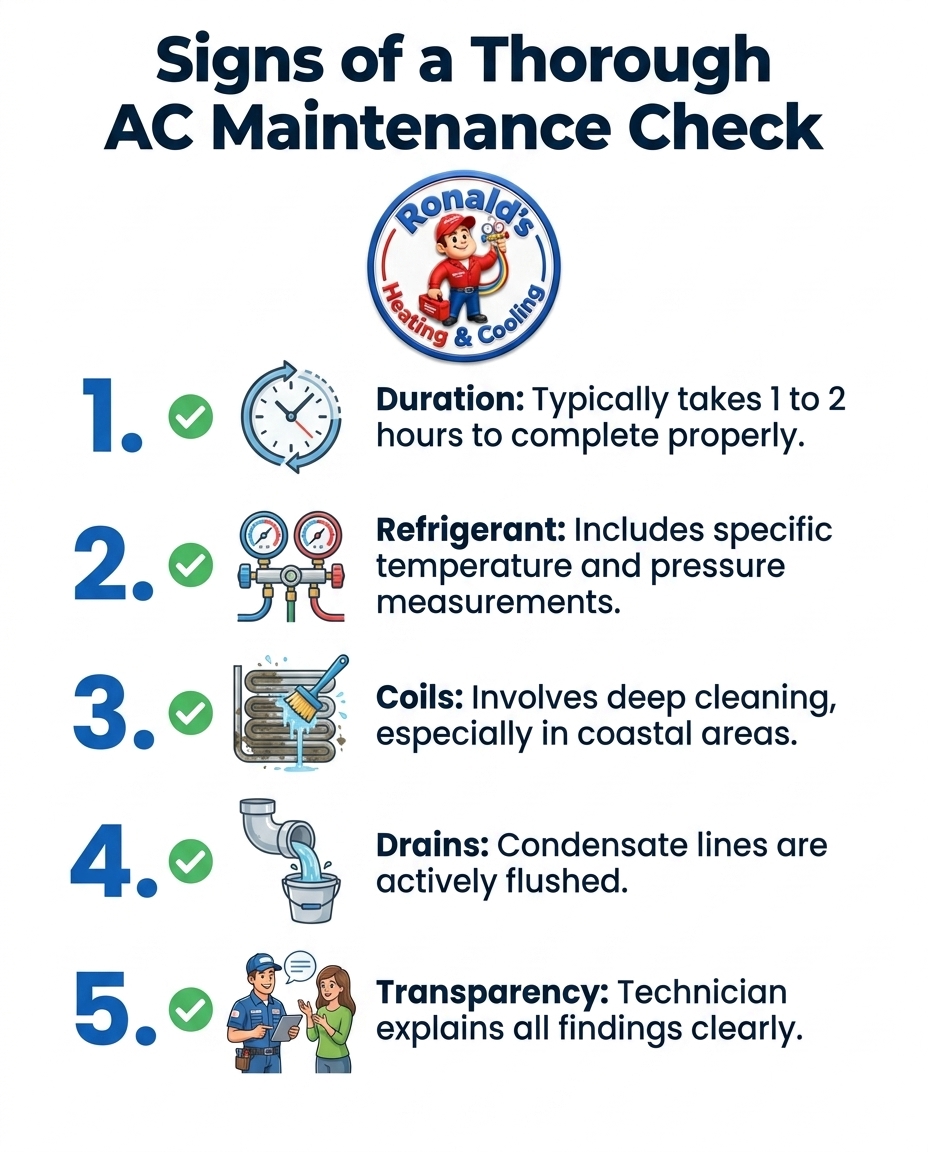
Checklist: Questions to Ask Your AC Technician Before They Leave
You do not need to be an HVAC expert to hold your contractor accountable. By asking a few pointed questions, you can quickly determine if you received a superficial check or a comprehensive diagnostic. If you are enrolled in year-round HVAC maintenance plans, keep this checklist handy for every visit.
• Did you measure the system's performance using digital gauges? Listen for them to mention specific refrigerant superheat and subcooling measurements. If they just say it "looks good," push for the actual data.
• What was the condition of the evaporator and condenser coils, and did they require deep cleaning? Ensure they actually opened the units and looked at the metal fins, rather than just wiping down the outside cabinet.
• Was the condensate drain flushed and cleared? Confirm that they actively treated the drain line, especially if it is late in the summer when algae growth is at its peak.
• Are all electrical components operating within their proper manufacturer specifications? Ask if the capacitor is still holding a strong charge and if the fan motors are drawing the correct amount of amps.
A good technician will welcome these questions and be eager to show you the results of their hard work.
Frequently Asked Questions
How long should an AC tune up take?
A thorough AC tune-up typically takes between one and two hours to complete properly. This timeframe allows the technician to clean the coils, flush the drain lines, test all electrical components, and take accurate diagnostic measurements. If a contractor finishes in under 30 minutes, they likely only performed a superficial visual inspection.
What is included in an AC tune up?
A comprehensive tune-up includes deep cleaning the condenser and evaporator coils, replacing or washing the air filter, clearing the condensate drain line, and testing electrical connections. It also requires the technician to measure amp draws on the motors and verify the refrigerant charge using digital gauges. The goal is to return the system as close to factory specifications as possible.
How do I know if my AC tech did a good job?
You know a technician did a good job if they provide a transparent, detailed explanation of their findings before leaving. They should be able to show you the data they collected, such as the microfarad readings on your capacitor or the exact condition of your coils. A clean workspace and a willingness to answer your questions objectively are also strong indicators of quality work.
What happens during annual HVAC maintenance?
During annual maintenance, a professional evaluates the entire heating and cooling system for safety, efficiency, and impending wear. They tighten loose electrical connections caused by vibration, lubricate moving parts to reduce friction, and clean critical components to ensure proper airflow. This proactive approach catches minor issues before they turn into expensive, sudden breakdowns.
Why is late-summer AC maintenance important?
Late-summer maintenance is crucial because your system has just endured months of continuous operation under extreme heat and humidity. By August, filters are heavily soiled, condensate drains are often thick with algae, and electrical components are stressed. Servicing the unit now prevents late-season failures and ensures the system is clean before it sits dormant for the winter.
Do coastal environments require different AC maintenance procedures?
Yes, coastal environments require much more rigorous maintenance due to the corrosive nature of salt air. Standard inland maintenance might just involve brushing off the outdoor unit, but coastal systems require deep chemical foaming cleansers to remove salt deposits from the aluminum fins. Without this specialized cleaning, the outdoor condenser will rapidly rust and deteriorate.
Holding your contractor to a high standard protects your investment and keeps your home comfortable. By understanding exactly what goes into a true diagnostic check, you can ensure your system is prepared for whatever the weather brings. Schedule your next comprehensive maintenance visit today and experience the difference of a fully transparent, professional tune-up.
